Media
Issue Date
1947-02-21
Volume
9
Issue Number
8
Plaintext
iftHESpiiii
v>^
'-y
Official Organ of the Atlantic and Gulf District, Seafarers International Union of North America
VOL. IX. NEW YORK. N. Y.. FRIDAY. FEBRUARY 21. 1947 No. 8
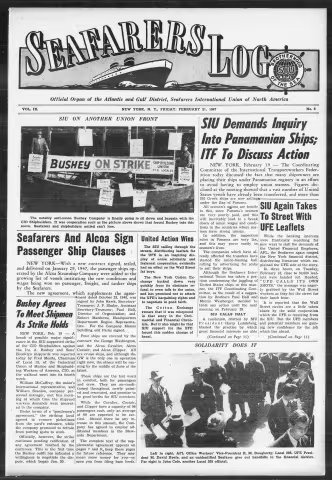
SlU ON ANOTHER UNION FRONT
The notably anti-union Bushey Company is finally going to sit down and bargain with the
CIO Shipbuilders. It was cooperation such as the picture above shows that forced Bushey into this
move. Seafarers and shipbuilders united can't lose.
SlU Demands Inquiry
Into Panamanian Ships;
ITF To Discuss Action
NE!W YORK, February 19 — The Coordinating
Committee of the International Transportworkers Feder
ation today discussed the fact that many shipowners are
placing their ships under Panamanian registry in an effort
to avoid having to employ union seamen. Figures dis
closed at the meeting showed that a vast number of United
States yessels have already been transferred, and more than
350 Greek ships are now sailingt^
" -SlU Again Takes
To Street With
UFE Leaflets
Seafarers And Alcoa Sign
Passenger Ship Clauses
NEW YORK—With a new contract signed, sealed,
and delivered on January 29, 1947, the passenger ships op
erated by the Alcoa Steamship Company were added to the
growing list of vessels instituting the new conditions and
wages being won on passenger, freight, and tanker ships
by the Seafarers.
The new agreement, which supplements the agree-
-tment dated October 23, 1946, was
signed by John Hawk, Secretary-Bushey Agrees
To Meet Shipmen
As Strike Holds
NEW YORK, Feb. 19 — A
break of possible major signifi
cance in the SlU-supported strike
of the CIO Shipbuilders against
the Ira. A. Bushey and Sons'
Brookly.n shipyards was reported
today by Fred Mesita, Chairman
of Local 13, of the Industrial
Union of Marine and Shipbuild
ing Workers of America, CIO, as
the walkout went into its fourth
week.
William McCaffrey, the union's
international representative, and
William Scanlon, company per
sonnel manager, met this morn
ing at which time the shipyard
workers demands were present
ed to the company.
Under terms of a "gentlemen's
agreement," the striking local
agreed to remove picketlines
from the yard's entrance, while
the company promised to refrain
from putting scabs to work.
Officially, however, the strike
continues pending ratification of
any. agreement reached by the
conferees. This is the first time
the Bushey outfit has indicated a
willingness to negotiate the dis
pute, which began Jan. 30.
Treasurer; J. P. Shuler, Assistant
Secretary-Treasurer; Paul Hall,
Director of Orgpnization; and
Robert Matthews, Headquarters
Department Engine Representa
tive. For the Company Messrs
Schilling and Parks signed.
Four ships are covered by the
contract: the George Washington,
and the Alcoa Cavalier, Alcoa
Corsair, and Alcoa Clipper. All
are cruise ships, and although the
GW is the only one in operation
right now, the others will be run
ning by the middle of June at the
latest.
These ships are the last word
in comfort, both for passengers
and crew. They are air-condi
tioned throughout, newly paint
ed and renovated, and promise to
be good berths for SIU members.
While the Cavalier, Corsair,
and Clipper have a capacity of 96
passengers each, only an average
of 60 are expected to be car
ried. Should there be any in
crease in this amount, the Com
pany has agreed to employ ad
ditional members in the Stew
ards Department.
The complete text of the sup
plemental agreement appears on
pages 7 and 8;, keep these pages
for future reference. They may
mean more money for you—or
save you from filing bum beefs.
United Action Wins
The SIU sailing through the
streets, distributing leaflets for
the UFE in an inspiring dis
play of union solidarity and
fraternal cooperation, evidently
had an effect on the Wall Street
fat boys.
The New York Cotton Ex
change backed down very
quickly from its obstinate re
fusal to even talk to the union,
and has promised not to attack
the UFE's bargaining rights and
to negotiate in good faith.
The Cotton Exchange
swears that it was misquoted
in that story in the Com
mercial and Financial Chron
icle. But it also might be that
SIU support for the UFE
forced this sudden change of
heart.
All seamen's ujjjons are hostile
to this, since Panama's seamen
are very poorly paid, and this
will inevitably lead to a break
down of union wages and condi
tions in the countries where sea
men have strong unions.
In addition, the inspection
rules in Panama are very lax,
and this may prove costly in
seamen's lives.
The companies which have al
ready affected the transfers have
started the union-busting ball
rolling by advertising for scabs
to sail their ships.
Although the Seafarers Inter
national Union has taken a pos
ition condemning the juggling of
United States ships in this man
ner, the ITF Coordinating Com
mittee, as the result of a sugges
tion by Brothers Paul Hall and
Morris Weisberger, decided to
table any action until the next
meeting on February 28.
SIU CALLS HALT
A resolution, drafted by SIU
President Harry Lundeberg,
blasted the practice by which
great financial interests are able
{Continned on Page 15)
While the banking interests
were frantically searching for
new ways to stall the demands of
the United Financial Employes,
AFL, the Seafarers again ranged
the New York financial district,
distributing literature which ex
plained the UFE side of the story.
In three hours, on Tuesday,
February 18, close to 50,000 leaf
lets were handed out. Headed,
"UFE CALLS ITS OWN
SHOTS," the message was eager
ly grabbed by the Wall Street
workers as they hit the street for
their lunch hour.
It is reported that the Wall
Street circles are a little taken
aback by the solid cooperation
which the UFE is receiving from
the SIU. But the UFE members
and potential members are gain
ing new confidence for the job
which lies ahead.
{Continued on Page 1 5)
SOLIDARITY DOES IT
Lefl to right, AFL Office Workers' Vice-President R. M. Daugherty; Local 205, UFE Presi
dent M. David Keefe, and an unidentified Seafarer give out handbills in the financial district.
Far right is John Cole, another Local 205 official.
V.. ^ :..V ;ES TL'i.
Page Two THE SEAFARERS LOG Friday, February 21, 1947
SEAFARERS LOG
Published Weekly by the
SEAFARERS INTERNATIONAL UNION
OF NORTH AMERICA
Atlantic and Gulf District
Affiliated with the American Federation of Labor
At 51 Beaver Street, New York 4, N. Y.
HAnover 2-2784
% ^ X X
HARRY LUNDEBERG ------- President
105 Market Street, San Francisco, Calif.
JOHN HAWK - -- -- -- - Secy-Treas.
p. O. Box 25, Bowling Green Station, New York, N. Y.
Entered as second class matter June 15, 1945, at the Post Office
in New York, N. Y., imder the Act of August 24, 1912.
GEORGE NOVICK, Editor
267
Peacetime Conscription
The men who make it a life work to be fftliticians
learn early that words are valuable mainly to hide what
they are really trying to say. The man who learns this
the best usually winds up in a position of major importance.
With hands patriotically lifted in the air, they say
that the United States needs a large standing army so as to
protect us from foreign countries.
They try to prove that a large navy is a necessity to
prevent other nations from conquering u^
A big air force is another must, according to the big
shots, so as to enable the United States to withstand in
vasion should it come by air.
There is not one single grain of truth in any of the
above arguments. Atomic warfare has made large armies
and navies silly holdovers from the past. A million men are
not a good match for one atom bomb.
Why, then, do the Washington legislators go down
the line for conscription of young men in time of peace?
The answer is simple, and is the other string to the anti-
labor bow that all Congressmen are equipped with.
By fair means or foul, the big businessmen of .the
United States have resolved to break up unions and thereby
send workers back into economic slavery. Through their
lackeys, the elected representatives who sit in the Halls
of Congress, they have started a flood of laws that will, if
passed, push the U. S. labor movcm.ent back 50 years.
But they are not satisfied with just that. They like to
make sure of their ground, and if the bills they favor are
not passed, they want another weapon to fall back on.
That is where conscription comes in.
A vast conscript army in an ever-ready source of
strike-breakers. During the days of the 1930's, when the
American labor movement was just emerging as a factor
in our economic life, the National Guard of various states
was called out to disperse pickets and club helpless men
and women. What the NO did, conscripted soldiers may
be forced to do.
We. all know only to well that the Army has no mind
of its own, but obeys blindly. Soldiers moved trucks when
the Teamsters were on strike; Army battalions stood ready
to run the railroads when the Railroad Unions were on
strike, and this was a large factor in breaking that strike.
After the end of the war, many United States soldiers
were trained in the use of billy clubs and tear gas. Taken
by Itself, this piece of information is not frightening, but
when this training was accompanied by lectures on break
ing picketlines and the handling of "mobs," then it became
a matter of concern to all vmrkers.
It took a great deal of publicity to force the Army
to halt the training of soldiers as strike-breakers. If the
brass-hats get the go-ahead signal now, nothing will stop
them in the future.
It may be that the men who are drafted for peace
time training will not be used as strike-breakers. But
labor cannot afford to take that chance. The only way
to make sure is to fight the program now, before it is
too late.
Hospital Patients
When entering the hospital
notify the delegate by post
card, giving your name and
the number of your ward.
Staten Island Hospital
Men Now In The Marine Hospitals
These are the Union Brothers currently in the marine hospitals,
as reported by the Port Agents. These Brothers find time hanging
heavily on their hands. Do what you can to cheer them up by writ
ing to them.
STATEN ISLAND HOSPITAL
R. G. MOSSELLER
J. S. WOOD
E. E. CASEY
W. G. H. BAUSE
F. H. DOLAN
L. A. CORNWALL
F. CORNIER
M. BAUCSKI
E. D. MILLER
M. MORRIS
H. BELCHER
L. L. MOODY
W. BLOOM
R. R. LEIKAS
R. MCDOWELL
K.- KORNELIUSSEN
M. J. LYDEN
J. H. DANIEL, Jr.
S. W. LESLEY
C. SULLIVAN
S" S" it
NEPONSIT HOSPITAL
J. R. HANCHEY
C. M. LARSON
J. S. CAMPBELL
R. A. BLAKE
L. TORRES
L. CLARK
H. SELBY
J. FIGUEROA
C. SCHULTZ
L. L. LEWIS
E. V. FERRER
H. BURKE
5, 5, S.
BALTIMORE HOSPITAL
CLIFTON COATES
CASIMIR HONOROWSKI
CHARLES SIMMONS
CLYDE MILLER
THEODORE BABKOWSKI
THEODORE CARROLL
MATTHEW CARSON
MAX BYERS
JOHN OSSMOW
PETER LOPEZ
ROBERT SHEHEE
LAWRENCE McCUNE
FRANK NIXON
DAVID HERON
4. t
SAN JUAN HOSPITAL
JUAN OLIVER
WALTER JORGENSON
RAYMOND SAUDERS
R. ARMSTRONG
P. FELICIANO .
R. SEIFO
You can contact your Hos
pital delegate at the Stateii
Island Hospital at the follow
ing times:
Tuesday—1:30 to 3:30 p.m.
(on 5th and 6th floors)
Thursday—-ItSO, to 3:30 p.m.
(on 3rd and 4th floors.)
Saturday>—1:30: to 3i30 pmi.
(on 1st and Znd floors.)
GALVESTON HOSPITAL
OLSEN
BENNETT
GALANE
R. V. JONES
HUTCHENSON
STAEINZ
MILKE
FLESHER
AKIN
GRAVES
BREASHAR
KOW LIM
t t t
BRIGHTON HOSPITAL
E. JOHNSTON
H. SWIM
R. LORD
E. CABRAL
A. MABIE
R. BROWN
T. ALDRIDGE
E. BOLEKALA
M. MCCARTHY
J. TIERNEY
X X %
ELLIS ISLAND HOSPITAL
C. RASMUSSEN
D. MCDONALD
J. KOSLUSKY
Friday. February 21, 1947 THE SEAFARERS LOG Page Three
By PAUL HALL
One of the most nauseating dishes cooked up at the San Fran
cisco meeting of the national council of the Marine Cooks and
Stewards union last December was an item probably served as
"Unity-a-la CMU." It was a proposal by the MCS New York agent
Sid Kaufman, that the Committee for Maritime Unity (which re-
recently went through a much-needed scrap job( move in and take
over the East Coast longshoremen of the American Federation of
Labor.
The stomach of any honest trade-unionist would have turned
at the first smell of such finking crap. But not so with the officials
of the MCS, whose guts have long been filled through with the
poisons of the communists' trade-union diet.
The finking raiding proposal was neither new nor surprising.
Any guy on the waterfront with the least bit of savvy would ex
pect just that sort of thing from these characters, whose mouths
shout workingclass slogans, but whose hands hold the knife that
rips the back of labor.
Always one of the major obstacles in the way of communist
waterfront ambitions, the AFL longshoemen have long been the
commies' chief target. Commie inspired attempts to move in on the
International Longshoremen have been made before. But the
wings of these redbirds were clipped, and we'll clip them again
if necessary.
Specifically, though, what can be done, what will be done
about this finking threat to our Brother outfit in the Maritime
Trades Department?
Agents Will Discuss jVIatter
As far as the Seafarers International Union is concerned, the
matter will receive careful attention at the Agents Conference of
the Atlantic and Gulf District, and at the International's conven
tion to be held in Chicago in March. The entire question will be
discussed very thoroughly on the basis of our considerable—and
bitter experience with the commies in the past.
Out of these two meetings will come specific recommenda
tions for combatting the latest in the sickening list of commie-dis
ruptive trade-union tactics. In addition the matter will be placed
on the agenda of the AFL Maritime Trades Department, and on
the agenda of the Maritime Councils in every port of West, Gulf
and Atlantic coasts. *
This latest commie-led maneuver shows up sharply one of the
fundamental reasons for the organization of the Maritime Trades
Department. The powerful alliance of AFL waterfront unions was
forged not only to strengthen its affiliates in their fights against
the operators, but also to successfully defend ourselves against the
raids of commie unions. We stand prepared to smash the foul tactics
of these red raiders, who, in order to carry out the dictates of
Mother Russia, must completely eontrol the maritime industry.
SIU Expansion Program Valuable
Definite signs of the value of the Seafarers' expansion program
are now becoming more and more evident. Added to the tremen
dously important victory in the Isthmian election are several new
contracts signed recently with dry cargo operators. And, while
other unions are experiencing tough shipping, the Seafarers is
enjoying uniformly good shipping up and down the ports.
Credit for this healthy condition must go not only to the all-out
efforts of the organizing department, but also to the membership
for its keen foresight in voting against indiscriminate issuance of
membership books. At the time this policy was put into operation,
some considered it an unwise move because it had the effect of
cutting down the Union's income. Now, however, the wisdom of the
move on this score is undisputed. For the time being, the threat of
unemployment has been throttled.
We can thank the membership for another move that con
tributed to the Union's smooth functioning. The recently voted re
quirement that every man must make one trip on an unorganized
ship, unless exempted because of other union activities, has had
tremendous educational value. As a result of this ruling new mem
bers are able to gain first-hand experience on the benefits of union
ism. The new man learns—and sees—the value of Union tactics.
The experience pays double interest—the man is come of an asset
to himself, and to his Union.
The progress we have made should furnish us with greater
power in continuing our important drive in unorganized fields. We
must keep steam up. We must complete the program we have laid
out. In doing so, not only will the size and strength of the Union
multiply, but the membership will acquire on-the-spot know-how
at the same time.
Seafarers Asks Congress For Action
On Program For Merchant Marine
We are taking this opportunity
to call your attention to various
problems which face the Ameri
can Merchant Marine and the
American .seamen, who make
their living sailing on American
ships; and also the people ashore;
such as the shipyard workers,
who are vitally effected and in
terested in maintaining a large
American Merchant Marine.
We hope you will read our
ideas on the subject, and give
them serious consideration.
AMERICAN SHIPPING
The great American Merchant
Marine, which reached its peak
of about 50 million tons during
the war, is rapidly dwindling
down. At the rate ships are be
ing laid up by the millions'of tons
all around the country; at the
rate ships are being sold to for
eign governments and foreign
operators, and at the rate Amer
ican capital is buying ships and
putting them under the Pana
manian Flag, it will not be long
before the American Seamen will
be in the breadline with the high
est wages in the world, but with
no ships to sail.
Before the war, the entire
American Merchant Marine was
approximately between 12 and 13
million tons; this included the
tonnage on the Great Lakes. The
way the American Merchant Ma
rine is decreasing, it will not. be
long before we are back to the
same tonnage we had before the
war. There are various reasons
for this, which we will attempt
to point out to you.
In our opinion, the major blame
for the sick status of the Ameri
can Merchant Marine today can
be laid squarely in the lap of the
Maritime Commission, the State
On this page the LOG is
proud to start the text of the
message sent by Seafarers
President Harry Lundeberg
to the members of the House
Merchant Marine and Fish
eries Committee and the
members of the Committee
on Commerce.
Due to space limitations,
the entire message could not
be printed in one issue. Next
week the concluding sections
will appear.
t J
Department, and the disinterest
ed part the United States Con
gress has played.
It is the opinion of many peo
ple in the maritime industry that
the Maritime Commission has not
laid down a strong enough policy
to safe-guard the American Mer
chant Marine. It appears they
just establish policies from day
to day.
The Merchant Marine Act of
1936 was specifically passed by
Congress to build and maintain a
large American Merchant Ma
rine, which would be large
enough to take care of the needs
of the United States in peace or
war; and the Maritime Commis
sion was created as the adminis
trative body to enforce the act.
SHIPS SALES BILL
Last year Congress passed a
Bill to dispose of all surplus
American tonnage. The Bill was
supposed to protect American
shipping, but it did not work out
that way. We find today that
foreign buyers and countries are
purchasing American ships by
the hundreds. They can afford to
buy them with American dollars
on long-term plans. American
banks lend them money to buy
doing this great job simply by helping other unions in their beefs.
Most recent example of this was the active aid given in New
York to the CIO Shipbuilders in their strike for a union contract,
and to the AFL United Financial Employes in their drive on Wall
Street. In Tampa, our Branch stood shoulder-to-shoulder with the
striking AFL Teamsters, and the Waiters and Bartenders union.
At the outset, some of the membership were of the opinion that ] can ships away to foreign coun-
the Seafarers was taking part in beefs that should be no concern of, tries, than helping to build a
ours. No doubt, they now understand that all labor stands—and powerful Merchant Marine. Our
falls—together. Union solidarity cannot be measured on a favor-for-1 Organization fought consistently
favor basis. Proof is that we, ourselves, were helped by other ^ hard for a decent Bill for the
Unions during our own General Strike. No occasion has arisen American Merchant Marine.
ships with; the foreign operators
immediately charter out these
ships on long-term contracts to
American exporters and impor
ters, at a rate much lower than
American operators can charter
out ships. This condiion prevails
both in the dry cargo and tanker
field.
These foreign ships haul Amer
ican imports and exports, and
pay from $100 to $150 less a
month for each sailor they hire.
They feed badly; they have poor
manning scales; and in a num
ber of cases, are subsidized by
their government; pay little or no
taxes, and can operate at a profit.
The American banker, who
lends money to foreign coun
tries and foreign operators to en
able them to buy American built
ships, owned by the United States
Government, gets a nice fat in
terest on his money, at the ex
pense of the American Merchant
Marine.
Every day more and more
American shipyard workers and
American seamen are out of
work. Moreover, this *is daily
weakening the national defense
status of the United States.
The Ships Sales Bill, in its
present form, is practically ruin
ing the American Merchant Ma
rine. There are certain people
within the United States Govern
ment, who do not believe the
United States should have a large
Merchant Marine. These people,
however, are in favor of allowing
foreign flag ships to carry im
ports and exports to the United
States, so foreign countries can
make the money to buy Ameri
can products.
One advocate of this theory is
Mr. Clayton, Assistant Secretary
of State. This is no idle state
ment, for Mr. Clayton has, from
time to time, expressed so pub
licly. Besides the theories of Mr.
Clayton, there are others within
the State Department, who are
more interested in giving Ameri-
where we might return that aid. But that is not the basis for
labor cooperation.
Our stand has contributed strength to the entire labor body.
When we throw pur support to one union, all American labor of ^ goijj foreign operators. Furth-
which we, the Seafarers, are an important part, picks up the gains, ermore, hundreds of ships are be-
Solidarity is ndt something achieved by words. It is built on the j^g laid up in American rivers
As a result of the present Ships
Sales Bill, the records will show
that thousands of ships are being
SIU Prestige Grows
Speaking of the size and strength of our Union brings up an
importantly related matter. The Seafarers is now following a
policy in all ports which is adding stature and prestige from out
side sources. We're gaining new friends all over, and we're putting
into practice the principle of real trade-union solidarity. And we're
picketlines; it is forged at the point of production.
Every SIU Hall—and this will come up before the Agents
conference should be so established physically and organizationally,
that if called upon, it can play a vital part in helping other trade
unions in their just beefs.
Action At Point Of Production
The point to be remembered is that in doing so, the Seafarers
will be educating the working stiffs of other unions in the prac
tical advantage of SIU policies and practices—the value of eco
nomic action at the point of production, as contrasted with the
political bull-s ... of the commie-dominated unions.
This type of assistance, if continued along with the rest of the
SIU program—organizational and educational—will aid the Sea
farers, and the trade-union movement in general. The Seafarers
must fight continually against the tactics of some so-called "labor
leaders," whose idea of bargaining is to go crawling to the bosses,
instead of fighting with their economic strength in honest, trade-
union style. The crawling approach if continued will reduce labor
to nothing.
We know now that a defeat of any union is a defeat for all
unions. We must use our economic power to keep the bosses, the
reactionaries and commies from smashing the labor movement.
Can this action be successful? Yes. Let us continue on our
chartered course—Let us continue to fight our beefs the hard way
—Job action. Most of all let us continue to realize that a defeat
for one union is a defeat for all unions!
and bays, and the active Ameri
can Merchant Marine is dwind
ling away.
The only American operators,
who buy tonnage today, are the
industrial carriers; such as Stand
ard Oil, Isthmian Line, and a few
companies, who carry their own
products.
The records will show that the
American government today is
helping to build up the Merchant
Marine • of foreign countries.
Some of them have already
passed the tonnage they had prior
to the war; others are rapidly
coming up to their pre-war ton
nage.
It must be remembered that
the American taxpayers spent 20
billion dollars to build a great
American Merchant Marine. It
must also be remembered that
the United States Legislators,
through Congress, enacted a law
(Continued on Page 8)
Page Four THE SEAFARERS LOG Friday, February 21, 1947
WHAT
itWIMC...
QUESTION:—^What do you think of the SIU policy of helping other unions in their beefs,
as we are now doing with the United Financial Employes, AFL?
! MICKEY HEALEY, OS:
If other unions can't depend on
j us for help, who can they de
pend on? We know how bad the
situation is on unorganized ships;
it is just as bad in unorganized
industries. When we go out on
the picketline to help the Long
shoremen, or the Shipbuilders, or
the Financial Employes, we are
just strengthening the whole la
bor movement and making it
tougher for the bosses to bust us
up. No sense kidding ourselves,
labor is in for a hard fight. We
are going to need all the help
we can give and get from each
other.
OSBORNE WILLIAMS, Cook:
I've been in the SIU since 1940,
and I have seen some of the
things we all went through before
our Union became as strong as it
is. It's a good idea for us to get
behind other unions if they have
just beefs. Recently we helped
out the ILA, the MM&P, ihe ClO
Shipbuilders, and now we are
assisting the AFL Financial Em
ployes. We have won a hard fight
against our own employers, and
if we can do something towards
helping others, I am all in favor
of doing it. That's how a strong
labor movement is built. »
EDWARD JANASZAK, Cook:
•
I agree with that 100 i>ercenl.
We are all working stiffs and v/e
should support each other. The
bosses always help each other
over rough spots, and we should
do the same thing. Of course,
that doesn't mean that we should
allow ourselves to be used by the
commie unions, or by the rack
eteering unions; but when an
honest union comes to us with
a beef, we should get right out
on the line with them. The SIU
has a fine reputation for doing
the things we have done in the
past year, and all SIU members
are proud.
PAT ROBERTSON, OS:
Helping out other unions is one
of the best things we can do.
When we have trouble, we ex
pect help from other unions, and
if they have trouble it is only
right that'we should assist them.
The SIU had a hard time in the
early days of our organiziiiion,
and if we can help other unions
over the bumps, we ought to do
it without one moment's hesita
tion. When we were asked to
volunteer to distribute literature
for the AFL Financial Employes,
there were plenty of guys who
came forward to do their part.
Great Lakes Seamen Held Ready For Unionism
As SIU Prepares To Launrh Organizing Drive
By EARL SHEPPARD
There exists a general tend
ency among salt water seamen to
refer to lakes seamen as "farm
ers" and, because of the seasonal
nature of the Lakes maritime in
dustry, to regard organization as
virtually impossible. When the
question of organization on the
Lakes is discussed, the answer is
generally "it can't be done."
Nothing can be farther from
• the truth. A little study of our
Union history shows that not only
can the Lakes seamen be organ
ized, but that actually their or
ganization ..and ..struggle., have
been responsible for many of the
greatest gains made by seamen
anywhere.
In 1912, three years before the
passage of the "Seamen's Act,"
sponsored by Andrew Furuseth,
the Lakes seamen were on the
picket lines fighting one of the
greatest battles in maritime his
tory.
It was this fight, led by the
American Federation of Labor
and waged against the greatest
of odds, that was responsible for
the passage of the act, and the
subsequent organization on a na
tional scale of seamen in the old
International Seamen's Union.
The question will then be ask-
C|d> "If the Lakes seamen were
the first to be organized, why are
they not organized today?"
The answer is that the ship
owners on the Great Lakes rep
resent the greatest financial mon
opoly ever known in American
history, the Steel Trust.
Literally tens of millions of
dollars have been spent by the
Steel Trust to prevent organiza
tion on the Lakes.
The two watch, twelve hour
day system was maintained on
the Lakes long after it had been
abandoned elsewhere. To main
tain this system, the owners, tak
ing full advantage of prevalent
unemployment, paid higher
wages, established a continuous
discharge "fink" book system,
company-union hiring halls, and
a large group of professional rats
to maintain a constant agitation
against unionism.
The millions of dollars that
have been spent by the Steel
Trust have not stopped organiza
tion any more than any amovmt
of dollars could succeed in bring
ing about successful organization.
This business of calling Lakes
seamen "farmers" and crying "it
can't be done" sounds much the
same as the weeping and wailing
that came from some people
when the Seafarers tackled Isth
mian.
In many ways, the problems to
be faced are the same. Isthmian
is U.S. Steel, part and parcel of
the major- factor on the Great
Lakes. Isthmian was won after
a long tough fight, and by using
the same methods combined with
the experience that has been
gained in the Isthmian drive, the
Lakes can and will be organized.
The SIU today is the strongest
and most respected organization
on the Lakes because of the fact
that, despite all obstacles, it has
remained in the field and kept
punching at all times. Much
money has been spent, but sum
med up, it is a small amount
when compared to the benefits
that have been gained.
This season the Seafarers In
ternational has allocated funds
for the purpose of making an all-
out drive.
These fund^, even the entire
treasury of our union, are but a
drop in the bucket when they are
compared to the immense finan
cial resources of the Lakes ship
owners.
The thing that is going to or
ganize the Lakes is manpower
and hard work, not cash. Every
member of the Seafarers, both or
ganizers and the rank-and-file,
must join hands, pitch in and
work like hell to do the organi
zing job.
The NMU is no longer- a factor.
The abortive strike of last year,
when a few men called a strike
without even consultmg the
Lakes seamen, has thoroughly
discredited the NMU leadership.
On the other side of the picture,
the Seafarers has succeeded in
signing new contracts, winning
bargaining elections and to a
great degree bettering the condi
tions of all Lakes seamen.
Add to this the off-shore record
of the Seafarers, and you have
the record, a record of achieve
ment which the NMU cannot ap
proach in the slightest.
The only thing that it needed
to make the Lakes one hundred
percent Seafarer is the full-heart
ed support and cooperation of the
membership. This support won
Isthmian, and this support will
organize the Lakes.
The membership as a whole is
showing a great interest in this
drive but interest alone won't
win the fight. All men who have
sailed the Lakes should contact
the organizers immediately and
find out what they can do to help.
Chipping, painting, splicing,
cooking and oiling are the same
on the Lakes as anywhere else. A
lot of steam is made with "backs
and shovels, but all in all, a sea
man's life is about the same on
fresh water as salt.
Staff Officers
Signs Mor-Mac;
Wins Two Polls
Despite the obstructionist tac
tics of the NMU, the American
Merchant Marine Staff Officer.^
Association has signed a new
contract with Moore-McCormack
Lines, and has won two NLRB
elections recently. These facts
were announced by Tom Hill,
East Coast Representative of the
AMMSOA.
Mor-Mac operates approxi
mately 80 ships, and the new
agi'eement covers more than 100
Pursers,
Wage increases averaging $40.00
per month, and overtime rates
of $1.60 per hour, are features
of the contract.
These apply to the freighters,
and passenger wages are still un
der negotiation.
The elections which- the
AMMSOA won were all hotly
contested by the NMU. There
was lots of mud-slinging by the
commies, but the good reputa
tion of the AFL Pursers Union
was more than a match for any
thing the NMU could do.
In the election covering the 17
ships of the Atlantic, Gulf and
West Indies Steamship Lines, the
NMU was snowed under by a 12
to 1 margin, and in the New York
TOM HILL
and Puerto Rico Steamship Com
pany election; the ratio was 6 tol.
The New York and Cuba Mail
Steamship Company has already
voted, but the results will not be
announced until February 26.
NO COMPANY VOTES
It is interesting to note that in
the two elections already certi
fied, the companies were not able
to muster one single vote.
Elections to select a bargaining
agent for Staff Officers are un
der way in the United States
Lines, American South African
Line, Black Diamond Steamship
Corporation, and Overlakes
Freight Company.
125 ships in all are involved,
and when the results are made
public on or about April 1, the
AMMSOA is confident that all
four will have rolled up a de
cisive majority in favor of rep
resentation by the AFL union.
Check It - But Good
Check the slop chest be
fore your boat sails. Make
sure that the slop chest con
tains an adequate supply of
all the things you are liable
to need. If it doesn't, call the
Union Hall immediately.
Friday. February 21. 1947 THE SEAFARERS LOG Page Five
New York Business Still Booms;
Rated Men Still At Premium
By JOE ALGINA
Oldtimes Returning To Boston;
Shortage Of Rated Men Hits Port
By JOHN MOGAN
BOSTON—Business and ship
ping for the port of Boston re
mains good for the third week in
a row. So much so, that there is
actually an acute shortage of
rated men. In fact, it looks like
old times on the board, with a
dozen or more jobs going beg
ging.
On the surface of things it
would appear that the industry
was heavily overmanned; but»the
question quite naturally arises:
Where are the men?
Last week we had occasion to
call New York for a couple of
rated men, and found that the
same situation exists there also.
Under the circumstances we
can only issue new permits and
consider ourselves lucky if there
are rated men around looking for
an opportunity to ship.
The Yarmouth will have been
crewed up by the time this goes
to press. This will just about
empty out the Hall, as the major
ity of book members currently at
tending meetings will imdoubt-
edly make bids for the Yarmouth.
This past week also saw two
payoffs hit this area, one of which
was the SS William Rawles
(Bull).
WAY IT'S DONE
Brother Golding, who is a fa
miliar figure at the New York
Hall, was Steward on this vessel,
and did a beautiful job in assist
ing the Patrolman at the payoff.
This kind of co-operation is
really appreciated, especially in
ports where one Patrolman cov
ers all three departments.
The other payoff was the SS
William Kamaka (So. Atlantic),
which paid off in good style. A
$50 log on one of the crewmem-
bers of this ship might have been
squared away, if the member had
remained over the weekend; but
he wanted to get started for home
immediately and charged up the'
$50 to profit and loss, mostly loss.
Together with the organizing
work going on in the port, which
was also rather hectic this past
week, the flow of shipping kept
all hands going around the office.
Brother Sweeney, in particular,
had a mighty busy week.
Of course, this business may be
a flash in the pan, but there is
every indication that it will con
tinue, in which case the port will
need another Joint Patrolman.
The members have really taken
up that advice not to sign on un
less a Patrolman is present, so
that even in Portland the crews
will hold up signing on until rep
resented by the Union, as was
the case last week during one of
our busiest days.
I went up to the ship myself
and explained to the crew the
SUP tanker rider which has been
causing some difficulty, and also
accepted written charges against
a book rtiember, who was accus
ed by his shipmates of being a
gashound, of failing to perform
his duties, and of stealing from
a shipmate.
Also during the week we con
tacted all the Congressmen from
this area with regard to the ex
tension of Maritime Commission
control over coastwise and inter-
coastal shipping. This port would
really suffer if these services were
curtailed at this time.
We received very favorable
replies from all of the solons,
and especially Congressman John
F. Kennedy, whose district cov
ers nearly the entire waterfront,
and who called up from Washing
ton to assure us of his 100 percent
cooperation.
The SS William Rawle just
paid off here and the following
Brothers donated one dollar
apiece to the boys in the marine
hospital: A. Smith', Joe Samuel
and Brother Gabor.
NO
Silence this week from the
Branch Agents of the follow
ing ports:
CHARLESTON
HG'JSTON
NORFOLK
JACKSONVILLE
BALTIMORE
MARCUS HOOK
TAMPA
NEW ORLEANS
The deadline for port re
ports. monies due. etc., is the
Monday preceeding, publica
tion. While every effort will
be made to use in the current
issue material received after
that dale, space commitments
generally do not permit us to
do so.
NEW YORK — All the Patrol
men in this port are being kept
pretty busy these days, what with
more ships coming in here than
we have seen in many a month.
Truly, the days of decent ship
ping have returned, and not
many men stay on the beach un
less they really want to rest.
Rated men are still at a pre
mium, and if there are men in
the outports who want to ship
fast, just contact New York and
we will tell you what jobs are
available. It sure does my heart
good to report this state of af
fairs.
Some of the boys who came
in recently had some hair-rais
ing tales to tell about the weather
in the.North Atlantic: Seas that
were stories high,y wind that
could push a man overboard,
and nights that were so black
you couldn't see one inch in
front of your face.
The boys kept the ships sailing
and they are the same guys who
are referred to as lazy and no-
good. In peace, and in war, the
men of the merchant marine
really keep the sea lanes of the
world open.
UNION-BUSTING IDEAS
The Senators in Washington
took office with the avowed in
tention of stripping Labor of all
its rights and privileges. They
threatened to outlaw the closed
shop, deny industry wide bar
gaining, and a whole host of
other things that would have put
labor in a strait-jacket.
What they didn't count on was
that Labor would not take these
changes sitting down. The men
and women who work for a
living are not going to stand
around and watch while the fat
boys cut the guts out of all they
have fought for.
And so now the bureaucrats
are backing water fast. They say
that they didn't mean all the
WEU.WHADOVA ICNtoW-
I DIDTMAT.'
Savannah Looks To Future As South Atlantic
Buys Four More Ships For North European Run
By ARTHUR THOMPSON
SAVANNAH —- As Gabriel
Heatter might say, "Ah, there's
good news tonight"—The South
Atlantic SS Co. has gone and
bought four ships. They will be
called the Southland, Southport,
Southwind and Southstar. Two
more will be bought, but I don't
know when.
The Southland pulled in this
morning, but I haven't had a
chance to go aboard yet. She
used to be the SS Black War
rior of the Isthmian Line.
These ships will take the old
South Atlantic run to LeHavre,
London, Antwerp and Rotter
dam. They are 10,000 ton cargo
ships having a speed of 15 Va
knots.
The Ocean Steamship Co. also
announced the purchase of two
7,000 ton C-I-A type ships, one
of which has already been de
livered to the company in New
York.
They are the Cape Ruce and
the Cape Nome. These ships
make the run between Savannah
have a speed of 14 knots. They'll
and New York in 48 hours, which
is 12 hours better than the ones
they ran before the war.
ONE HITCH
The only hitch in this announ
cement is the fact that the ships
will "be used when conditions
warrant resumption of operations
New Galveston Hall
It may sound funny in
these days of housing short
ages, but it is true that the
Seafarers has a new Hall in
Galveston. It is located at
2081/2—23rd Street, just a
block from the old one. The
new Hall is a big improve
ment over the one just va
cated. Shipping is good in
Galveston these days, so if
you find yourself down in
that Texas Port, make a bee-
line for the Hall where you
can rest comfortably while
wailing for the Dispatcher's
call.
by the Company." That can
mean almost anything.
As for other ships in port, we
still have the SS Zachary Taylor,
which is paid off and crewed up;
the SS Beloit Victory, ditto and
the SS Raphael Semmes, which
only called for two replacements
and will be well on the way to
Shanghai by the time you read
this.
The good old Jefferson City
Victory just paid off yesterday
and, as usual, there were no
beefs, and all hands were ap
parently happy.
If all ships were like this a
piecard's life would be a bed of
roses. But then life might be a
bit too dull at that.
BAD NEWS
Thai's about all we can say for
the business at hand and it ap
pears that Savannah will soon be
a steadily busy port. We haven't
done bad all along, but we did
have a few slack periods.
We also have a piece of bad
news to report. The body of Har
rison Whittmore was found float
ing in the river a few days ago.
No one seems to know how it
happened.
He's not registered in this port
and never shipped from here. He
lived in South Carolina and prob
ably shipped through Charle.ston.
However, Charleston has no
record of his shipping since the
strike and no ship in Savannah
has reported a man missing.
No marks of violence were re
ported on the body and the coro
ner declared the cause of death
was accidental drowning.
nasty things they were quoted
as saying. In fact, they are all
Labor's best friends, and they
wouldn't do anything to hurt
their friends.
This change of heart proves
that Labor has plenty of power, ,|
and that if we choose to use our
power and influence, the men
who play the bosses' game will
find themselves out on their;
backs.
We are the people who built
the United States, and we are
the ones who fought for it. All
we ask is a decent break, and
we are not going to allow a bimch
of over-stuffed stooges for the
bosses cheat us out of what is
our rightful due.
WITB THE SlU !H GAHADA
VANCOUVER, B. C. — The
Prince David, which was recently
sold to a British Company, hasn't
gotten very far on her voyage
to England. We've just received
a report that she had a rough trip
from Vancouver and had to put
into San Francisco for repairs.
The trip, from what we've
heard, was also rough on the
crew with many of them hanging
over the side and the messroom
•empty at mealtime. If that's the
case it mu.'^t have been really
rough sailing.
We've always know that the
Log really gets around, but a let
ter I received recently shows
what happens to one copy of it.
The letter was from Scotland and
was written by Malcolm McMil
lan, Labor Member of Parlia
ment, who says he reads his copy
of the Log from cover to cover,
and enjoys every part of it
He also says that when he is
through with it he sends it on
to a friend of his in North Scot
land. who likewise passes it along
to someone else. That's real news
consumption.
TOUGH SHIP
The British ship, Brighton, re
cently arrived here from Colom
bo, Ceylon, after what was re
ported to be a very hungry trip.
The Skipper cabled the Hall here
while at sea and requested an
official of the Union to meet her
when she docked so we could get
a first hand story of the condi
tions on board. The Skipper
wanted a witness so the matter
could be reported to the British
Seamen's Union.
A Patrolman covered the ship
when she hit port, and she was
really in rough shape. A report
is being made to the British
Seamen's Union in an attempt to
rectify the objectionable and
starvation conditions aboard the
ship.
A few days after this incident
I got a call from the English Blue
Funnel Line ship, Bellerophon.
On contacting the vessel it was
found the deck crew was in a
state of semi-starvation, being
unable to stomach the food served
them.
The complaint was dealt with
by the Patrolman who went
aboard and some changes were
agreed to by the Skipper and
Company Agent. After the little
conference the crew agreed to the
changes and the vessel pulled
out.
Since then we've heard that
there is more trouble aboard the
ship, and the firemen have walk
ed off the .ship in Oakland, Cali
fornia.
, The cableship Restorer is
changing her base of operations
—she is going to handle repair
operations in the Pacific. As she
expects to be away from the
West Coast for about a year, she
will operate out of Honolulu.
The Restorer is under an SIU
contract, and it is the first union
contract in her history. We got
an excellent agreement with good
conditions and wages, also a 40
and 48 hour week. In fact, she
now has the best working agree
ment of any ship in the Domin
ion of Canada.
Page Six THE SEAFARERS LOG Friday. February 21. 1947
MM&P Charters Local In Duluth;
Weather Slows Other Activities
By EINAR NORDAAS
DULUTH — Things are good
and bad here in Duluth as far as
organized labor is concerned. On
the dark side of the ledger the
reactionaries in the state legisla
ture are working overtime to
shove through an anti-closed shop
bill. If they succeed it will come
up for referendum vote in 1948.
The State Federation of Labor
has called a meeting for this
month in St. Paul of all AFL or
ganizations in the state to fight
such legislation. It'll sure get a
fight in this state.
We don't intend to sit idly by
and watch the state become a re
plica of Florida, where the anti-
closed shop law has made life
miserable for everyone, not just
the labor unions.
On the sunnier side of things
• there is a new AFL outfit being
formed here on the Lakes. The
pilots of the Bulkcarriers are be
ing organized into a local of the
Masters, Mates and Pilots.
I attended the last meeting of
the Pilots, and was highly pleas
ed by the enthusiasm shown by
the new members.
They have already received
their charter from the MM&P
and are well on their way to be
coming a strong outfit.
The Duluth branch of the SIU
takes this opportunity to wel
come the Pilots into the AFL.
LITTLE LOCAL NEWS
Locally there isn't much do
ing right now, although every
thing isn't dead in the harbor by
any means. Just the other day
they transported a house from
Superior, Wis., over here to Du
luth. So you can see there is some
activity up here.
Also in the local picture, the
girls on strike at the-Glassblock
store are still out in force. The
strike has been in progress for
over six months, with no weak
ening on the part of the girls.
The strikers are members of Re
tail Clerks Union Local 3, AFL.
We've ben suffering a spell of
sub-zero weather for the past
week, so the girls, rather than
stand out in the cold, let old man
winter hold down the picketline.
They didn't have to worry about
anyone crossing the line as the
.streets are pretty well deserted
right now.
Until the cold spell lets up the
best place to be is in front of a
fireplace, and not on the water
front.
SIU VOLUNTEER
Vernon Pickelman is a vet-
earn of two Isthmian ships. He
says that Isthmian ships are
pretty rugged, but that all the
seamen are looking forward to
the time when the SIU will be
doing the bargaining for all of
them.
Philadelphia Makes Imprbvements
In Hall And In Shipping System
By EDDIE HIGDON
PHILADELPHIA — Improve
ments ' in the operation of the
Seafarers Hall in this port have
already been made, and the drive
to increase service to the mem
bership will continue in full
swing until we are satisfied that
everything possible is being done
in that direction.
Among the physical changes
that have already been made in
the Hall, was the installation of a
public address system. The micro
phone has been placed on the
Dispatcher's desk, with two
speakers located at vantage
points in the Hall.
Now the shipping calls reach
everyone, and the necessity for
Chicago Seafarers Are Anxious
To Start Organizing Campaign
By HERBERT JANSEN
CHICAGO — Until this week
it looked like a late start for
Lakes shipping out of this port,
due to the heavy weather and
the large ice fields on Lake Mich
igan. Now, however, we have
had almost a week of balmy
spring weather and the ice on the
Lakes is quickly melting.
With the spurt of warm
weather hitting the port, the
boys have started to ask when
shipping will start. I guess they
have a premature touch of spring
fever; however, it won't be too
long before they'll be going back
to the ships.
While most of the men coming
in are concerned with the open
ing of shipping, a good percent
age of the Brothers are pledging
themselves to assist the SIU in
the organizing drive when it
gets under way.
MEN CONFIDENT
All the men coming in are
confident that the drive will be
a success, and I can assure all of
them that it will definitely be a
success if we all pull together.
If we get in there and hit them
with all we've got there can be
no doubt as to the outcome.
There are, of course, some ob
stacles that will have to be con
tended with, namely, the NMU
and LSU.
The NMU will use all kinds of
methods to sabotage this cam
paign and we can look for some
new tricks to come out of their
bag of sell-out tactics.
They are fighting a negative
campaign on the Lakes now, for
their own record has ended any
chance of their doing a job for
themselves.
The Lake Seamen's Union, run
by the Cleveland Cliffs Company,
will be doing all it can to dis*
credit the SIU by using all its
resources and power to spread
anti-labor propaganda to the un>
organized seamen.
SOLID FRONT
Neither of these groups will
succeed if we form a .solid front.
Let's show the LSU and the
NMU that we are a real Union,
and cannot be swayed in our de
termination to organize Lakes
seamen.
We have gained top wages and
conditions in the maritime field
and we will continue , to fight for
an even better life for seamen.
We won't let any phony union or
employer stop us from gaining
that end. That's our program,
and it's the best.
James Tuphy, who is well
known around the Lakes, met
with an accident while working
at a shoreside job. A large seg
ment of ice fell from a roof and
struck him in the body.
At first it was thought he was
in grave condition, but x-rays
showed no serious injury. He
is now recuperating in the Marine
Hospital here in Chicago.
crowding the Dispatcher's desk
has been eliminated.
In accordance with the effort
to standardize a new shipping
system has been put into effect.
Announcements of further
changes in the operation and
structure of the Hall will appear
in the Log as they are made.
SEARCH FOR QUARTERS
The search for cleaner, and
more ample quarters for Phila
delphia Seafarers continues.
Word has just come from the
committee designated to inspect
suitable locations, saying they
have turned down a building
which was under consideration.
Careful investigation proved it
to be far short of the commit
tee's standards.
Shipping at the moment is
pretty good, but there are few
ABs around to take the jobs call
ing for that rating. We are ex
pecting more companies to start
sending vessels here for payoffs
in the very near future. This
prospect of greater activity is
certainly okay with us.
Dispatcher Harry Collins, and
Patrolman Ernest Tilley are turn
ing in fine jobs in the perform
ance of their duties. Their help,
and the splendid cooperation
which the membership is giving,
accounts for the smooth way in
which this port is now function
ing. We're also getting the full
cooperation of the other AFL out
fits in this port.
PAYOFFS WERE CLEAN
Two payoffs here on Monday
were clean. The Topa Topa and
the Waltham Victory were the
ships paid off, without any
trouble, all beefs being settled at
the point of production.
At this point I should like to
stress the importance of having
all Delegates aboard vessels com
ing into this port notify the Hall
immediately of their arrival here.
Prompt notification will enable
us to get out to the ships with
out delay and will insure settle
ment of all beefs before the pay
off.
Tom Wickham
Away back in 1904, Thomas
Wickham was a young squirt of
18 with a strong desire to see
what lay over the far horizons.
He had an overwhelming urge to
see what the wide world was like,
and what better way is there "to
satisfy such a desire than by go
ing to sea.
For the past forty years he has
been doing just that. He has had
a long and colorful career as a
seaman, and he has sailed in
every capacity on deqk from
Cabin boy to Second Mate.
Brother Wickham joined a sea
man's union thirty years ago, and
he has been a union member ever
since. When the SIU started he
was among the first to join.
Tommy took part in both
World Wars, as well as a few
wars of his own. In 1921 he was
made a prisoner of war in Punta
Arenas, Costa Rico, when he be
came involved in a boundary
dispute between that country and
Panama.
The Second World War found
Tommy right there as usual and
raring to go. Being a real sailor
he didn't pick his runs, so he was
available for the first ship that
called for a man, and he travel
led in all waters.
He was torpedoed only once,
when the SS Benjamin Smith
went down in January; 1945,
SIU Committee
Investigates New
Hall In Mobile
By CAL TANNER
MOBILE—There is a good pos
sibility that we'll be changing our
address down here soon, as we've
found a building that is much
more satisfactory than the one
we now occupy.
At the last membership meet
ing, a building committee of
three members was elected to in
spect the new building, and give
the final approval or disapproval.
If it gets their okay, and we
can get the necessary repairs and
renovations made in the new
Hall, I'll be pickipg up my hat
and coat, and the Union will
switch its base of operations from
this old joint.
The address of our prospective
headquarters is 1 South Law
rence Street. One thing in favor
of the switch is the fact that it
will be an easy number to re
member.
SHIPPING FAIR
Shipping is going along at a
fair rate with men going out to
the regular Alcoa and Waterman
ships that stop off here, but we
won't kick if we get a sudden
rush of shipping.
We are still contacting the un
organized ships that hit Mobile
with good results. There never is
a dearth of unorganized ships, so
we are kept pretty well on the
ball.
When and if we get the new
Hall, we'll pretty her up and take
some pictures for the Log, giving
all the Seafarers a glimpse of the
Union's new home in the good old
port of Mobile.
However, that doesn't mean that
he wasn't in the thick of things.
If you think that, then you don't
know Brother Wickham.
REAL OLDTIMER
Even now, at the age of 61,
Tommy is as good a sailor as
most men half his age. He can
work aloft with the best of them,
and can hold his own with any
man on the deck or below decks.
He went through many strikes
and job actions, and can tell
plenty of stories about the old
days. Always a Union militant,
he was in the forefront of the
battle to improve the wages and
conditions of seamen.
Brother Wickham doesn't re
gret one single day that he has
spent at sea. In fact, his only re
gret is that it is now time for him
to retire.
Those who know Tommy, or
have sailed with him, will be
sorry to learn that he is on his
way to the Sailors Snug Harbor.
His rest is well deserved, and it
is the earnest hope of all his
buddies — he numbers them in
the thousands — that he lives in
comfort to a ripe old age.
Brother Thomas Wickham —
a credit to his calling and his
Union. He's a real Seafarer!
Corpus Christi
Is Busy With
Organizing Work
By J. S. WILLIAMS
CORPUS CHRISTI — Business
and shipping have been a bit slow
in this area for the past couple
of weeks. At the same time, how
ever, there aren't many men on
the beach waiting for jobs, so
the situation isn't too bad.
Although there have not been
many contracted ships coming in
lately, we have been kept busy
contacting the unorganized ships
and we seem to be making good
headway on that score.
Things are also looking good in
the organizing efforts of the other
ports around here. I was down to
Brownsville and Port Isabel last
week and everything is in good
shape and going smooth down
there.
We had.the Cape Breten, Bull
Line, in with no beefs and in
good shape. She had Brother
Red Hall aboard her as Chief
Bellyrobber, and for once a ship
came in with no squawks about
the Stewards Department.
I'll sign off for now and I hope
to be able to report better busi
ness and shipping next week.
Friday, February 21, 1947 THE SEAFARERS LOG Page Seven
And The Seafarers International Union Of N.A.
GENERAL RULES
Employment. The Company agrees that only mem
bers of the Union shall be employed in all unlicensed
personnel ratings on their Passenger vessels or Ameri
can Flag Passenger vessels taken over on bareboat
charter, with the exception of the following: Cadets,
Super-Cargo, Pursers, Doctors, Concessionaires, and
female employees other than Stewardesses and Wait
resses.
. Except, as provided herein, all other provisions of the
General Rules of the agreement shall apply.
RECK DEPARTMENT
Special Working rules arid wages for certain ratings
in the Deck Department of the SS Cavalier type pas
senger vessels and the SS George Washington type
passenger vessels:
Monthly Wages
Boatswain—Cavalier type passenger vessel....$235.00
Carpenter—Cavalier type passenger vessel.... 225.00
Boatswain—George Washington type pas
senger vessel 225.00
Carpenter—George Washington type pas
senger vessel 225.00
Section 1. Quartermaster's Duties, (a) While on
watch. Quartermasters shall not be required to leave the
wheelhouse or navigation bridge for any purpose unless
relieved by another Quartermaster or by an Able Sea
man. The sending of the Quartermaster on watch for
tools or supplies or for the purpose of carrying messages
shall not be deemed as adequate reason for his leaving
.the bridge or wheelhouse without proper relief.
(b) Quartermasters shall be relieved thirty (30) min
utes during each watch for coffee by one of the AB's
on his watch. However, the AB shall not receive any
extra compensation for such relief. In port Quarter
masters may be required to stand gangway watches
without payment of overtime except on Saturdays,
Sundays, and holidays.
(c) The Quartermaster shall be responsible for the
rigging of the flags upon arrival or departure of the
vessel fiom any port. Other members of the Deck De
partment shall not be utilized for this purpose except
when ship is being dressed.
Section 2. Watchman's Duties: (a) Watchman shall be
required to stand watches of eight (8) hours on and
sixteen (16) hours off. They shall be required to make
their regular rounds for the key stations and punch
the clocks. They may be required to stand gangway
watches in port.
(b) Any watches stood on Sunday at sea shall be paid
for at the regular overtime rate. He shall receive over
time for all watches stood on Saturdays, Sundays, and
holidays in . port.
(c) Watchmen shall not be required to perform duties
normally under the jurisdiction of a Master-at-Arms.
Where no Master-at-Arms is carried, his duties shall
not be delegated to other members of the Deck De
partment.
(d) Any work performed by watchmen other than
their regular and accepted duties shall be paid for at
the regular overtime rate.
Except as provided herein, all other provisions of
the Deck Department Working Rules and General Rules
of the Agreement shall apply.
ENGINE DEPARTMENT
It is agreed that on the SS Alcoa Cavalier type pas-
enger vessel a Second Electrician will be carried in
stead of an Assistant Electrician and the wages for the
Second Electrician shall be $271,50 per month.
It is also agreed that the Second Electrician must hold
an Electrician's endorsement.
Except as provided herein, all other provisions of the
Engine Department Working Rules and General Rules
of the Agreement shall apply.
STEWARDS DEPARTMENT
Cavalier Type Passenger Vessel
Manning And Wage Scale
Monthly'
Number Rating Wage Rate
1 Chief Steward $325.00
1 Second Steward 220.00
1 Chief Cook 260.00
1 Second Cook 220.00
1 Larder Cook 220.00
1 Third Cook 195.00
1 Crew Cook 205.00
1 Chief Baker 250.00
1 Second Baker 211.25
1 Butcher 222.75
2 Galley Utilitymen 150.00
1 Deck Steward •. 155.00
1 Lounge and Smoking Room Steward. .. 155.00
1 Saloon Steward 160.00
5 Waiters 150.00
3 Room Stewards 150.00
1 Night Steward 155.00
1 Chief Pantryman 195.00
1 Assistant Pantryman 165.00
1 Night Pantryman 165.00
1 Dishwasher 150.00
5 Messmen 150.00
2 Bellmen ^ 150.00
2 Porters 152.50
1 Bartender ; 175.00
1 Gloryhole Steward 150.00
1 Linen-Storekeeper ."i •195.00
1 Captain Waiter 150.00
I Officers' Room Steward 150.00
2 Stewards-Utility 150.00
1 Stewardess 175.00
If at any time the above Manning Scale is not suf
ficient to give required service to the passengers and
crew, the Company agrees to add such personnel as
deemed necessary.
Section 1. (a) Routine Duties for members of the
Stewards Department shall be to prepare regular meals,
the cleaning and maintaining of licensed officers, staff
officers and chief stewards and passengers quarters,
dining rooms and messrooms, all enclosed passage
ways, smoking and lounge rooms, bathrooms, toilets,
galley, pantrys and all departmental equipment.
(b) Any work necessary for the service of passengers
shall be performed by the members of the Stewards
Department assigned to those partieular duties such
as deck service, handling deck chairs, layout of games,
handling hand baggage from deck to passengers rooms
when taking on passengers, and from passengers rooms
to custom inspectors' office when passengei's are dis
embarking.
Section 2. Selection of Personnel, (a) Recognizing the
fact that the following are essential to the welfare of
the passengers, the Union agrees that the Company
may select and employ men for the following ratings
from those members of the Union who are available
provided such men are suitable to the Company. The
Company shall be the sole judge of the man's suit
ability. The Company agrees to make every reason
able effort to obtain suitable men from within the mem
bership of the Union, and if such men are not available
from among the Union membership, the Union agrees
that the Company may secure men for these ratings
from any source. Men so selected may remain in the
employ of the Company provided that they become
members of the Union.
The penalty provided in Article 1, Section 3 of the
General Rules shall not be applicable to this section.
Chief Steward Store-Linenkeeper
Second Steward Chief Cook
Head Waiter Chief Baker
Bai'tender Larder Cook
Storekeeper
(b) The Company agrees to select all other unli
censed personnel in the Stewards Department through
the offices of the Union.
Section 3. Passenger Vessels, (a) These rules shall
be in effect for passenger vessels and shall not be con
sidered as being in conflict with freight ship working
rules for members of the Stewards Department.
Section 4. Overtime Work, (a) All work performed
on Saturdays, Sundays and holidays in port and Sun
days and holidays at sea shall be paid for at the over
time rate.
(b) The hours of work for the Stewards Department
shall be eight (8) hours within a spread of fourteen
(14) hours. Any work performed in excess of eight (8)
hours or outside of the fourteen (l4) hour spread shall
be paid at the regular overtime rate.
(c) Members of the Stewards Department assigned
for the exclusive service of the crew shall perform theii'
regular duties between the hours of 6:30 A.M. and
6:30 P.M.
Section 5. Saloon Service for Officers, (a) No officers
or crew members except the Master, Chief Engineer,
Chief Mate, 1st Asst., Purser, Cruise Director, Chief
Steward and Doctor shall be served in the saloon during
the passengers meal hours or be entitled to bell service.
The Second Steward's room and Purser's office shall be
entitled to bell service.
(b) No member of the Stewards Department shall be
required to serve meals to officers or crew [except those
entitled to dining salon service as in Section 5, Para
graph (a)] outside their respective messrooms, without
the payment of overtime. This section shall not be con
strued to apply to passengers or unlicensed personnel
served during regular working hours on account of
illness.
Section 6. Late Meals, (a) When members of the
Stewards Department are required to serve late meals
due to the failure of officers eating within the prescribed
time, the members of the Stewards Department ac
tually required to stand by to prepare and serve the
late meals shall be paid at the regular overtime rate.
(b) When meal hours are extended for any reason
at all and the unlicensed personnel are unable to eat
within the regular prescribed time, all members of the
Stewards Department required to stand by to prepare
and serve the meal shall be paid- at the regular over
time rate for the time meal is extended. This shall not
be construed to mean overtime shall be paid when meal
hours are shifted as per Article II, Section 37, Para
graph (c) of this Agreement.
Section 7. Extra Meals, (a) When meals are served
to other than officers or crew in the messrooms, fifty
cents per meal shall be paid. This is to be divided
among the members of the Stewards Department ac
tually engaged in preparing and serving the meals. No
extra meals shall be served without the authority of
the Master or Officer in charge of the vessel.
(b) All meals served in the passenger's dining saloon
other than to passengers, the Captain, Chief Engineer,
Chief Mate, Chief Purser, Chief Steward, executive of
ficers of the Company or Government Officials, shall
bo paid for at the rate of fifty cents for each meal
served to the waiter actually serving the meals. How
ever, when the complement of passengers aboard vessel
is not sufficient to require the service of the dining
room crew, guests shall be served during their regular
eight (8) hours without extra compensation, providing
passengers and guests combined does not exceed 96
perosns on the Alcoa Cavalier type vessel and shall not
exceed 200 persons on the George Washington type ves
sel.
Section 8. Stores and Linen, (a) Members of the
Stewards Department shall not be required to carry
stores or linen to or from the dock but when stores or
linen are delivered aboard the ship, the storekeeper and
linenkeeper shall handle their respective stores without
the payment of overtime within their regular pre
scribed hours. When the ship is in port and no pas
sengers are aboard, members of the Stewards Depart
ment on day work may be required to handle stores
and linen aboard ship within their regular working
hours without the payment of overtime.
Section 9. Cleaning Chill Boxes, (a) Members of the
Stewards Department shall be assigned by the Steward
to clean domestic refrigerated walk-in boxes and shall
be paid at the regular overtime rate for the time that
the work is performed. This shall not apply to re
frigerators in pantrys, messrooms, bake shops, etc.
Section 10. Chipping and Painting, (a) Members of
the Stewards Department shall not be required to chip,
.scale or paint.
Section 11. Sougeeing, (a) At sea when members of
the Stewards Department are required to sougee, over
time shall be paid for the actual time worked, how
ever, porters and utilitymen shall be required to sougee
in their regular prescribed hours without the payment
of overtime. This section shall not apply to waiters
and bedroom stewards on day work when full comple
ment of passengers is not carried, however, bedroom
stewards shall be required to spot up within their regu
lar hours witkout the payment of overtime.
Section 12. Shifting Ship, (a) When a ship is making
a shift as prescribed in this agreement. Article II, Sec
tion 21, it shall be considered in port and overtime
shall be paid to the members of the Stewards De
partment on duty on Saturdays, Sundays, ,and holidays.
Section 13. Required Complement, (a) When mem
bers of the Stewards Department are required to do
extra work because '^a vessel sailed without the full
complement required by this agreement, or because of
illness or injury, the wages of the missing or disabled
men shall be divided among the men who do their
work, but no overtime shall be included in such wages.
This shall not apply when extra work is not necessary
due to the fact that the amount of passengers carried
does not require the services of the full complement
of the crew.
(b) In port members of the Stewards Department
shall be paid overtime for work in excess of eight (8)
hours caused by the shortage of the department but
there shall be no division of wages because of such
shortage.
Section 14. Galley- Gear and Uniforms, (a) The Com
pany shall furnish all tools for the galley including
knives for the cooks. White caps, aprons, and coats
(Contin-ued on Page 8)
Page Eight THE SEAFARERS LOG Friday, February 21, 1947
Seafarers Supplementary Agreement Alcoa
(Continued from Page 7)
worn by the Stewards' Department shall be furnished
and laundered by the Company. The white trousers
worn by the galley force shall be laundered by the
Company.
(b) The uniforms worn by the Stewardesses shall be
furnished and laundered by the Company.
Section 15. Fireroom. (a) Members of the Stewards
Department shall not be required to enter the engine
or fire rooms for any purpose.
Section 16. Minimum Complement, (a) No members
of the Stewards Department shall be laid off Sundays
or holidays while at sea, or in port other than home
port.
(b) On ships arriving or sailing on Saturdays, Sun
days or holidays the Stewards Department shall only
be paid overtime for the hours actually worked.
(c) When the full complement of the Stewards De
partment is carried and the passenger complement
aboard ship does not require full Stewards Department
service, members of the Stewards Department not re
quired for the service of the passengers may be placed
on day work and shall be subject to the working rules
for day workers as provided for in Section 18 of this
Supplement Agreement.
(d) When the ship is in home port and no passengers
are aboard but officers and crew are eating aboard,
the minimum Stewards Department required aboard
on Saturdays, Sundays and holidays for the purpose
of preparing and serving meals shall be; 1-Chief Cook,
1-Crew Cook, 1-Butcher, 1-Baker, 1-Galley Utility, 1-
Officer Bedroom Steward, 5-Messmen, 2-Steward Utili
ties, 1-Linen and Storekeeper; other members of the
Stewards Department whose service is not required by
the Company shall not be turned to on Saturdays, Sun
days, and holidays in home port. For the purpose of
this agreement, the home port shall be considered the
port in which they sign articles.
The above members of the Stewards Department
shall be required to do all cooking, baking and serving
the officers and crew in the home port.
Section 17. Cleaning Toilets, (a) No members of the
Stewards Department who are required to handle food
for the unlicensed personnel shall be required to clean
toilets or baths.
Section 18. Day Work, (a) At sea and in port other
than the home port, when members of the Stewards
Department are on day work their hours shall be from
8:00 A.M. to 12:00 Noon and from 1:00 P.M. to 5:00
P.M. In home port when members of the Stewards
Department are on day work-their hours .shall be from
8:00 A.M. to 12:00 Noon and from 1:00 P.M. to 5:00 P.M.
Monday through Friday.
(b) When members of the Stewards Department are
on day work they may be required to work in store
rooms, linen lockers, toilets, passenger and officers
quarters, messrooms, galleys, bake shops and butcher
shops, steward department passageways, and do gen
eral cleaning including sougeeing, within their regular
hours without the payment of overtime.
(c) When members of the Stewards Department are
on day work they shall be allowed fifteen minutes for
coffee at 10:00 A.M. and fifteen minutes at 3:00 P.M.,
or at a convenient time near these houfs.
(d) When members of the Stewards Department are
on day work they shall receive one full hour from
12:00 Noon to 1:00 P.M. for lunch.
(e) When any members of the Stewards Department
on day work are required to change their hours so as
to serve visitors, parties, or other persons in the dining
saloon, they shall be knocked off of their day work
at least four hours prior to the time of beginning such
service or shall be paid at the regular overtime rate
for all work performed outside of their regular day
work schedule.
Section 19. Penalty Work. Any work performed by
the Stewards Department that is not recognized as
routine duties in this Agreement shall be paid at the
regular overtime rate.
Section 20. Authority of Chief Steward, (a) Nothing
in these working rules shall be deemed to detract from
the authority of the Chief Steward who shall be final
authority aboard the vessel in all disputes in the Stew
ards Department subject to, the pi'ovisions of Article
II, Section 9, of this agreement.
George Washington
Type Passenger Vessel
Minimum Manning And Wage Scale
Monthly'
Number Rating Wage Rate
1 Chief Steward $325.00
1 Second Steward 220.00
1 Storekeeper 195.00
1 Linen Keeper ; 165.00
1 Bartender 185.00
1 Deck Steward 155.00
1 Lounge Steward 155.00
1 Stewardess 175.00
1 Assistant Stewardess 150.00
1 Captain's Steward 150.00
1 Head Waiter 205.00
15 Waiters 155.00
1 Smoking Room Steward 150.00
1 Dining Room Utility 150.00
9 Bedroom Stewards 150.00
2 Bellmen 150.00
1 Night Waiter 150.00 .
1 Crew Pantryman 162.50
1 Assistant Crew Pantryman .....'. 150.00
4 Messmen 150.00
1 Officer's Bedroom Steward 150.00
1 Gloryhole Steward 150.00
1 Bath Steward 150.00
1 Chief Cook 260.00
1 Second Cook 220.00
1 Third Cook 195.00
1 Fourth Cook 180.00
1 Fifth Cook 175.00
1 Night Cook 175.00
1 Crew Cook 205.00
1 Chief Butcher 222.75
1 Second Butcher 190.00
1 Chief Baker : 250.00
1 Second Baker 211.25
3 Galley Utility 150.00
1 Chief Pantryman -. 195.00
1 Second Pantryman 180.00
1 Third Pantryman 170.00
1 Night Pantryman 170.00
5 Pantry Utility 150.00
5 Stewards Utility 150.00
All working rules and conditions contained in this
agreement will also apply to the SS GEORGE WASH
INGTON except that to the ratings listed in Section
16 (d) there will be. added: One (1) Pantryman and one
(1) Pantry Utility.
This supplement agreement is being signed subject
to the ratification of the membership of the Union and
in case no notice is given the Company within thirty
(30) days from January 29, 1947, it shall be deemed
ratified by the Union and binding on both parties
hereto.
This supplement agreement shall automatically go
into effect on January 29, 1947.
Dated: January 29. 1947
ALCOA STEAMSHIP COMPANY, INC.
Signed:—
R. P.- SCHILLING
L. A. PARKS
SEAFARERS INTERNATIONAL UNION
OF NORTH AMERICA
Signed:—
JOHN HAWK
J. P. SHULER
PAUL HALL
ROBT. A. MA-TTHEWS
Seafarers Asks Congress For Action
(Continued from Page 3)
to protect the American Merchant
Marine.
At the rate we are going today,
it is our definite opinion that the
law is not being lived up to; and
the ones responsible for admin
istrating the law—the Maritime
Commission—are not doing the
job they are supposed to do,
which is to protect and maintain
a large American Merchant Ma
rine.
Last year, our Organization
went on record requesting Con
gress, when they passed the
Ships Sales Bill, to insert a clause
in the Bill to the effect that all
American ships sold to foreign
countries and foreign owners
should be made to pay the Amer
ican standard of wages and
working conditions, while plying
in and out of American ports in
competition with American ton
nage. This, we feel, is no more
than fair. "Why should our coun
ty spend billions of dollars to
build a merchant fleet, and then
make it so easy for the foreign
countries to buy American ships?
For immediately after acquiring
American tonnage, the foreign
operators put them in the Amer
ican freight markets; thereby un
der-cutting the rates of American
operators, and driving American
ships off the seas.
The least we should insist on,
and Congress should see that it
is enacted, is that these foreign
countries, who receive our ships,
do not sail the ships in and out
of American ports, carrying Am
erican cargoes, unless they pay
the American standard of wages;
then they will come down to a
comi?etitive level with American
operators.
We would also like to know
why hundreds of ships, which
were turned over to the Soviet
Government and Great Britain
during the war under Lend Lease
Agreement, have not been turned
back to the United States, to
whom they belong.
At the present time, they are
using American ships; built with
American money, without the
cost of a nickel, and competing
directly with American shipping.
This is outrageous, and we feel
it is the job of the State Depart
ment to see that these ships are
returned.
The American Government,
during the war, built approxim
ately five hundred first-class
tankers. These tankers are turbo-
electric driven and carry approx
imately 135,000 barrels of oil.
It cost the American Govern
ment approximately three mil
lion dollars to build each one of
these tankers. Today we find,
due to the peculiarities of the
Ships Sales Bill, which prohibits
American operators from chart
ering government tankers, the
only ones who are buying these
tankers from the government are
companies who carry their own
products; such as Standard Oil
Company of New Jersey, etc.
American operators can not char
ter a government vessel.
Meanwhile, the foreign coun
tries and operators can afford to
buy American tankers and chart
er them out to carry oil in and
out of this country for far less
than American operators are able
to do, because American ships
pay higher wages and they must
repair their vessels in American
yards. While foreign vessels have
their repairing done in foreign
yards, where wages and ma
terials are much cheaper than in
the United States. Consequently,
there again, we are making it
possible to build up the Merchant
Marine of foreign countries with
American ships; while the Am
erican ships are tied up in rivers
or sold to foreigners.
We urge Congress to make an
immediate and serious study of
the Ships Sales Bill and make
proper recommendations, in or
der that the American Merchant
Marine and the thousands of peo
ple engaged in the maritime in
dustry in our country will be
protected.
PANAMANIAN SHIPS
At the present time, the Re
public of Panama has twice as
large a merchant fleet as they
had prior to the war; and at the
rate American companies and
foreign countries are putting
their ships under the Panaman
ian Flag, the Republic of Panama
will soon have the largest Mer
chant Marine in the world. There
are various reasons for this:
(1) When a vessel is registered
in the Republic of Panama, it
does not come under the rigid
Steamboat Inspection Laws
which an American vessel comes
under.
(2) Operators do not have to
pay high taxes.
(3) They can hire seamen at
any wage and under any condi
tions they see fit, because in
Panamanian ships, seamen of all
nationalities are gathered up in
various ports of the WPrld where
they can be hired the cheapest.
(4) Panamanian ships do not
have to be repaired or overhauled
in American yards; rather op
erators can pick any country they
wish—where work is cheapest,
and put their ships in for repairs;
thus saving millions of dollars in
repair bills.
At the present time, there are
several American companies, in
cluding the largf^t American oil
company; namely Standard Oil
Company of New Jersey, who
is operating a fleet under the
Panamanian Flag.
It must be remembered
that this fleet was built with
American taxpayers'" money and
owned by the United States Gov
ernment until they were bought
by these companies, who regis
tered them in the Republic of
Panama, in order to operate them
cheaper. Today, even the Greeks
are operating American built
ships under Panamanian registry.
We believe that it is the duty
of the!' Maritime Commission and
the United States Congress to in
vestigate this matter thoroughly
and pass legislation which will
stop this practice and also pro
tect the American Merchant Ma:
rine.
(The conclusion of this report
will appear in next week's LOG.)
s- .
Friday-, February 21, 1947 THE SEAFARERS LOG Page Nine
Bandelier Voyage Rugged Enough For All
The last voyage of the SS Ban
delier, Pacific Tankers, started
off all wrong from just about the
first day. On that day, October
14, 1946, the Chief Steward came
aboard at the last minute, and
before the trip to Curacao was
well under way the whole crew
was already starting to feel the
effects of this.
Food shortages were the rule
during the entire length of the
voyage. Even where food could
1 -rfcTTHiMS MOPF
wecAwRuw
our OF!
have been procured, the Master
of the ship refused permission to
do so.
When the crew tried to hold a
shipboard meeting to protest.
Captain Langbehn objected, and
quoted the WSA Order of Decem
ber, 1944, in support of his po
sition.
He stated that he had to have a
written request before he would
permit the crew to hold meetings.
This the crew refused .to do, and
as a result no meetings were held
throughout the trip, nor was the
vessel in any port long enough
to contact the SIU until the voy
age ended in New York on Feb
ruary 11.
From the first the Captain tried
to show the crew that he was
supreme master of the ship and
' all the men aboard. One instance
I will show to what lengths he
went to make the crew toe the
mark.
Harry Gebbie, Wiper, dropped
a cup in the mess room, and be
cause of this the Skipper order
ed him to eat out of a tin plate
and off the bits instead of in the
mess room.
After one full day of this Cap
tain Langbehn relented, but the
pattern had already been set.
The Bandelier loaded oil at
Curacao and then headed across
the ocean for England. In Shell-
haven, the Skipper posted a no
tice that no women were to be
allowed aboard, and then he and
his officers violated that ruling.
Not only were women brought
aboard for the enjoyment of the
licensed personnel, but they were
served three meals a day for
two days while the crew had to
make do with short rations.
Soon the Bandelier crew put
England behind them and head
ed for the Mediterranean. In
quick succession Vada, Italy; Has
Tamura, and Bari, were visited.
At Bari, women were again
brought aboard for the officers,
and again food was served to
them despite the fact that the
crew had boon without sugar,
butter, eggs, and potatoes for al
most two months.
After discharging cargo at
Bari, the Bandelier headed back
across the Atlantic Ocean for
Carapito, Venezuela. On the way
over a pressure spray-painting
pot disappeared. No one in the
Deck Department had any idea
what had happened to it. It was
thought that the pot had been
swept overboard in the heavy
seas.
However, this absence of evi-
For dropping a cup in ihe mess room, Harry Gebbie, FWT,
was forced by Ihe Skipper to eat his meals out of a tin plate from
the bits. After a day of this, the Captain reconsidered. But
Brother Gebbie will not soon forget the Master's high-handed
methods.
dence did not stop Captain Lang
behn. Before the ship made port
in Carapito he posted the follow
ing notice:
SS Bandelier
At Sea
Jan. 25. 1947
NOTICE TO ALL UN
LICENSED PERSONNEL:
Going ashore in any foreign
port shall not be permitted for
the duration of this voyage
until the person or persons re
sponsible for the disappearance
of the deck department pressure
spray-painting pot, either dis
close its whereabouts on the
ship or volunteer to pay for its
replacement.
The two lengths of spray hose
that had previously vanished
can be replaced by requisition,;
but this is not so regarding the
mechanical equipment, hence it
must be bought and paid for in
cash.
Not wishing to impose a pen
alty on all unlicensed person
nel for the acts of a few it is
my earnest desire to settle this
as quickly as possible.
F. H. LANGBEHN.
Masterj
The provisions of this notice
were rather hard to live up to,
and in Carapito a few of the
Left to right, Glenn Jenkins, AB; Jimmy Drawdy. and Ray
Gonxales, Patrolmen; and Joe Warner, AB. Glenn and Joe were
locked in the linen closet for a good part of the trip, and both
were in irons for a while. Note the bandage on Joe's right hand.
That's from the irons. Brothers!
men went ashore for a fast beer.
They were discovered by the
Captain and he ordered them to
return to the ship within five
minutes or he would log them all.
The men quickly returned to
the ship, but the Master logged
them all anyway, and they were
placed in the linen closet where ^
they were kept for 25 hours. 1
Joe Warner, who was one of
the men locked in the closet, was
the last to be released. He re
ceived special treatment, and on
January 26, the Skipper had him
locked up for the remainder of
the voyage.
Warner was only allowed to
take a shower every three days,
was permitted to go to the toilet
only twice a day, and at Trini
dad and Halifax the Captain did
all in his power to get Warner to
quit the ship.
On February 1, Warner was
given a companion in misery.
Glenn Jenkins, AB, was put in
irons for insubordination, and
he stayed there for the rest of the
trip.
Finally, as with everything else,
this brutal trip came to an end.
As soon as the ship made fast in
the port of New York, the crew-
members made a beeline for a
telephone to call the Hall. They
wanted fast action, and they got
it.
Patrolmen Ray Gonzales, Joe
Volpian, and Jinnny Drawdy,
were dispatched from the SIU,
and Bill Armstrong, from the
SUP. By this time the Captain
had taken Warner and Jenkins
up to the Coast Guard to place
charges.
IN IRONS
Upon return to the ship, Jen
kins was not placed back in irons,
but Warner was, and it was only
the fact that the Patrolmen came
out to the ship that forced the
Skipper to release him.
In the course of the trip Cap
tain Langbehn contrived to place
at least one log against each
member of the crew. But this
could not stand up under ques
tioning from the SIU Patrolmen.
The Shipping Commissioner only
allowed a total of three logs to
stand.
Right now the situation stands
thusly: Captain Langbehn has
Warner and Jenkins up on
charges before the Coast Guard.
But he, himself, is also being
charged with certain violations of
his duty.
No matter what happens, SIU
and SUP members now have suf
ficient warning, and it will be a
long time before a Seafarers crew
will take a chance sailing with
this latest copy of Captain Bligh.
iBiiiiilii
ElilElEE'E ii;
si:
"A lough Irip," was Ihe concensus of opinion when the SS Bandelier arrived in New York
Harbor. There was plenty of reason for this opinion. Read the story on this page and find out
what it's like to sail with a Skipper who hasn't the interests of his crew in mind.
Page Ten THE SE AF AR EHS LOG Fziday, Februacy 21. 1947
John Knapp Dies In France;
At Rouen Rites
Mine-Tom
Signal Hills
Still In Yard
j The SS Signal Hills is still un-
' dergoing extensive mine-damage
-repairs in Genoa, Italy, where it
I is reported she will be in dry-
dock for at least two more
months, according to Vincent
Keller, a member of the crew.
The Pacific Tanker vessel was
struck by a mine off Savona,
Italy, last October, and was tow
ed to Leghorn, and later taken to
T.a Spezia, From there she was
transferred to the repair docks
at Genoa.
The mine explosion causing
' great damage was sustained Oct.
• 6, 1946, after the ship had clear-
''ed Savona, where she had un-
loaded a cargo of high-test gaso-
'line.
About 6:30 in the morning the
vessel was struck in number 9
^ tank portside, the explosion
sent water, fuel, oil and steel
flying 500 feet into the air.
EYE-WITNESS REPORT
The crew, most of them asleep,
,:was awakened by the general
, alarm bell, and in a report of the
i mishap. Keller related:
> ."As I came out on deck I saw
• some of the deck had been blown
through. I then looked into the
pumproom which was flooded
with about 15 feet of water. After
• seeing that, I ran back to my
room to get on some clothes, as
when the alarm rang I didn't
wait to put on anything but a
pair of shoes."
After the first stunning effects
of the explosion had worn off, the
crewmembers assembled at their
boat stations in a prompt and or-
John Raymond Knapp, who
died aboard the SS Richard Rush
while the vessel was in France,
was buried in a Rouen cemetery
on Jan. 10, after a simple, but im
pressive ceremony attended by
his Seafarer shipmates and the
ship's officers.
Funeral services were conduct
ed at the chapel by the Reverend
Menard, and the flag-draped cas
ket was carried to its resting
place by six SIU pallbearers.
They were: Joseph Gill, Jacob
Otrera, Raymond Kryling, Leon
E. Foskey, Charles C. Kershaw
and Floyd Hillier.
FLORAL OFFERINGS
As the coffin was lowered into
the grave, the Reverend Menard
closed the burial service with the
Lord's prayer and pronounced
the benediction. Floral offerings
from the Rush's crew and officers
and from the Union Maritime, the
company's agents in France, were
placed at the grave.
Deep regrets over Brother
Knapp's passing were expressed
by his shipmates and the officers
alike. Knapp, who died on Jan.
6, made friends easily and those
with whom he came in contact
found his friendship worthwhile.
Born on March 21, 1902, Knapp
had been a member of the Sea-
derly manner, waiting to aban
don the ship, as it was at first
thought the stern of the ship
was blown off. The crew stood
by the boats for about four hours,
with all the men acting calm and
orderly in spite of the ship's;
dangerous condition.
When it was seen that the ship
was in no immediate danger of
sinking the crewmembers left
their emergency stations.
farers for close to four years, and
shipped as a Fireman, Oiler, and
Watertender. He is survived by
his parents, Mr. and Mrs. Charles
Knapp, of Port Jervis, N. Y.
CONDOLENCES TO PARENTS
Messages of condolence from
the entire personnel aboard the
Rush were sent to Brother
Knapp's parents by the ship's
master, Capt. Richard R. Ren-
strom, along with details of the
funeral ceremony.
Captain Renstrom's letter to
the parents said that he had "en
deavored to see to it that your
son was placed at rest in the very •
best manner possible," and that
' all due respects had been paid
to him." I
Every member of the crew,
whose presence aboard ship was
not necessary, attended the fu
neral of their shipmate, Capt.
Ranstrom added. oeaicurer pallbearers, shipmates of the late John Knapp.
carry his casket from the chapel after the funeral service.
BROTHER WANTS
BEEF AIRED
AT MEETING
Dear Editor:
My ship pulled into port on
i Friday, Jan. 31 at 6 o'clock at
. night. The Waterman company
. terminated the articles, while the
^ship was in. the stream, at 12 mid-
. night the same day, without giv-
j ing the crew money with which
to come ashore.
The crew was not paid off un
til Monday, Feb. 3, although they
were paid until the previous Fri
day. Only if they worked on
Monday, Feb. 3 were they paid
for the weekend.
Oilers in port are supposed to
have the weekend off. The ship
broke watches on Friday at 6
o'clock. Are we going to con
tinue to let the company pull this
trick?
..(If J am not at the next mem
bership meeting. I wish one of
the membership would bring up
this subject.
Robert P. Hanley
CREW PRAISED
Later when an investigation
was made into the accident, the
inve,stigating committee c o m -
mended the crew for its fine con
duct. When it submitted its re
port to Washington, it included
high praise for the gallant way
the Engine Department had kept
the plant going under such try
ing conditions, while not know
ing if the ship was going to stay
afloat or sink.
The committee also lauded the
fine conduct of the Deck Depart
ment during the emergency and
gave both departments letters to
that effect.
At the time the ship took on
its cargo in Corpus Christi one
of the crewmembers had- a pre
monition of what was to occur.
Brother Keller says, "While we
were taking on our cargo of high-
test gasoline, one of the Oilers
had a bad night and dreamed
that something was going to hap
pen to the ship. «e asked the
Old Man if he could pay off, and
after what happened later he
sure was right."
The Signal Hills began its ill-
fated voyage at Corpus Christi,
Texas, on September 13, with a
crew that had signed articles in
New York.
The Reverend Menard (back to camera) leads members of the crew of the Richard Rush
in prayer at Brother Knapp's final resting place in Rouen, France, cemetery.
Parker Cops Second Skate Crown In Week
With Wins In 440, 880 And 1-Mile Events
Scoring his second major triumph in less than a week,
speed'-skater Jack Parker raced home first in three events
to win top honors in the 27th Annual Winter Carnival at
Utica, N. Y., last Saturday. The flashy Bosun was awarded
the carnival's trophy for being the outstanding performer
of the day, adding to the champ-*
pionship laurels bestowed upon trying to get himself in shape for
him at the neighboring city of next month's Metropolitan In-
Rome, four days earlier. 'toor Championships to be held
Parker received medals for his
victories in the 440-yard and 880-
yard men's open races, his time
being 0:42.1 in the former event
and 1:53 in the latter.
TAKES 1-MILE
Feature attraction on the card
was the one-mile open event,
which Parker took handily by
beating last year Carnival cham
pion. The skating Seafarer was
clocked at 3:36.2. Never extend
ing himself, Parker paced him
self well, holding second place
until the final lap. Then he let
go with a burst of speed that car
ried him over the finish line 40
yards ahead of his nearest com
petitor. and won for him the
third medal for the day and title
of Carnival champ.
The. stocky Seafarer is now
in the Brooklyn Ice Palace. This
indoor event is one of the high
lights of the skating season, and
attracts most of the top blade
speedsters in the area. Most of
Jack's competition has been on
the outdoor ice, and he feels he
won't be at his best on the arti
ficial ice. He's going to take a
crack at it, nevertheless, just for
the excitement that comes with
top-level competition.
PLACED LAST YEAR
In spite of his comparative in
experience in the indoor field,
Parker took a medal in last year's
meet at the Brooklyn ice-spot for
crossing, the line third in a speed
event. He says he'll be satisfied
with a. similar showing this year.
Overshadowing all the events,'
past and future, in Parker's car
eer, is one he has been eagerly
Jack Parker with latest trophy
anticipating for the past several
days—the arrival of a baby. Jack
and his wife, Genevieve are
anxious for an heir—or heiress—
to step into the "old man's"
skates and take his place at the
starting line when his legs begin
to slow up.
Friday. February 21, 1947 THE SEAFARERS LOG Page Eleven
SIU Ship's Minutes In Brief
MIDWAY HILLS. Nov. 12—
Chairman Arl Newman; Secre-
lary D. O. Pierce. Delegales
reported all okay. List of tines
for various offenses drawn up.
New Business: At next port of
call. Patrolman to be called
aboard and the water tanks be
inspected. If the water is un
fit for use and nothing is done
about the situation, the crew
will give the Skipper 24 hours
notice to have the condition
rectified. Beef about leaving
linen in passageway discussed.
Cleared by delegates.
X X
BIENVILLE. Dec. 28—Chair-
•man Talley; Secretary Willianf
Ruggie. Good and Welfare;
Motions carried that cooks
quarters be changed to PO
messroom which is not bein^
used: that all crew's quarters
be fumigated, painted and
thoroughly dried before sailing
on next voyage: that a scrub
board, ironing board, and at
least two irons be supplied;
that proper representation be
aboard before anyone signs off,
also all beefs must be settled
to the satisfaction of all before
signing off: that air condition
ing and heating system be
checked and fixed: that ice
machine be replaced or re
paired.
its.
The G. Washington
Upholds Tradition
With the birthday anniversary
of the"father of our country,"
coming up tomorrow we are
moved to give space to the min
utes of the SIU ship bearing his
name.
Like their illustrious forebearer,
the crew of the SS George Wash
ington, at a recent meeting,
blazed the way for better things.
There were recommendations
that the sun deck be waterproof
ed, and that the Master be ap
proached in regard to placing
the seamen in dry foc'sles.
Also urged were recommenda
tions for racks to be placed in
the messhall to hold condiments,
and for greater effort in keeping
the vessel's cups hnd dishes clean.
Brother Hunt was chairman of
the meeting, while Brother Char
les did the recording.
4. 4.
JOHN MILLEDGE. Sept. 8—
Chairman P o z e n : Secretary
Early. No new business. Good
and Welfare: All^ agreed to
slick with Bosun in regards to
time-off in port. What he says
will be accepted. Chief En-
gineer is to be informed thai
the steering gear is to be re
paired as soon as possible.
Chief Steward is to see Chief
Engineer about crew's refriger
ator. Agreed that only in case
of emergency will anyone be
allowed to eat chow in galley.
Agreed that each crewmember
shall donate $1.00 to go to
Patric Forest for keeping recre
ation room clean. Money to be
collected by ship's delegate.
SAN ANGELO^ VICTORY.
Jan. 24—Chairman Jack Gil-
ler: Secretary Franklin Smith.
Delegate gave their reports.
Ch. Mate hired customs men to
stand gangway watches in Ma
nila, Hilo, Cebu and Saigon.
First Assistant refused soap
powder to Engine Department,
issuing the soap to licensed
personnel only. No overtime
pay for election day, as com
pany did not allow time off to
vote. Recommended that four
men who had signed pledge
cards previously be admitted to
Union because of their consis
tent - battles in behalf of our
membership aboard ship.
4. 4, 4
NEWBERG. Jan. 5—Chairman
L. L. Phillips: Secretary John
Siler. Motions carried: that
hook be dropped on arrival at
Corpus Christi until Union Pa--
trolman can be contacted in
regard to paying off at new
wage scale: that we see SIU
Patrolman about turning; on
water fountains, in crew's pas
sageways. Brother Stewart of
the Engine department was in
formed by Boston Patrolman
that crew would be paid off
under new wage scale.
4 4 4
ALCOA PEGASUS, Jan. 5—
Chairman Sullivan: Secretary
Bischoff. Discussed matter of
getting draws in American
money. Motions passed: That
Delegates look into matter: that
Purser try to take back foreign
money which crew has left
over: that present mattresses
be replaced with innersprings:
that crew will be advised not
to Sciil if ship is not fumigated
Antinous Accident
Victim On Mend
Henry Bildc, who was severely
injured I'ecenlly in an accident
aboard the Waterman vessel SS
Antinous, is recuperating, accord
ing to word just received from
Jerry J. Palmer, Deck Delegate
on the SS Maiden Victory, now
in Bi'emerhaven, Germany.
Brother Bilde is wearing a plas
ter cast as a result of the injury
to his back. He is, however, out
of bed, and is "walking around
and in the best of spirits," ac
cording to Palmer.
Palmer added that Bilde "is ex
pecting to arrive on the next hos
pital ship from the 21st Station
Hospital here in Bremerhaven."
at end of next trip: that crew is
not to pay off until all pay,
beefs and overtime are squared
away: that prices of cigarettes
be investigated.
4 4 4
ALMA, Jan. 19—Chairman J.
Graley: Secretary "Red" Sully.
Minutes of previous meeting ac
cepted as read. Delegates gave
their reports. With a few min
or disputes in the Engine de
partment everything reported
okay. Recommendations for
ship repairs submitted, along
with request for fumigation.
All books are to ba ready for
the Patrolman before the pay
off. Motion unanimously car
ried to give J. Eleridge an SIU
permit card.
4 4 4
WILLIAM BREWSTER, Jan.
26—Chairman Bankert: Sec
retary Haase. A repair list will
be turned in, and Steward was
elected to inspect the rooms.
Agreed to give a letter of
recommendation to four mem
bers of the crew. Brother
Doyle expressed thanks of all
hands to Brother Wolch for his
help and guidance throughout
the trip. Motion carried that
letter be sent to Log about our
dog, Kilroy, the ships mascot,
who attended the meeting.
4 4 4
Bcrea Victory Crew
Bans Wipers' Pin-Ups
The pin-up girl is on her way
out.
The photographic female pul
chritude was started on the road
to oblivion with a send-off in the
form of a motion passed by the
lads aboard the SS Berea Victory
at the Jan. 26 meeting, held at
sea.
The beginning of the end to an
American era was pronounced
tersely, as follows:
"Motion carried that Wipers re
move pin-up girls from heads as
this practice does not look good."
Theer will be one moment of
silence out of respect for the
memory of those choice morsels.
4 4 4
LAREDO VICTORY, Feb.
I—Chairman Harvey Hill: Sec
retary R. A. Wickham. One
man in each department to be
chosen by delegate to clean
laundry. Steward requested
those needing mattresses to ad
vise him now or before ves
sel reach port. Discussion on
payoff and sign on within same
day: matter to be left to Pa
trolman's discretion. One min
ute of silence out of respect to
Brothers lost at sea.
•BuiU-tteS.ltt-
foanvMion /
SEAFARER SAM SAYS
\ 6ETITOFF 0
3 YOUR CHEST/
SAM WAfHS "PD
KNO\AJ YOOR BE£fS,yOLJR
SOSGESnOMS, IDEAS OM
MEMBERSHIP ACTIV/ITIES
AMD ACTiOMS,E-rG.—
IN SHORT, ANVTHINJSTHAT
CAN BENEFIT SEAFARERS .
WRiTE TQ :
SEAFARER SAM
THE S.I.U. voe>
Si BEAVER
NBvj YORK4.NY.
CUT and RUN
By HANK
First of all, a shout of congratulations and a sincere wish for
continued good health to Jack Parker and his wife, who just gave
birth to an eight-pound, four-ounce baby girl, who will be called
Linda. Thanks for the cigar, "Pop" Parker . . . That man from New
Orleans, the great Percy Boycr, the mustached Bosun and a swell
skate in more ways (and saloons) than one, is fresh in town, con
fessing that The Champ, Moon Koons, must still be in New Orleans,
as usual . . . Jimmy Mulligan humorously laments the fact, that after
his six-week trip to the islands he only paid off with five dollars
and twenty-five cents—which is about enough for four or five heavy
meals and a few packs of smokes, eh Jimmy? . . . Eugene "Jimmy"
Crescitelli reveals that Brother Johnny Flynn is in town celebrat
ing and that he has refused to join Brother Flynn in his celebration.
Must be some old birthday he forgot to observe or something? . . .
Attention Johnny Johnston: Did you know that two of your friends
have asked for you on two occasions. One of them was AB-Bosun
Kenneth Dickenson. The other was Edward Baggus ... If you want
to see a big smile on his face and watch him in his glory then ask
Bill Higgs to'get a guitar to play and sing a song called "Union
Blues!"
4 4 4 4
Brofher Eddie Kelly, who loves fo go fishing and will keep
on frying fo own his own fishing boaf some day, jusf blew info
fown from a shorf frip. Eddie says fhe besf European port is
Bremen: fhe besf Mediferranean porf is Genoa, Ifaly and fhat
Marseilles isn'f so good. Eddie smilingly says fhat Brofher John
Flannery is one of fhe nicest guys but he could also haunt a
house reasonably. John has no vices, but fhe funny thing about
it is, he's just like a woman—he brings all his troubles fo Eddie.
The latest accomplishment up John's sleeve is fhe fact that he
has bought a sextant and will be frying fo raise himself in fhe
future up info fhe topside life aboard ship. Happy climbing,
Brofher Flannery!
4 4 4 4
Bosun Bera Smyley just sailed with his shipmate, AB Bill
Shorten, who had been beached since the strike in this town and
also hospitalized. They sailed with Paddy Walsh and Peg Leg An
derson on the SS Monroe Keith heading for Lisbon, Portugal . ....
Leo Siarkowski and Ozzie Okray came into New York last week
from a trip but it seems that they're making another trip . . .
Charlie Fischer continues to be a familiar sight in the hall. Is he
shipping. Nah, just waiting for his wife to arrive here from England.
Yens Nielsen, the oldtimer of an AB, just sailed out with his familiar
pipe for a Far East voyage . . . After four years of Army life, old-
timer John J. Giordano, citizen of Brooklyn, is waiting to ship out
soon . . . Oldtimer J. D. Lewis just registered for shipping. What's
new. Brother Lewis? . . . Does anyone know the name of the fa
mous "Beachcomber" anchored amongst the coffee beans down in.
Santos, Brazil?
4 4 4 4
If happened recenfly on one of fhe Sfreefs of Dreams, other
wise known as fhe Times Square secfion—which is fhe happy,
expensive melfing pof of dollars and sense. Bosun Mike Rossi,
fhe smiling, musfached, faxi-driving, saloon-waifer of a happy-
go-lucky Seafarer—accidenfly met one of his former shipmafes,
now a chief in fhe gold deparfmenf. Well, affer fhe usual round
of jokes, memories, some convincing conversation and cokes or
something, Mike was merrily shanghaied down fhe coast for a
frip aboard the Stephen Leacock. headed for Rio. etc. Also
aboard is a famous ex-pugilisf. If should be some trip, Mike ... '
If all Ihe Commies in Ihis country got together and went to
Russia fo taste fhe Life of Communism as it really exists, they
would never be Commies again and frying to rule and ruin cur '
country with their decaying minds and flaming dreams.
Page Twelve THE SEAFARERS LOG Friday, February 21, 1947
THE MEMBERSHIP SPEAKS
Boxcar Sailors Mastered
Every Trick Of The Jungle
THE END OF THE TRAIL
Dear Editor:
What has become of the old
boxcar sailor? Today many of
our members think this is some
kind of drink, but plenty recall
the day when a sailor was as
much at home on a rolling freight
as on rolling deck.
In prewar days, when shipping
was good in one port, the grape
vine would carry the word to
the dead ports, and pretty soon
the job-hungry would be pulling
into the local railroad yards from
all parts of the country. This was
once the only mode of transport
a sailor ever used.
SKILL NECESSARY
In those days, a seaman had to
be as expert at catching a grab
iron as he was at a monkey's
fist. He kept a sharper lookout
for the RR bulls than he ever did
for white water. If shipping was
bad all over, he would take to
the road until it picked up. Often
he would follow the fruit crop.
Many of our piecards can still
pick prunes with the best of
them.
In those days, a sailor could
rustle up a chicken or a sack
of spuds as quick as John Farm-
AVAST! BATTEM ,
-ORSOMPW...
cannot be arrested for vagrancy.
This is due to an old Federal
law, which protects seamen out
of work from the "no visible
means of support" routine. Just
show your papers, tell them you
are on the way to a ship and you
can't be held. (If the judge heard
of the law, that is).
Perhaps, as jobs get scarcer,
some of the boys would like a
few lessons in the ancient art of
getting into a boxcar without a
stepladder. Just apply to one of
us Knights of the Road. You'll
find us around the Hall arguing
about the best recipe for Mulli
gan. Be sure to bring along an
onion or a potato.
"Sfeamboat O'Doyle"
Alcoa's MV Manrope Knot as she discharged her cargo of
bauxite in Trinidad recently. Crew member Michael Baal
"shot" the picture.
Bishop Slaps At Labor Critics,
Says They Court Dictatorship
er himself. He was an expert at
"pie-snatching and carrying the
banner"—panhandling to you. •
A favorite trick was to ask the
butcher for a piece of meat to go
with your bread, then ask the gro
cer for some bread to go with your
meat. You would let some solid
citizen see you pick up a butt
(previously planted), and then
when you asked him for a smoke
he would give you the pack. Ah,
hobo days!
Some sailors became quite
well-known in the jungles. I be
lieve Ropeyarn nearly got elect
ed King of the Hoboes once in
PhiUy, but he had to leave town.
Incidentally, the added mobil-
ihy which 10,000 freight cars give,
and by which a sailor could get
out of town in any direction al
most instantly, was often a great
Onelp in affairs of the heart. Par
ticularly in the "shotgun belt," it
was a useful talent to take quick
leave without worrying about the
passenger schedule.
Easy shipping during the war,
and juicier pork chops, have con
verted many of the boys from
riding the rods to riding the cush
ions. Old time 'bo's who once
rode the blind and dodged the
cinder-bull with the best of them,
today, look down their noses at
the poor bums who go by in box
cars. Never mind boys, you'll be
back.
Few seamen know that they
Dear Editor:
I'd like to avail myself of the
columns of the Seafarers Log in
an attempt to refute some of the
intimations and statements be
ing made by certain columnists.
I'd like to address the following
remarks to David Lawrence,
Westbrook Pegler, and other
columnists of the same caliber:
What, may I ask, do you use
for brains when you think up
these things you say? I'd like to
use Mr. Lawrence's recent article
entitled: "National Unions Have
Own System of Laws" as an il
lustration.
Men of your caliber keep talk
ing of monopoly when referring
to Labor. However, you consis
tently forget the monopoly en
joyed by the National Associa-';
tion of Manufacturers and such J
organizations. |
Also, you forget to mention tht •
NAM'S assessments that are lev-1
ied against the members to de
fray the expen.ses entailed but
tonholing men like yourself and
lobbying members of Congress
into passing such detrimental
laws against Labor as those you
propose. Who, do you think, en
joys the monopoly over our law
makers?
GOVERNMENT OF THE
PEOPLE . . .
The tendency for a good many
years has been for the govern
ment to be the master of the cit
izen, rather than his servant. It
is high time that we got back to
the state from whence we start
ed: A Government of the peo
ple, by the people and for the
people.
The right to work and earn a
livelihood has never been de
nied anyone in these United
States. This right certainly would
be^ denied if your theory is fol
lowed. Under all foreign isms,
the citizen becomes the servent
of the government and does what
he is told to do.
To remove the closed shop and
national unions, would be a dic
tatorial measure and hasten a
police state.
Today, national unions do not
have their own system of law.
The laws and rules of a union
are made by democratic rank and
file workers who recognize that
which has been preached in this
country since its inception. Name
ly, united we stand, divided we
fall.
As for tribute, do you classify
what NAM members pay as tri
bute? No, you don't. Why call
union dues tribute? ' The dues
paid by union members today are
used to defray administrative
costs, build welfare, recreational.
NoW!-Vo(J
LlSTEMT60Si
and strike funds. These are very
necessary, because of the fact,
that it takes money to fight
money. No union funds find their
way into the hands of journalis
tic parasites or crooked politi
cians. Perhaps, that's why you
hate us as badly as you do. Con
gress will probably try to abol
ish the closed shop and other
weapons with which the slave
has been able to arm himself. On
that score I don't doubt you are
right. However, they wouldn't
dare put such a proposition to a
vote of the people. The landslide
against it would be larger than
the one for Roosevelt over Lon
don in '36r
ABUSES PUBLIC
You are right again when you
say that the present Congress
was elected on a mandate of li
beralism. However, it has cer-
trainly started to abuse the pub-
He that put it there. You say the
public wants no authority set up
that can freeze their food supply
or keep them cold in winter. Yet
you criticize the very people who
would break that authority, be
cause it already has existed for
a good many years. Only recent
ly the government, that same
supposedly servant of the pub
lic, attempted to take over that
power from those who hold it.
Last summer, a few ill-advised
old men and a few misled com
munists made an agreement to
hold seamen's wages at a certain
level. When a majority of the
American seamen through their
duly elected representatives ne
gotiated higher wages and con
ditions through the shipowners,
this group, known as the Wage
Stabilization Board, ordered the
seamen to work for what they
and the communists had agreed
was enough for a dumb sailor.
/It didn't work. Why? Because the
seamen are united on a national
basis, and they refused to accept
I this dictatorial mandate. Thus,
dnto the lap of a power-mad gov-
I ernment bureau can be Ihrowhi
the blame for the greatest strike
in maritime history.
UNITED SEAMEN
Why? Because someone want
ed to show his power. Why did
the dictator lose? Because sea
men all over the country remem
bered what they learned in cle
mentary school—united we stand,
divided we fall.
Also the contributing factor
was a large strike fund which
enabled men to eat and live while
they waited for common sense to
come to light. That strike fund
was built not by tribute, as you
put it Mr. Lawrence, but by vol
untary contributions by members
of a democratic union.
Last winter another man tried
the same thing. A bureaucrat
named Krug managed to with
hold over three million bucks
from a lot of hard working
miners. I don't remember read
ing a single column in protest to
this.
However, the Supreme Court
has yet to hand down its de
cision, and it ha,d better be care
ful, for a wrong decision could
well lead to open rebellion. Peo
ple like yourselves, Mr. Law
rence, are certainly no help in
preventing such disasters.
The people of the United States
want true democracy. Most un
ions already have it, but can you
say the same for our govern
ment?
Ira E. Bishop
Aliom 111. .
w
Log 'A' Rhythms
Ab-sho-looly
V ' 'ji
The things that you say when
you're stewed, boys.
Are the things you mean when
you're not.
But you haven't the gall to say
them, that's all.
Until you make whoopee a lot.
The things that you say when
you're stewed boys.
Are the things that are close to
your heart.
And I'll just bet a ten, if you
start something then.
It is something you wanted to
start!
So, here's to the brew as it stews,
boys.
And here's to the stews that it
brews.
The courage you get when you're
plumb soaking wet.
Ought to be labeled "90 Proof
Booze."
—Barleycorn
Dear Editor:
I picked up "this poetry at a bar
in Honolulu.
Vic Gardecke,
SS Santa Clara Victory
SignedyMom"
By WAYNE McALLISTER
The letters I get.
They are quite a few.
But the one I like best.
Is the one sent by you;
Each word that you write
Is to me like the lights.
Which brightens my days
And fills lonely nights.
To me they are treasures.
To have and to hold.
The joy that they"bring me
Could never be told;
I like to get letters
From Jack or from Tom,
But the ones that I love
Are the ones signed 'Mom.'
ATTENTION!
If you don't find linen
when you go aboard your
ship, notify the Hall at once.
A telegram from Le Havre or
Singapore won't do you any
good. It's your bed and you
have to lie in iL
Friday, February 21, 1947 THE SEAFARERS LOG Page Thirteen
SPIC AND SPAN SIU-MANNED PASSENGER SHIP Marine Hospital Personnel
Lauded By New Orleans Man
Seafarers conlribuie to the smooth, safe sailing of the passengers pictured above in the
lounge of Mississippi Shipping Company's 10,000-ton passenger-cargo liner, Del Norte. The IBVz
knot vessel has accommodations for 120 passengers and 124 SIU crew members. She plies be
tween New Orleans and East Coast ports of South America on a 47-day round trip schedule
This is not the Lounge for the crew, but since an SIU ship is a clean ship, even the passeng
gers' quarters are kept spic and span. The SS De! Norte is the newest of the Mississippi Steam
ship Company's passenger fleet, and the above picture was taken on the mciiden voyage.
Dear Editor:
I would like to write a short
letter in behalf of the U. S. Ma
rine Hospital in New Orleans. I
have been reading the Log for
over two years, and so far I have
never seen or heard a good word
expressed about the hospital here,
its nurses or doctors.
I know that I speak from ex
perience, having been here since
Nov. 1944.
Many men write in conplain-
ing of the conditions but, if all
the seamen could only realize
that a lot of ailments cannot be
checked in two or three days, as
in my case it took six months,
and then months of treatment
and operations.
PRAISE
My family and myself cannot
praise the doctors for all they
have done, and the nurses with
always a smile or a glad word.
Do not think for a minute that
they like to see you suffer, as
there ara times when that comes
to all of us.
Other groups in the hospital
we don't want to forget are the
nurses in the operating rooms,
and those who have charge of the
ALIEN SEAMEN'S
WAR RECORD RATES
CONSIDERATION
i)ear Editor:
I realize that our Union has
made great strides forward the
past year, and will make even
greater advances this coming
year. Our rank and file, should
again, as in the past, give our of
ficials the complete and neces
sary cooperation, which has gain
ed for us so many victories, and
will win for us so many more.
One of these battles will be to
extend the waiver granted to
alien seamen to facilitate their
sailings on American ships. This
waiver, I understand, is to ex
pire in the near future, and when
it does expire, it will be disas
trous for all of us who are es
pecially desirous of becoming
naturalized.
HAD LOYAL WAR RECORD
Our actions during the war
should have spoken of our loyal
ty to America. At least, we alien
seamen should be rated a little
higher than the conscientious ob
jectors who were hustled off to
detention camps during the war.
Few Americans realize what a
Wonderful country they are liv
ing in and it is usually the new
ly-arrived alien who is quick to
notice the differences between
the country of his birth and the
country of his choice.
Few unions are so democratic
as om- SIU. At least if a man
should disagree with an elected
official, or vice-versa, the prob
lem is discussed openly on both
sides. Thereby heightening an
interest, not only in the Union,
but in the best course to follow.
Also, the solidarity and mutual
understanding between the of
ficials and the rank and file is
vastly increased.
NOT LIKE SIU
In some foreign* unions, if a
member should openly disagree
with union policy, or with an of
ficial, he promptly becomes a
marked man for the rest of his
union life.
Due to an outmoded American
law, alien seamen are not per
mitted to ship coastwise. Yet in
Galveston and Fort Arthiur, I
have seen the Dispatchers tear-
SS August Belmont Crewmembers
Wrestled Tough Food Problems
Dear Editor:
The conversation aboard this
ship goes something like this:
"Hey, Joe, lend me a spoonful
of sugar 'til chow time, will ya?"
You're not dreaming. Brother,
for that is actually what liappens
at coffee time aboard the SS Aug
ust Belmont.
The funniest doings I've seen
aboard any ship occur on this
one at coffee time, chow time, or
any time where a bit of sugar is
required Whenever the occasion
arises, off you troop to your
foc'sle to get your half-pound of
sugar, or whatever remains of it.
Ten days out of Philly, on the
return trip, an acute sugar short
age was the main topic of the
special meeting called by the dele
gate. With the consent of all
haiids, enough sugar was set aside
for baking bread, "until we hit
port," and the remaining 19
pounds was distributed amongst
the crew, one half-pound per
man.
NO HOARDING
This seemed to be the best way
to avoid hoarding. You received
your ration and when it was
gone, your coffee was drunk un
sweetened. This applied only to
coffee, because we had run out
of tea three weeks earlier.
The borrowing occurs mainly
at coffee time, when time is short
and the man has forgotten to
bring his own sugar.' The debt
is promptly repaid at chow time,
however.
This ship signed articles in
New York and was stored for a
60-day trip to Norfolk, Lisbon
and back. Instead, due to the
coal strike, we lay 20 days in
Norfolk awaiting coal and then
Plugs Log For 'Good Work' .
Dear Editor:
Thank you very much for
printing the article headlined,
"SIU Corrects Deck Hazard on
ing their hair trying to sell mem
bers on shipping on tankers going
coastwise. The main reason for
not taking the ships was because
New York and Boston were too
cold. Aliens meanwhile, could
sail only on a few ships that wei'e
going foreign, and which hadn't
at the time called for any crews.
In order to maintain our Union
conditions and contracts, we
must keep those ships crewed up,
and especially the tankers, which
were among the most difficult to
organize.
Thomas "Aussie" Dawes
Span Splice," in the Jan. 31 issue
of the Log.
My brother," Johnny Steeber,
whose picture was printed along
with the article, is the Deck
Delegate aboard the ship. "We
were all very pleased to see his
picture—he was also in the group
picture on page 4.
Each issue of the Log is more
interesting than the one before—
from the articles about the ships
down to the jokes.
Please keep up the good work!
Jeanne Steeber
Mobile, Alabama
(Editor's note: The Log
thanks Seafarer Johnny Slee-
ber's sister for the gracious
plug. We promise to "keep up
the good work"—in fact, to
improve upon it whenever we'
can).
headed for Sweden and a 90-day
trip. En route, we ran out of
"canned cow." We unloaded a
half cargo in Gothenburg, then
proceeded to Stockholm where
unloading was completed. By
that time, the evaporated milk
supply had been replenished and
fresh milk and ice cream had
been added to the larder.
BACON SCARCE
The dock workers there don't
believe in hurrying, so unload
ing proceeded rather slowly. We
ran out of bacon but managed to
get some Swedish bacon that was
as salty as the Atlantic, but they
would not supply us with other
meats. Our meat supply ran low,
and we had very little variety on
the way back.
By the time we finished load
ing chemically treated wood pulp
destined for Philly and New
York, we ran out of butter and
potatoes. Eggs were rationed
one a day per person, and we re-
received no cakes or puddings for
dessert. Soup crackers joined the
missing list six days later, and
coffee lasted until we reached
port, with 12 pounds to spare.
According to the Steward, none
of our very scarce commodities
were obtainable in Sweden, due
to strict rationing there.
Outside of all this, however,
we had a very pleasant trip.
Walter Blazer
(Editor's note:—At one point
in Brother Blazer's letter, he
changed from writing in ink to
a pencil. He added a post
script saying "as you can see, I
even ran out of ink.")
meals. There are about 16 dif
ferent diets to be prepared every
day, so just let some Stewards
try and figure that headache out.
Yet in all the time I have been
here the food has been good and
plenty when a man is fit to have
more.
OVERWORKED STAFFS
In the Log of Jan. 24, Brother
Bause said the truth. The facili
ties of all marine hospitals are
overworked, with not enough
doctors or nurses, and overtime
something they do not know
about.
Let us give credit where credit
is due. let's not forget the ma
rine hospital at New Orleans and
all the persormel.
Also a word should be said for
our Patrolman R. Birmingham
for his unfailing Sunday after
noon visits with the latest news
in the Secffarers Log.
Let us hear from all the sea
men on the good points as well
as the bad points in our marine
hospitals. There is plenty of
good to be found in these hospi
tals.
Charles Tiller
New Orleans, Leu
(Editor's note: The Log en
deavors to present both sides
of a question, whenever pos
sible. It has, in the past, pub
lished favorable articles by hos
pitalized Brothers. Prominent
among these were items by
William Bause, in the May 31,
1946 issue, and a group letter
from Brothers in the Norfolk
Marine Hospital, which ap
peared Aug. 23, 1946).
LAREDO VICTORY
A SAFE BET
FOR GOOD TRIP
Dear Editor:
I have a straight tip for the
Brothers, and the three Delegates
aboard this ship are in complete
agreement on it.
If you would like to have a
pleasant trip, sailing with 100
percent SIU members, and good
officers, then the next time you
see the SS Laredo Victory on the
shipping board in our Union
Halls, take this ship and see for
yourself. You won't regret it.
By the way, if you ever go to
Antwerp, and providing you like
to drink good beer, pay a visit to
Angela's Cafe Rotterdam on
Koolkaal St., 6., or Eddie's Black
Cat Cafe on Kuipersstraat. You
can enjoy fine recordings from
rhumba, bolero, and boogie
woogie to La Traviata. And there
is a chance that you wUl meet
some of our Brothers there.
Pablo R, Lopez
Engine Delegate
Photos Of Trip
Of San Angelo
Victory Wanted
Dear Editor:
While I was aboard the San
Angelo Victory, the boys and my
self had some pictures taken. I •
would like to have duplicates of
these shots that covered our trip
to "Rio, Montevideo and Buenos
Aires.
If Bob Petersen, Oiler, or Tiny,
the crew messman, still have
these pictures in their possession,
I would appreciate it very much /||
if they would send me copies of
the shots.
Vincent Meehan
2940 Tremont Ave.
Bronx, N. Y.
Page Fourleen THE SEAFARERS LOG Friday. February 21, 1947
Ships, Girls Abound
Seafarers Are Needed
In Miami;
For Both
Dear Editor:
Ever since the Seafarers Inter
national Union Hall opened in
Miami, Fla., there have been
numerous questions asked about
this Hall. Mostly, what the boys
want to know is where it is lo
cated, who is the Agent^ and how
general conditions are in that
port.
There was a little mixup on the
address sent to the Log, and some
of the boys were almost across
the street, but couldn't find it. I
chased all over town and was
walking back when I happened
to discover it. For all you Bro
thers who want to visit the va
cation city and ship out from this
Hall, the address is 1352 First
Ave., N.E., Miami, Fla. The Port
Agent is Charles Starling.
THE SIU PATTERN
LEAK ON SEMMES
MAY BE POOL ERE
CHINA IS REACHED
Dear Editor:
Just a few notes as to what has
been taking place aboard the
Raphnel S e m m e s , Waterman,
since we signed on here in Sa
vannah for a trip to the far east.
Although the ship needed many
repairs, we started on what look
ed to be an uneventful trip, Fri
day, Jan. 30, but it didn't remain
uneventful for long, as about 350
miles out of Savannah we broke
down with one boiler out of com
mission.
We limped back into port and
reports have it we'll be here ten
or fourteen days for repairs. At
the same time we hope to get the
other needed repairs made. May
be while they're at it they'll fix
that big leak down below, 'cause
if they don't it will make a nice
swimming pool by the time we
hit Shanghai.
They'd better get busy and fix
the leaks we have already as they
are coming on faster than they
can be stopped. Last night the
coal oil got loose and squired all
over everything. And today, the
coldest day they've had in
Georgia in seven years, we have
no heat.
We've got a god crew aboard,
a real international set-up. There
are Indians, Jamaicans, Puerto
Ricans, Italian, Spanish, and even
a hill-billy represented.
The boys aboard all feel they
can put up with all the incon
veniences I've mentioned but
there is one that has us all down.
The toilets are on the fritz and to
top that off we are stuck in the
mud at the pier. So, with the
suction pumps working in the
mud they overflow sometimes
and the whole mess sure makes
for rough wading.
The Chief Engineer has said to
hell with it, along with the Elec
trician who doesn't know where
the light connections are for the
boxes.
While we are tied up here we
are taking in. the town. All the
native Georgians see us coming
and from the taxi cab to the bar
they soak us extra for being
"yankees."
The Skipper we have is ugly as
a bear. I don't come in contact
with him so everything is going
ta be alright.
As you can surmise from the
above mentioned mishaps this is
a real hard luck ship. If she
doesn't fall apart, or hit a mine
I should be back in the big city
about June 1.
Harold Farrington
The Agent and Patrolman are
diligently spending their time
lining up the port in true SIU
manner. They are having the Hall
repaired and painted so that the
boys will feel more at home.
They are taking care of the beefs
and doing a good job of it. How
ever, they had some trouble when
they first started.
It seems that the companies
did not want to recognize the
presence of the Union, and they
directed the skippers of each ves
sel to go to the Seamen's Insti
tute here and pick up men. Of
course, they were brought to a
screeching halt by the Agent.
I was asked by men about the
sick care there and made it my
business to inquire into condi
tions. I found that the Agent had
god reports from all concerned.
the Brothers there is a Hall down
here and more guys are needed.
One word of advice to Broth
ers putting into Miami: Don't
send any personal laundry ashore
unless it is absolutely urgent.
These laundry men wait in every
nook and corner, it .seems. They
all have the characteristics of a
Jessie James, without the gun. It
was reported to me that some
men were charged as high as
$1.75 to $2.00 for sponging and
pressing a two-piece suit.
As they were about to sail,
some of the men went looking
for the laundry man to get their
shirts. I don't know whether they
carried fire axes, etc., or not, but
if it had been me I probably
would have done so.
By JOSEPH VOLPIAN
Paul Parsons.
'in I
If a person is to be treated as an
out-patient he is cared for by the
Public Health Service, but if hos
pitalization is required, the sea
men is sent to the Jackson Mem
orial Hospital where the best of
care is given by competent doc
tors and pretty nurses.
There were some beefs about
the ruling of not being allowed
in these marine hospitals, if a dis
charge was less than a month.
However, even if you have spent
only one day aboard, just request
a hospital slip from the master
of the vessel you happen to be
on, and present it to the medical
officer-in-charge. You will have
no trouble in obtaining treatment.
San Juan Slow,
But More Ships
Are Due To Come
By SALVADOR COLLS
PHONE COMING
Many of the men arriving in
this port, found there was no
phone in the Hall, but one has
been ordered and it will be in
stalled as soon as possible. There
is a reported upsurge in shipping
here and, in my opinion, there
will be a need for many men to
man the ships. At present there
is a shortage, and there has been
a request to reinstate Brothers
in bad standing to man the ves
sels in this port. The request was
presented to the regular meeting
held Feb. 12.
This Hall needs more publicity.
I saw many oldtimers here, but
it is my belief that in the near
future there will be a real short
age unless some men come down
to relieve the situation.
SAN JUAN — Business in the
port of San Juan during the past
week was the best it has been in
a very long time. Shipping on
the other hand was not up to par,
with only a few ships touching
port.
I think shipping to this port
will improve when the Ponce Ce
ment outfit gets the two addi
tional ships it has ordered, which
should be around the end of the
month. Also Waterman is getting
three or four C-2 ships to run in
here from the Gulf.
With the addition of these ships
we should have enough shipping
to keep us busy for quite a while.
The extra ships shouldn't make
it difficult for the officials, as the
boys on the southern run are
good Union men, all knowing the
score when it comes to shipboard
unionism.
Most of these men square their
beefs away themselves, leaving
little for the Agent to handle.
We have heard of more than
one instance of buckaroo masters
in the last few years. And this
is true, despite the fact that
there is plenty of legislation in
the books for the purpose of
making any potential "Captain
Bligh" remember that his crew
is composed of human beings* —
guys like himself, trying to earn
a living the hard way.
Every once in a while we run
across a ship's master who ex
emplifies a total disregard for
the rights and privileges of the
men who ai'e in the unfortunate
position of being subject to his
command.
A person applying for licensing
as a ship master of steam has to
meet requirements by way of
qualifications and character.
The rules say he must satisfy
the authorities that his ability,
experience and habits warrant
belief that he can safely be in
trusted with the duties and re
sponsibilities of master.
Like most laws of the United
States, provision is made for pen
alties upon satisfactory proof of
bad conduct, intemperance, in
capacity, inattention to duty, or
willful violation of laws of the
sea.
The punishment may be sus
pension or revocation of papers.
These ., same requirements and
checks are present also in the
case of all the ship's officers gen
erally.
TYRANTS PARADISE
CIO RAID
A lot of talk is going around
about the expected exit of the
Coast Guard from its position of
interference in merchant ship
ping. The boys all want to lend
a helping hand in giving them an
added push toward the place
marked EXIT.
SUN. HONEY AND OH BOY!
So much for that, but serious
ly, fellows, come on down to the
land of sunshine, milk, honey and
beautiful girls. Get away from
that cold weather up North. Tell
On the local labor scene, there
has developed a little tension be
tween the CIO and AFL. The
General Labor Confederation,
CGT-CIO, is trying to organize
everything on the Island and is
not stopping with the unorgan
ized maritime workers.
It is trying to break up the ILA
and UTM, two affiliates well
kijown down here. I don't think
the CGT will succeed in their
raiding attempts as the two AFL
waterfront unions are sticking to
gether and presenting a solid
front.
The nights here are becoming
a little cooler now, and it is en
joyable to take a stroll at night
under the big round moon.
Life aboard ship can be made
plenty disagreeable by the pres
ence of one iron-handed officer.
But ship life becomes hell when
this ratio is increased — the ves
sel whose officers are an iron
handed clique with only one ex
ception.
Occasionally a group of self-
esteemed little tin gods get com
mand of a vessel, and act as if
the ship were their pleasure
yacht and the crew their slaves.
Unreasonable searches are made
at all hours; shore leave is pro
hibited; ship's compartments are
converted into prisons; single
and double irons are polished up;
twelve for one loggings are levi
ed; laws protecting life and lib
erty are forgotten, and proper
procedure is circumvented.
The unlicensed crew on a
"Bounty" ship of that type leads
a dog's life until the voyage ends.
The taking away of shore leave
alone is likely to cause drastic
action such as jumping ship. But
the crew should always remem
ber that there is eventually a day
of accounting for the voyage —
a Jay when the self-inflated slave
drivers have to answer for cruel,
harsh, inhuman and unlawful
treatment.
This day is when the vessel
pays off at it's destination. Prop
erly made complaints are lodged
with the authorities resulting in
hearings at which all sides get an
opportunity to present their story.
Findings are made on the evid
ence, and penalties are enforced
based on what was done; not
who did it.
Crews which find themselves
in the unfortunate position of
being under articles with un
reasonable officers should be
mindful of the fact that the law
is a two-way proposition.
It gives the master almost dic-
tatoi'ial rule during the term of
the voyage but he and his officers
are accountable for wrongful acts,
the day of reckoning being reach
ed ultimately at the final port.
Of course there are remedies
which the crew can try to use
while on the voyage. Upon re
quest, the master must grant a
reasonable opportunity for sea
men to present grievances to the
American Consul for settlement.
By this means, the men may be
able to tone down a highhanded
ship's captain during the progress
of the voyage so that life will be
more bearable until the final port
is reached.
There is an old and very true
saying that "a little knowledge
is often a dangerous thing."
Too many skippers regai'd
themselves as legal authorities
after reading a copy of the Ship
ping Code in which certain pen
alties may be imposed for various
infractions of the law.
SEAMEN'S RIGHTS
Unfortunately, it does not oc
cur to these lunk-headed skip
pers that each seaman under their
command is entitled to certain
constitutional liberties.
We have in mind the skipper of
an oil tanker who just completed
a four-month voyage, the des
cription of which can be found in
the pages of this issue of the Log.
It is our understanding that the
crew has brought criminal charges
against this individual who
thought he was a law unto him
self by keeping them in irons in
a number of ports, without re
porting the fact to the Consul or
any of the law enforcement agen
cies.
By so doing, he deprived these
men of their civil liberties such
as: the right to bail; the right to
file writs of habeas corpus; the
rights to earn a livelihood; and
what is the first principle of the
American conception of justice,
that a man is innocent until
proven guilty.
As we go to press, this petty
de.spot is sweating aplenty.
WE CROSS
THE Rl\/Efel&
NISHT-SI6M
UP Al^ SID/
CLREW/
SeasShippingReports
Belle Of West Is Safe
The Seas Shipping Company
has announced that the dispatch
from London reporting the tank
er Belle of the West as being on
fife is erroneous. The Company
reports the vessel as not being in
any difficulty. A United Press
dispatch early this week had
listed the vessel as being aflame.
'V. .v.-'
V-- • •'
Friday, February 21. 1947 THE SEAFARERS LOG Page Flfleen
Resolution On Panamanian Ships
This is a view of Palermo, fair
est flower in the garden of Sicily,
as seen by a non-too-observant
seaman as he wends his dreamy
way along her dusty, sun-drench
ed streets.
A short stroll from the docks
takes us to a narrow street, lined
on either side by the hovels of
the poor. A handsome boy of
perhaps six, with dark flashing
eyes and agreeable features,
darts before us chasing an ema
ciated dog.
They tumble pell-mell into a
miserable one-room shack. A gi
gantic peasant woman, presum
ably his mother, cuffs both boy
and ring hack out again and bonds
back over her crude stone oven.
We saunter a trifle closer and
are rewarded with the delicious
aroma of garlic braising in real
olive oil. We sniff and sigh ap
preciatively. She turns her lined,
heavy-featured faee.and nods in
smiling agreement.
It is the Freemasonry of con
noisseurs, for an appreciation of
good food makes brothers of us
all. Food, too, has its romantic
asppcis, but: one must serve one's
apprenticeship to life ere he
learns that the aroma of prop
erly braising garlic is every bit as
sweet as the perfume of the rose.
She bears her trials with the
stolid endurance of the animal
that browses in the distant fields,
this woman of the people.
"Perhaps tomorrow," she
thinks, "things may be a little
better. Does not the Good Book
say that the meek shall inherit
the earth?"
Perhaps, Madam, but the earth
will be but a son-y patrimony by
the time the quick and the strong
get around, to handing it over to
the likes of you and yours.
BUREAUCRATS
Two stevedores shuffle along
By FRENCHY MICHELET
should sure get fat and sassy in
this joint-
But then we figure: what the
hell, if that old spider can get
that fat living in it, why, a slug
or two of vermouth shouldn't
make a lot of difference at this
stage of the game—so we order
a bottle without further ado.
AH. PEACE
The stuff is good. It warms us
deep inside. It's good to sit here
on this glorious Mediterranean
morning and dream of the port
over the distant hill.
History tells us that Ponce de
Leon scoured the New World in
search of a Fountain of Youth.
But we who were born and bred
there know that it's just as apt
to be found within the precincts
of the Old, for the only Fountain
of Youth on this good green earth
lies in the -seeking thereof.
To follow the sun is to be eter
nally young in heart.. It was the
beloved vagabond poet* of Eng
land who so knowingly dubbed
Adventure the "True Romance:—
"Who holds by thee hath heaven
in fee to gild his dross thereby
And knowledge sure that he
endure a child until he die."
Two grimy bewhiskered Amer
ican beachcombers stagger past,
a little the worse for the cup that
cheers. "Ya know," one confides
to the other, "these foreigners
aint bad Joes at all."
We Americans are truly a race
apart. We are the only people
WHEREAS, the American Merchant Marine during World War
II was built up to approximately 50 million tons by American tax
payers. at a cost to ihem of approximately 20 billion dollars; and
WHEREAS, the American Merchant Marine today is rapidly
decreasing and if nothing is done by the Maritime Commission and
Congress to stop this decrease of American ships we will find our
selves with an American Merchant Marine of less tonnage than we
had prior to the war; and
WHEREAS, in 1936 the Merchant Marine Act was passed by
Congress, which had for its purpose the building and maintaining
of a large and substantial American Merchant Marine to take
care of the commerce of this country and to establish national de-
;fense; and
WHEREAS, in the last few months millions of tonnage of
American built ships, built by the American taxpayers' money, have
been bought by foreign operators and transferred to foreign flags,
including the Panamanian flag, and also American capital has
transferred a number of U. S. Governmenf boughf ships fo Pana
manian registry: and
WHEREAS, today the Republic of Panama has a merchant
marine tonnage twice as large as it had prior to the war; and
WHEREAS, the Republic of Panama is not a seafaring nation
and does not by any stretch of the imagination need this type of
tonnage in connection with the export and import trade of their
country; and
WHEREAS, American capital and foreign countries who trans
ferred their ships under the Panamanian flag obviously did this
tor several reasons; namely, to save taxes, to opexale ships with
cheaper crews, and to avoid regular steamboat inspection service; and
WHEREAS, this condition not only weakens the American Mer
chant Marine and puts thousands of seamen and American ship
yard workers and longshoremen out of work, but also weakens the
national ddfense of the United States of America;
NOW THEREFORE BE IT RESOLVED that the Seafarers In
ternational Union as an organization petition Congress to immed-
Halt Ship Switch
To Panama Flag,
Says Seafarers
(Covtinued from Ptge I)
to mask their vessels under Pan
amanian registry, and called upon
Congress to immediately inves
tigate the condition.
This resolution was unani
mously adopted in San Francisco,
and at a special New York Branch
meeting today, the same resolu
tion was passed without a dis
senting vote. (See text of reso
lution on this page.)
Besides discussing the change
of registry of American owned
vessels, the agenda of the Co
ordinating Committee meeting
also included the welcoming of
Captain William Ash, MM&P,
as the representative of'4;his new
est ITF affiliate.
Also present at the meting were
the following; William Dorchain,
United States Representative of
the ITF; Emmanuel Pithavoulis,
Federation of Greek Maritime
Unions; Fred B. Clausen, Danish
Seamen's Union; J. Scott, Na
tional Union of Seamen of Great
Britain; Einar Johansen, Nor
wegian Seamen's Union, Ernst
Rabcrg, Swedish Seamen's Union;
W. J. Van Buren, Secretary-
ietely invesfigafe this condition and fake proper steps to safeguard Treasurer of the ITF; and Paul
ihe American Merchant Marino; and
BE IT FURTHER RESOLVED that it no action is taken by
Congress that we inaugurate the policy of boycotting all Pema-
manian ships sailing in and out of American ports; and
BE IT FURTHER RESOLVED that we also inaugurate the
policy of Closing up all fink halls shipping seamen to Panamanian'
vessels in American ports until such time as Panamanian-flag regis
tered ships running in and out of American ports pay the prevailing
scale of American union wages and live up to the prevailing man
ning scale of American ships and to adopt the working rules now in
force and effect in American union vessels;
BE IT FURTHER RESOLVED that we send this resolution
Hall and Morris Weisberger,
representing the SIU.
SIU HALLS
in the world who go to another Maritime Trades Department of the American Federation of
man's country and look upon the
guy as a "foreigner."
We once saw three American
soldiers celebrating something or
other by shooting holes in a bar
mirror in Gran. They got highly
insulted because the MP's made
'em cut it out.
If a foreigner ever pulled
caper-like that in a gin mill in
America the "cops would beat
on the opposite side of the street his head all the way to
bound for the docks, evidently,
where they will earn about one
hundred lire an hour for work
ing cargo.
The lire is theoretically pegged
at two hundred and twenty-five
to the American dollar. But the
Italian government's economists
are about as trustworthy a tribe
as their American counterparts.
We often wonder by what ab
struse arithmetic the American
economists arrive at those pecu-
lar cost-of-living charts that they
try to palm off on labor every
time we get around to asking for
a living wage.
We will take the ads of one of
the large food chains in any news
paper of, say, the normal year
of 1939, and compare it with that
of 1946.
If the prices aren't uniformly
25 percent higher than the gov
ernment's experts say they are,
then we will undertake to eat a
dozen hot cakes cooked in the
Maritime Commission's Stewards
Retraining School by the sorriest
shoemaker in the house.
A smiling publican with an
enormous paunch, barely covered
by a greasy apron that is evi
dently an utter stranger to soap
apd water, invites us in to sample
hjs wares.
We preer into the dungeon-like
iiaj:erior dubiously. If germs ac-
the can. And he'd play hell try
ing to get out again in less than
39 years—and a dark night, too.
ACCIDENTAL APPRENTICE
By the way, they tell us that
the Maritime Commission is still
operating their ridiculous Stew
ards Dept. Retraining School.
There's a tripcard man aboard
who has a certificate of gradua
tion from this boon-doggling pro
ject. He cooks as though he got
his culinary education by wap-
dering into a chance afternoon
cooking lecture and taking cuff-
notes on a shortsleeve shirt.
We think that'this Union should
immediately take steps to bring
this glaring waste of the taxpay
ers' money to the victims' atten
tion. The Stewards Dept. Re
training School is an out and out
steal of public funds. It cannot
be defended except on the char
acteristic bureaucratic gj'ounds
that it provides jobs for the faith
ful.
How sad a thing it is that the
scum as well as the cream must
often rise to the top of the po
litical cauldron.
It is one of the inevitable evils
attendant upon the democratic
way of life that many of the prin
cipal administrative tasks should
fall to the lot of the basets of
self-seeking men.
Labor for action and introduce this resolution to the Seafarers In
ternational Union of North America's convention being held in
Chicago in March for the purpose of setting up a policy to^be car
ried out by the East and West Coast seamen affiliated with the
American Federation of Labor;
BE IT FINALLY RESOLVED that we request support on this
by the American Federation of Labor and also notify Congress
of our action.
PERSONALS SIU Again Takes
To Street With
UFE Leaflets
We are living right smack dab
tually thrive on dirt then they'in the middle of an era unique in
RAYMOND L. PERRY. Steward
Write to, or call. Special Ser
vice Department at New York
Hall immediately regarding your
beef with the Hotel New Yorker.
EDWARD^ M. PHILLIPS
Write to Ernest Wainwright,
P.O. Box 717, Norfolk 1, Va.
JAMES R? WIGHT
Contact C. A. Lester at 76 Mer-
rimac Road, Portsmouth, Va.
S. 4- J.
JACK PEABER
"Tiny" E. T. O'Mara would
like Jack Peaber, Electrician off
the SS Celilo to get in touch with
him; Ward B, Marine Hospital,
Portland, Maine.
HAROLD V.^GOHN
Your mother is holding some
important mail for you and is
anxious that you communicate
with her.
the annals of American history.
Today our Army and our Navy
are being denied sufficent funds
to protect our precious heritage
of Liberty, while miserable para
sites on the body politic are still
able to wrangle enough dough to
teach shoemakers a smattering
of cooking in order that they
might qualify for nonexistent
jobs!
(Continued from Page 1)
The Commercial and Financial
Chronicle, a bankers publica
tion, gives the tipoff on the at
titude of the financiers toward
the UFE.
In the issue dated Thursday,
February 13, a long write-up is
devoted to the fact that the New
York Cotton Exchange is refus
ing to even sit down to negotiate
a contract unless the union agrees
to an escape clause by which
members are free to leave the
union during a fifteen day period
each year.
This is a.trick which is used to
divide the union forces, and in
this instance it is being employ
ed to stall the UFE and force a
showdown.
More than 70 percent of the
Cotton E.xchange employees are
members of the UFE, and they
have agreed, unanimously, to go
on strike March 3 unless a new
contract is signed by that date.
Whatever happens, the UFE is
assured of the active cooperation
of the Seafarers, whether it is to
help them publish and distribute
literature, or participation on the
picketline.
BALTIMORE 14 North Gay St;
Calvert 4E39
BOSTON 276 State St.
Boudoin 4455
BUFFALO 10 Exchange St.
Cleveland 7391
CHARLESTON 424 King Street
Phone 3-3680
CHICAGO 24 W. Superior Ave.
Superior 5175
CLEVELAND ...1014 E. St. Clair Ave.
Main 0147
CORPUS CHRISTI ..1824 Mesquite St.
Corpus Christi 3-1509
DETROIT 1038 Third St.
Cadillac 6857
DULUTH 531 W. Michigan St.
Melrose 4110
GALVESTON 30823rd Street
2-8448
HONOLULU 16 Merchant St.
58777
HOUSTON 1515 75th Street
Phone Wentworth 3-3809
JACKSONVILLE 920 Main St.
Phone 5-5919
MARCUS HOOK 114 W. 8th St.
Chester 5-3110
MIAMI 1356 N. E. 1st Ave.
MOBILE 7 St. Michael St.
2-1754
NEW ORLEANS 339 Chartres St.
Magnolia 6112-6113
NEW YORK 51 Beaver St.
KAnovcr 2-27S4
NORFOLK 127-129 Bank Street
4-1083
PHILADELPHIA 9 South 7th St.
Phone Lombard 3-7651
PORT ARTHUR . .909 Fort Worth Ave.
Phone: 2-8532
PORTLAND Ill W. Burnside St.
Beacon 4336
RICHMOND, Calif 257 5th St.
2599
SAN FRANCISCO 105 Market St.
Douglas 5475-8363
SAN JUAN. P. R. . . .252 Ponce de Leon
San Juan 2-5996
SAVANNAH 226 East Bay St.
8-1728
SEATTLE 86 Seneca St.
Main 0290
TAMPA 1809-1811 N. Franklin St.
M-1323
TOLEDO 615 Summit St.
WILMINGTON 440 Avalon Blvd.
Terminal 4-3131
VICTORIA, B. C 602 Boughton St.
Garden 8331
VANCOUVER 144 W. Hastings St.
Pacific 7824
PERSONALS
KARL AGNE HELLMAN
The Swedish Consul has been
notified that your mother passed
away, and that your father is anx
ious for you to communicate with
him. ,
4' 4>
FRED BRUGGNER
Please get in touch with the
SIU Port Agent at Marcus Hook,
Pa., immediately.
• T r. , ' •>- iSr"
Page Sixteen THE SEAFARERS LOG Friday, February 21, 194>
ii~-
A'
FIRST IN WAR,
FIRST IN PFACE ...
.. i
FIRST IN MARITIME!
1+ IS v\o acGidei^'f +hcH"i-he Seotarers Irrternorfional
UKIIOH has groLon-frona "fhe original 2,doo members
m 1938 ix5"tirie G2,OOOi-hat notu hold SlU books •
The SlU has consisten1-|q se"bH^e pace in getting
betfer condi1"ipns-For its membership, and thus
for the entire uJcfterf rorrt. From the verg -first"
dags dotun to i-uinnmg the Isthmian eiectionr
ft"'
v>^
'-y
Official Organ of the Atlantic and Gulf District, Seafarers International Union of North America
VOL. IX. NEW YORK. N. Y.. FRIDAY. FEBRUARY 21. 1947 No. 8
SlU ON ANOTHER UNION FRONT
The notably anti-union Bushey Company is finally going to sit down and bargain with the
CIO Shipbuilders. It was cooperation such as the picture above shows that forced Bushey into this
move. Seafarers and shipbuilders united can't lose.
SlU Demands Inquiry
Into Panamanian Ships;
ITF To Discuss Action
NE!W YORK, February 19 — The Coordinating
Committee of the International Transportworkers Feder
ation today discussed the fact that many shipowners are
placing their ships under Panamanian registry in an effort
to avoid having to employ union seamen. Figures dis
closed at the meeting showed that a vast number of United
States yessels have already been transferred, and more than
350 Greek ships are now sailingt^
" -SlU Again Takes
To Street With
UFE Leaflets
Seafarers And Alcoa Sign
Passenger Ship Clauses
NEW YORK—With a new contract signed, sealed,
and delivered on January 29, 1947, the passenger ships op
erated by the Alcoa Steamship Company were added to the
growing list of vessels instituting the new conditions and
wages being won on passenger, freight, and tanker ships
by the Seafarers.
The new agreement, which supplements the agree-
-tment dated October 23, 1946, was
signed by John Hawk, Secretary-Bushey Agrees
To Meet Shipmen
As Strike Holds
NEW YORK, Feb. 19 — A
break of possible major signifi
cance in the SlU-supported strike
of the CIO Shipbuilders against
the Ira. A. Bushey and Sons'
Brookly.n shipyards was reported
today by Fred Mesita, Chairman
of Local 13, of the Industrial
Union of Marine and Shipbuild
ing Workers of America, CIO, as
the walkout went into its fourth
week.
William McCaffrey, the union's
international representative, and
William Scanlon, company per
sonnel manager, met this morn
ing at which time the shipyard
workers demands were present
ed to the company.
Under terms of a "gentlemen's
agreement," the striking local
agreed to remove picketlines
from the yard's entrance, while
the company promised to refrain
from putting scabs to work.
Officially, however, the strike
continues pending ratification of
any. agreement reached by the
conferees. This is the first time
the Bushey outfit has indicated a
willingness to negotiate the dis
pute, which began Jan. 30.
Treasurer; J. P. Shuler, Assistant
Secretary-Treasurer; Paul Hall,
Director of Orgpnization; and
Robert Matthews, Headquarters
Department Engine Representa
tive. For the Company Messrs
Schilling and Parks signed.
Four ships are covered by the
contract: the George Washington,
and the Alcoa Cavalier, Alcoa
Corsair, and Alcoa Clipper. All
are cruise ships, and although the
GW is the only one in operation
right now, the others will be run
ning by the middle of June at the
latest.
These ships are the last word
in comfort, both for passengers
and crew. They are air-condi
tioned throughout, newly paint
ed and renovated, and promise to
be good berths for SIU members.
While the Cavalier, Corsair,
and Clipper have a capacity of 96
passengers each, only an average
of 60 are expected to be car
ried. Should there be any in
crease in this amount, the Com
pany has agreed to employ ad
ditional members in the Stew
ards Department.
The complete text of the sup
plemental agreement appears on
pages 7 and 8;, keep these pages
for future reference. They may
mean more money for you—or
save you from filing bum beefs.
United Action Wins
The SIU sailing through the
streets, distributing leaflets for
the UFE in an inspiring dis
play of union solidarity and
fraternal cooperation, evidently
had an effect on the Wall Street
fat boys.
The New York Cotton Ex
change backed down very
quickly from its obstinate re
fusal to even talk to the union,
and has promised not to attack
the UFE's bargaining rights and
to negotiate in good faith.
The Cotton Exchange
swears that it was misquoted
in that story in the Com
mercial and Financial Chron
icle. But it also might be that
SIU support for the UFE
forced this sudden change of
heart.
All seamen's ujjjons are hostile
to this, since Panama's seamen
are very poorly paid, and this
will inevitably lead to a break
down of union wages and condi
tions in the countries where sea
men have strong unions.
In addition, the inspection
rules in Panama are very lax,
and this may prove costly in
seamen's lives.
The companies which have al
ready affected the transfers have
started the union-busting ball
rolling by advertising for scabs
to sail their ships.
Although the Seafarers Inter
national Union has taken a pos
ition condemning the juggling of
United States ships in this man
ner, the ITF Coordinating Com
mittee, as the result of a sugges
tion by Brothers Paul Hall and
Morris Weisberger, decided to
table any action until the next
meeting on February 28.
SIU CALLS HALT
A resolution, drafted by SIU
President Harry Lundeberg,
blasted the practice by which
great financial interests are able
{Continned on Page 15)
While the banking interests
were frantically searching for
new ways to stall the demands of
the United Financial Employes,
AFL, the Seafarers again ranged
the New York financial district,
distributing literature which ex
plained the UFE side of the story.
In three hours, on Tuesday,
February 18, close to 50,000 leaf
lets were handed out. Headed,
"UFE CALLS ITS OWN
SHOTS," the message was eager
ly grabbed by the Wall Street
workers as they hit the street for
their lunch hour.
It is reported that the Wall
Street circles are a little taken
aback by the solid cooperation
which the UFE is receiving from
the SIU. But the UFE members
and potential members are gain
ing new confidence for the job
which lies ahead.
{Continued on Page 1 5)
SOLIDARITY DOES IT
Lefl to right, AFL Office Workers' Vice-President R. M. Daugherty; Local 205, UFE Presi
dent M. David Keefe, and an unidentified Seafarer give out handbills in the financial district.
Far right is John Cole, another Local 205 official.
V.. ^ :..V ;ES TL'i.
Page Two THE SEAFARERS LOG Friday, February 21, 1947
SEAFARERS LOG
Published Weekly by the
SEAFARERS INTERNATIONAL UNION
OF NORTH AMERICA
Atlantic and Gulf District
Affiliated with the American Federation of Labor
At 51 Beaver Street, New York 4, N. Y.
HAnover 2-2784
% ^ X X
HARRY LUNDEBERG ------- President
105 Market Street, San Francisco, Calif.
JOHN HAWK - -- -- -- - Secy-Treas.
p. O. Box 25, Bowling Green Station, New York, N. Y.
Entered as second class matter June 15, 1945, at the Post Office
in New York, N. Y., imder the Act of August 24, 1912.
GEORGE NOVICK, Editor
267
Peacetime Conscription
The men who make it a life work to be fftliticians
learn early that words are valuable mainly to hide what
they are really trying to say. The man who learns this
the best usually winds up in a position of major importance.
With hands patriotically lifted in the air, they say
that the United States needs a large standing army so as to
protect us from foreign countries.
They try to prove that a large navy is a necessity to
prevent other nations from conquering u^
A big air force is another must, according to the big
shots, so as to enable the United States to withstand in
vasion should it come by air.
There is not one single grain of truth in any of the
above arguments. Atomic warfare has made large armies
and navies silly holdovers from the past. A million men are
not a good match for one atom bomb.
Why, then, do the Washington legislators go down
the line for conscription of young men in time of peace?
The answer is simple, and is the other string to the anti-
labor bow that all Congressmen are equipped with.
By fair means or foul, the big businessmen of .the
United States have resolved to break up unions and thereby
send workers back into economic slavery. Through their
lackeys, the elected representatives who sit in the Halls
of Congress, they have started a flood of laws that will, if
passed, push the U. S. labor movcm.ent back 50 years.
But they are not satisfied with just that. They like to
make sure of their ground, and if the bills they favor are
not passed, they want another weapon to fall back on.
That is where conscription comes in.
A vast conscript army in an ever-ready source of
strike-breakers. During the days of the 1930's, when the
American labor movement was just emerging as a factor
in our economic life, the National Guard of various states
was called out to disperse pickets and club helpless men
and women. What the NO did, conscripted soldiers may
be forced to do.
We. all know only to well that the Army has no mind
of its own, but obeys blindly. Soldiers moved trucks when
the Teamsters were on strike; Army battalions stood ready
to run the railroads when the Railroad Unions were on
strike, and this was a large factor in breaking that strike.
After the end of the war, many United States soldiers
were trained in the use of billy clubs and tear gas. Taken
by Itself, this piece of information is not frightening, but
when this training was accompanied by lectures on break
ing picketlines and the handling of "mobs," then it became
a matter of concern to all vmrkers.
It took a great deal of publicity to force the Army
to halt the training of soldiers as strike-breakers. If the
brass-hats get the go-ahead signal now, nothing will stop
them in the future.
It may be that the men who are drafted for peace
time training will not be used as strike-breakers. But
labor cannot afford to take that chance. The only way
to make sure is to fight the program now, before it is
too late.
Hospital Patients
When entering the hospital
notify the delegate by post
card, giving your name and
the number of your ward.
Staten Island Hospital
Men Now In The Marine Hospitals
These are the Union Brothers currently in the marine hospitals,
as reported by the Port Agents. These Brothers find time hanging
heavily on their hands. Do what you can to cheer them up by writ
ing to them.
STATEN ISLAND HOSPITAL
R. G. MOSSELLER
J. S. WOOD
E. E. CASEY
W. G. H. BAUSE
F. H. DOLAN
L. A. CORNWALL
F. CORNIER
M. BAUCSKI
E. D. MILLER
M. MORRIS
H. BELCHER
L. L. MOODY
W. BLOOM
R. R. LEIKAS
R. MCDOWELL
K.- KORNELIUSSEN
M. J. LYDEN
J. H. DANIEL, Jr.
S. W. LESLEY
C. SULLIVAN
S" S" it
NEPONSIT HOSPITAL
J. R. HANCHEY
C. M. LARSON
J. S. CAMPBELL
R. A. BLAKE
L. TORRES
L. CLARK
H. SELBY
J. FIGUEROA
C. SCHULTZ
L. L. LEWIS
E. V. FERRER
H. BURKE
5, 5, S.
BALTIMORE HOSPITAL
CLIFTON COATES
CASIMIR HONOROWSKI
CHARLES SIMMONS
CLYDE MILLER
THEODORE BABKOWSKI
THEODORE CARROLL
MATTHEW CARSON
MAX BYERS
JOHN OSSMOW
PETER LOPEZ
ROBERT SHEHEE
LAWRENCE McCUNE
FRANK NIXON
DAVID HERON
4. t
SAN JUAN HOSPITAL
JUAN OLIVER
WALTER JORGENSON
RAYMOND SAUDERS
R. ARMSTRONG
P. FELICIANO .
R. SEIFO
You can contact your Hos
pital delegate at the Stateii
Island Hospital at the follow
ing times:
Tuesday—1:30 to 3:30 p.m.
(on 5th and 6th floors)
Thursday—-ItSO, to 3:30 p.m.
(on 3rd and 4th floors.)
Saturday>—1:30: to 3i30 pmi.
(on 1st and Znd floors.)
GALVESTON HOSPITAL
OLSEN
BENNETT
GALANE
R. V. JONES
HUTCHENSON
STAEINZ
MILKE
FLESHER
AKIN
GRAVES
BREASHAR
KOW LIM
t t t
BRIGHTON HOSPITAL
E. JOHNSTON
H. SWIM
R. LORD
E. CABRAL
A. MABIE
R. BROWN
T. ALDRIDGE
E. BOLEKALA
M. MCCARTHY
J. TIERNEY
X X %
ELLIS ISLAND HOSPITAL
C. RASMUSSEN
D. MCDONALD
J. KOSLUSKY
Friday. February 21, 1947 THE SEAFARERS LOG Page Three
By PAUL HALL
One of the most nauseating dishes cooked up at the San Fran
cisco meeting of the national council of the Marine Cooks and
Stewards union last December was an item probably served as
"Unity-a-la CMU." It was a proposal by the MCS New York agent
Sid Kaufman, that the Committee for Maritime Unity (which re-
recently went through a much-needed scrap job( move in and take
over the East Coast longshoremen of the American Federation of
Labor.
The stomach of any honest trade-unionist would have turned
at the first smell of such finking crap. But not so with the officials
of the MCS, whose guts have long been filled through with the
poisons of the communists' trade-union diet.
The finking raiding proposal was neither new nor surprising.
Any guy on the waterfront with the least bit of savvy would ex
pect just that sort of thing from these characters, whose mouths
shout workingclass slogans, but whose hands hold the knife that
rips the back of labor.
Always one of the major obstacles in the way of communist
waterfront ambitions, the AFL longshoemen have long been the
commies' chief target. Commie inspired attempts to move in on the
International Longshoremen have been made before. But the
wings of these redbirds were clipped, and we'll clip them again
if necessary.
Specifically, though, what can be done, what will be done
about this finking threat to our Brother outfit in the Maritime
Trades Department?
Agents Will Discuss jVIatter
As far as the Seafarers International Union is concerned, the
matter will receive careful attention at the Agents Conference of
the Atlantic and Gulf District, and at the International's conven
tion to be held in Chicago in March. The entire question will be
discussed very thoroughly on the basis of our considerable—and
bitter experience with the commies in the past.
Out of these two meetings will come specific recommenda
tions for combatting the latest in the sickening list of commie-dis
ruptive trade-union tactics. In addition the matter will be placed
on the agenda of the AFL Maritime Trades Department, and on
the agenda of the Maritime Councils in every port of West, Gulf
and Atlantic coasts. *
This latest commie-led maneuver shows up sharply one of the
fundamental reasons for the organization of the Maritime Trades
Department. The powerful alliance of AFL waterfront unions was
forged not only to strengthen its affiliates in their fights against
the operators, but also to successfully defend ourselves against the
raids of commie unions. We stand prepared to smash the foul tactics
of these red raiders, who, in order to carry out the dictates of
Mother Russia, must completely eontrol the maritime industry.
SIU Expansion Program Valuable
Definite signs of the value of the Seafarers' expansion program
are now becoming more and more evident. Added to the tremen
dously important victory in the Isthmian election are several new
contracts signed recently with dry cargo operators. And, while
other unions are experiencing tough shipping, the Seafarers is
enjoying uniformly good shipping up and down the ports.
Credit for this healthy condition must go not only to the all-out
efforts of the organizing department, but also to the membership
for its keen foresight in voting against indiscriminate issuance of
membership books. At the time this policy was put into operation,
some considered it an unwise move because it had the effect of
cutting down the Union's income. Now, however, the wisdom of the
move on this score is undisputed. For the time being, the threat of
unemployment has been throttled.
We can thank the membership for another move that con
tributed to the Union's smooth functioning. The recently voted re
quirement that every man must make one trip on an unorganized
ship, unless exempted because of other union activities, has had
tremendous educational value. As a result of this ruling new mem
bers are able to gain first-hand experience on the benefits of union
ism. The new man learns—and sees—the value of Union tactics.
The experience pays double interest—the man is come of an asset
to himself, and to his Union.
The progress we have made should furnish us with greater
power in continuing our important drive in unorganized fields. We
must keep steam up. We must complete the program we have laid
out. In doing so, not only will the size and strength of the Union
multiply, but the membership will acquire on-the-spot know-how
at the same time.
Seafarers Asks Congress For Action
On Program For Merchant Marine
We are taking this opportunity
to call your attention to various
problems which face the Ameri
can Merchant Marine and the
American .seamen, who make
their living sailing on American
ships; and also the people ashore;
such as the shipyard workers,
who are vitally effected and in
terested in maintaining a large
American Merchant Marine.
We hope you will read our
ideas on the subject, and give
them serious consideration.
AMERICAN SHIPPING
The great American Merchant
Marine, which reached its peak
of about 50 million tons during
the war, is rapidly dwindling
down. At the rate ships are be
ing laid up by the millions'of tons
all around the country; at the
rate ships are being sold to for
eign governments and foreign
operators, and at the rate Amer
ican capital is buying ships and
putting them under the Pana
manian Flag, it will not be long
before the American Seamen will
be in the breadline with the high
est wages in the world, but with
no ships to sail.
Before the war, the entire
American Merchant Marine was
approximately between 12 and 13
million tons; this included the
tonnage on the Great Lakes. The
way the American Merchant Ma
rine is decreasing, it will not. be
long before we are back to the
same tonnage we had before the
war. There are various reasons
for this, which we will attempt
to point out to you.
In our opinion, the major blame
for the sick status of the Ameri
can Merchant Marine today can
be laid squarely in the lap of the
Maritime Commission, the State
On this page the LOG is
proud to start the text of the
message sent by Seafarers
President Harry Lundeberg
to the members of the House
Merchant Marine and Fish
eries Committee and the
members of the Committee
on Commerce.
Due to space limitations,
the entire message could not
be printed in one issue. Next
week the concluding sections
will appear.
t J
Department, and the disinterest
ed part the United States Con
gress has played.
It is the opinion of many peo
ple in the maritime industry that
the Maritime Commission has not
laid down a strong enough policy
to safe-guard the American Mer
chant Marine. It appears they
just establish policies from day
to day.
The Merchant Marine Act of
1936 was specifically passed by
Congress to build and maintain a
large American Merchant Ma
rine, which would be large
enough to take care of the needs
of the United States in peace or
war; and the Maritime Commis
sion was created as the adminis
trative body to enforce the act.
SHIPS SALES BILL
Last year Congress passed a
Bill to dispose of all surplus
American tonnage. The Bill was
supposed to protect American
shipping, but it did not work out
that way. We find today that
foreign buyers and countries are
purchasing American ships by
the hundreds. They can afford to
buy them with American dollars
on long-term plans. American
banks lend them money to buy
doing this great job simply by helping other unions in their beefs.
Most recent example of this was the active aid given in New
York to the CIO Shipbuilders in their strike for a union contract,
and to the AFL United Financial Employes in their drive on Wall
Street. In Tampa, our Branch stood shoulder-to-shoulder with the
striking AFL Teamsters, and the Waiters and Bartenders union.
At the outset, some of the membership were of the opinion that ] can ships away to foreign coun-
the Seafarers was taking part in beefs that should be no concern of, tries, than helping to build a
ours. No doubt, they now understand that all labor stands—and powerful Merchant Marine. Our
falls—together. Union solidarity cannot be measured on a favor-for-1 Organization fought consistently
favor basis. Proof is that we, ourselves, were helped by other ^ hard for a decent Bill for the
Unions during our own General Strike. No occasion has arisen American Merchant Marine.
ships with; the foreign operators
immediately charter out these
ships on long-term contracts to
American exporters and impor
ters, at a rate much lower than
American operators can charter
out ships. This condiion prevails
both in the dry cargo and tanker
field.
These foreign ships haul Amer
ican imports and exports, and
pay from $100 to $150 less a
month for each sailor they hire.
They feed badly; they have poor
manning scales; and in a num
ber of cases, are subsidized by
their government; pay little or no
taxes, and can operate at a profit.
The American banker, who
lends money to foreign coun
tries and foreign operators to en
able them to buy American built
ships, owned by the United States
Government, gets a nice fat in
terest on his money, at the ex
pense of the American Merchant
Marine.
Every day more and more
American shipyard workers and
American seamen are out of
work. Moreover, this *is daily
weakening the national defense
status of the United States.
The Ships Sales Bill, in its
present form, is practically ruin
ing the American Merchant Ma
rine. There are certain people
within the United States Govern
ment, who do not believe the
United States should have a large
Merchant Marine. These people,
however, are in favor of allowing
foreign flag ships to carry im
ports and exports to the United
States, so foreign countries can
make the money to buy Ameri
can products.
One advocate of this theory is
Mr. Clayton, Assistant Secretary
of State. This is no idle state
ment, for Mr. Clayton has, from
time to time, expressed so pub
licly. Besides the theories of Mr.
Clayton, there are others within
the State Department, who are
more interested in giving Ameri-
where we might return that aid. But that is not the basis for
labor cooperation.
Our stand has contributed strength to the entire labor body.
When we throw pur support to one union, all American labor of ^ goijj foreign operators. Furth-
which we, the Seafarers, are an important part, picks up the gains, ermore, hundreds of ships are be-
Solidarity is ndt something achieved by words. It is built on the j^g laid up in American rivers
As a result of the present Ships
Sales Bill, the records will show
that thousands of ships are being
SIU Prestige Grows
Speaking of the size and strength of our Union brings up an
importantly related matter. The Seafarers is now following a
policy in all ports which is adding stature and prestige from out
side sources. We're gaining new friends all over, and we're putting
into practice the principle of real trade-union solidarity. And we're
picketlines; it is forged at the point of production.
Every SIU Hall—and this will come up before the Agents
conference should be so established physically and organizationally,
that if called upon, it can play a vital part in helping other trade
unions in their just beefs.
Action At Point Of Production
The point to be remembered is that in doing so, the Seafarers
will be educating the working stiffs of other unions in the prac
tical advantage of SIU policies and practices—the value of eco
nomic action at the point of production, as contrasted with the
political bull-s ... of the commie-dominated unions.
This type of assistance, if continued along with the rest of the
SIU program—organizational and educational—will aid the Sea
farers, and the trade-union movement in general. The Seafarers
must fight continually against the tactics of some so-called "labor
leaders," whose idea of bargaining is to go crawling to the bosses,
instead of fighting with their economic strength in honest, trade-
union style. The crawling approach if continued will reduce labor
to nothing.
We know now that a defeat of any union is a defeat for all
unions. We must use our economic power to keep the bosses, the
reactionaries and commies from smashing the labor movement.
Can this action be successful? Yes. Let us continue on our
chartered course—Let us continue to fight our beefs the hard way
—Job action. Most of all let us continue to realize that a defeat
for one union is a defeat for all unions!
and bays, and the active Ameri
can Merchant Marine is dwind
ling away.
The only American operators,
who buy tonnage today, are the
industrial carriers; such as Stand
ard Oil, Isthmian Line, and a few
companies, who carry their own
products.
The records will show that the
American government today is
helping to build up the Merchant
Marine • of foreign countries.
Some of them have already
passed the tonnage they had prior
to the war; others are rapidly
coming up to their pre-war ton
nage.
It must be remembered that
the American taxpayers spent 20
billion dollars to build a great
American Merchant Marine. It
must also be remembered that
the United States Legislators,
through Congress, enacted a law
(Continued on Page 8)
Page Four THE SEAFARERS LOG Friday, February 21, 1947
WHAT
itWIMC...
QUESTION:—^What do you think of the SIU policy of helping other unions in their beefs,
as we are now doing with the United Financial Employes, AFL?
! MICKEY HEALEY, OS:
If other unions can't depend on
j us for help, who can they de
pend on? We know how bad the
situation is on unorganized ships;
it is just as bad in unorganized
industries. When we go out on
the picketline to help the Long
shoremen, or the Shipbuilders, or
the Financial Employes, we are
just strengthening the whole la
bor movement and making it
tougher for the bosses to bust us
up. No sense kidding ourselves,
labor is in for a hard fight. We
are going to need all the help
we can give and get from each
other.
OSBORNE WILLIAMS, Cook:
I've been in the SIU since 1940,
and I have seen some of the
things we all went through before
our Union became as strong as it
is. It's a good idea for us to get
behind other unions if they have
just beefs. Recently we helped
out the ILA, the MM&P, ihe ClO
Shipbuilders, and now we are
assisting the AFL Financial Em
ployes. We have won a hard fight
against our own employers, and
if we can do something towards
helping others, I am all in favor
of doing it. That's how a strong
labor movement is built. »
EDWARD JANASZAK, Cook:
•
I agree with that 100 i>ercenl.
We are all working stiffs and v/e
should support each other. The
bosses always help each other
over rough spots, and we should
do the same thing. Of course,
that doesn't mean that we should
allow ourselves to be used by the
commie unions, or by the rack
eteering unions; but when an
honest union comes to us with
a beef, we should get right out
on the line with them. The SIU
has a fine reputation for doing
the things we have done in the
past year, and all SIU members
are proud.
PAT ROBERTSON, OS:
Helping out other unions is one
of the best things we can do.
When we have trouble, we ex
pect help from other unions, and
if they have trouble it is only
right that'we should assist them.
The SIU had a hard time in the
early days of our organiziiiion,
and if we can help other unions
over the bumps, we ought to do
it without one moment's hesita
tion. When we were asked to
volunteer to distribute literature
for the AFL Financial Employes,
there were plenty of guys who
came forward to do their part.
Great Lakes Seamen Held Ready For Unionism
As SIU Prepares To Launrh Organizing Drive
By EARL SHEPPARD
There exists a general tend
ency among salt water seamen to
refer to lakes seamen as "farm
ers" and, because of the seasonal
nature of the Lakes maritime in
dustry, to regard organization as
virtually impossible. When the
question of organization on the
Lakes is discussed, the answer is
generally "it can't be done."
Nothing can be farther from
• the truth. A little study of our
Union history shows that not only
can the Lakes seamen be organ
ized, but that actually their or
ganization ..and ..struggle., have
been responsible for many of the
greatest gains made by seamen
anywhere.
In 1912, three years before the
passage of the "Seamen's Act,"
sponsored by Andrew Furuseth,
the Lakes seamen were on the
picket lines fighting one of the
greatest battles in maritime his
tory.
It was this fight, led by the
American Federation of Labor
and waged against the greatest
of odds, that was responsible for
the passage of the act, and the
subsequent organization on a na
tional scale of seamen in the old
International Seamen's Union.
The question will then be ask-
C|d> "If the Lakes seamen were
the first to be organized, why are
they not organized today?"
The answer is that the ship
owners on the Great Lakes rep
resent the greatest financial mon
opoly ever known in American
history, the Steel Trust.
Literally tens of millions of
dollars have been spent by the
Steel Trust to prevent organiza
tion on the Lakes.
The two watch, twelve hour
day system was maintained on
the Lakes long after it had been
abandoned elsewhere. To main
tain this system, the owners, tak
ing full advantage of prevalent
unemployment, paid higher
wages, established a continuous
discharge "fink" book system,
company-union hiring halls, and
a large group of professional rats
to maintain a constant agitation
against unionism.
The millions of dollars that
have been spent by the Steel
Trust have not stopped organiza
tion any more than any amovmt
of dollars could succeed in bring
ing about successful organization.
This business of calling Lakes
seamen "farmers" and crying "it
can't be done" sounds much the
same as the weeping and wailing
that came from some people
when the Seafarers tackled Isth
mian.
In many ways, the problems to
be faced are the same. Isthmian
is U.S. Steel, part and parcel of
the major- factor on the Great
Lakes. Isthmian was won after
a long tough fight, and by using
the same methods combined with
the experience that has been
gained in the Isthmian drive, the
Lakes can and will be organized.
The SIU today is the strongest
and most respected organization
on the Lakes because of the fact
that, despite all obstacles, it has
remained in the field and kept
punching at all times. Much
money has been spent, but sum
med up, it is a small amount
when compared to the benefits
that have been gained.
This season the Seafarers In
ternational has allocated funds
for the purpose of making an all-
out drive.
These fund^, even the entire
treasury of our union, are but a
drop in the bucket when they are
compared to the immense finan
cial resources of the Lakes ship
owners.
The thing that is going to or
ganize the Lakes is manpower
and hard work, not cash. Every
member of the Seafarers, both or
ganizers and the rank-and-file,
must join hands, pitch in and
work like hell to do the organi
zing job.
The NMU is no longer- a factor.
The abortive strike of last year,
when a few men called a strike
without even consultmg the
Lakes seamen, has thoroughly
discredited the NMU leadership.
On the other side of the picture,
the Seafarers has succeeded in
signing new contracts, winning
bargaining elections and to a
great degree bettering the condi
tions of all Lakes seamen.
Add to this the off-shore record
of the Seafarers, and you have
the record, a record of achieve
ment which the NMU cannot ap
proach in the slightest.
The only thing that it needed
to make the Lakes one hundred
percent Seafarer is the full-heart
ed support and cooperation of the
membership. This support won
Isthmian, and this support will
organize the Lakes.
The membership as a whole is
showing a great interest in this
drive but interest alone won't
win the fight. All men who have
sailed the Lakes should contact
the organizers immediately and
find out what they can do to help.
Chipping, painting, splicing,
cooking and oiling are the same
on the Lakes as anywhere else. A
lot of steam is made with "backs
and shovels, but all in all, a sea
man's life is about the same on
fresh water as salt.
Staff Officers
Signs Mor-Mac;
Wins Two Polls
Despite the obstructionist tac
tics of the NMU, the American
Merchant Marine Staff Officer.^
Association has signed a new
contract with Moore-McCormack
Lines, and has won two NLRB
elections recently. These facts
were announced by Tom Hill,
East Coast Representative of the
AMMSOA.
Mor-Mac operates approxi
mately 80 ships, and the new
agi'eement covers more than 100
Pursers,
Wage increases averaging $40.00
per month, and overtime rates
of $1.60 per hour, are features
of the contract.
These apply to the freighters,
and passenger wages are still un
der negotiation.
The elections which- the
AMMSOA won were all hotly
contested by the NMU. There
was lots of mud-slinging by the
commies, but the good reputa
tion of the AFL Pursers Union
was more than a match for any
thing the NMU could do.
In the election covering the 17
ships of the Atlantic, Gulf and
West Indies Steamship Lines, the
NMU was snowed under by a 12
to 1 margin, and in the New York
TOM HILL
and Puerto Rico Steamship Com
pany election; the ratio was 6 tol.
The New York and Cuba Mail
Steamship Company has already
voted, but the results will not be
announced until February 26.
NO COMPANY VOTES
It is interesting to note that in
the two elections already certi
fied, the companies were not able
to muster one single vote.
Elections to select a bargaining
agent for Staff Officers are un
der way in the United States
Lines, American South African
Line, Black Diamond Steamship
Corporation, and Overlakes
Freight Company.
125 ships in all are involved,
and when the results are made
public on or about April 1, the
AMMSOA is confident that all
four will have rolled up a de
cisive majority in favor of rep
resentation by the AFL union.
Check It - But Good
Check the slop chest be
fore your boat sails. Make
sure that the slop chest con
tains an adequate supply of
all the things you are liable
to need. If it doesn't, call the
Union Hall immediately.
Friday. February 21. 1947 THE SEAFARERS LOG Page Five
New York Business Still Booms;
Rated Men Still At Premium
By JOE ALGINA
Oldtimes Returning To Boston;
Shortage Of Rated Men Hits Port
By JOHN MOGAN
BOSTON—Business and ship
ping for the port of Boston re
mains good for the third week in
a row. So much so, that there is
actually an acute shortage of
rated men. In fact, it looks like
old times on the board, with a
dozen or more jobs going beg
ging.
On the surface of things it
would appear that the industry
was heavily overmanned; but»the
question quite naturally arises:
Where are the men?
Last week we had occasion to
call New York for a couple of
rated men, and found that the
same situation exists there also.
Under the circumstances we
can only issue new permits and
consider ourselves lucky if there
are rated men around looking for
an opportunity to ship.
The Yarmouth will have been
crewed up by the time this goes
to press. This will just about
empty out the Hall, as the major
ity of book members currently at
tending meetings will imdoubt-
edly make bids for the Yarmouth.
This past week also saw two
payoffs hit this area, one of which
was the SS William Rawles
(Bull).
WAY IT'S DONE
Brother Golding, who is a fa
miliar figure at the New York
Hall, was Steward on this vessel,
and did a beautiful job in assist
ing the Patrolman at the payoff.
This kind of co-operation is
really appreciated, especially in
ports where one Patrolman cov
ers all three departments.
The other payoff was the SS
William Kamaka (So. Atlantic),
which paid off in good style. A
$50 log on one of the crewmem-
bers of this ship might have been
squared away, if the member had
remained over the weekend; but
he wanted to get started for home
immediately and charged up the'
$50 to profit and loss, mostly loss.
Together with the organizing
work going on in the port, which
was also rather hectic this past
week, the flow of shipping kept
all hands going around the office.
Brother Sweeney, in particular,
had a mighty busy week.
Of course, this business may be
a flash in the pan, but there is
every indication that it will con
tinue, in which case the port will
need another Joint Patrolman.
The members have really taken
up that advice not to sign on un
less a Patrolman is present, so
that even in Portland the crews
will hold up signing on until rep
resented by the Union, as was
the case last week during one of
our busiest days.
I went up to the ship myself
and explained to the crew the
SUP tanker rider which has been
causing some difficulty, and also
accepted written charges against
a book rtiember, who was accus
ed by his shipmates of being a
gashound, of failing to perform
his duties, and of stealing from
a shipmate.
Also during the week we con
tacted all the Congressmen from
this area with regard to the ex
tension of Maritime Commission
control over coastwise and inter-
coastal shipping. This port would
really suffer if these services were
curtailed at this time.
We received very favorable
replies from all of the solons,
and especially Congressman John
F. Kennedy, whose district cov
ers nearly the entire waterfront,
and who called up from Washing
ton to assure us of his 100 percent
cooperation.
The SS William Rawle just
paid off here and the following
Brothers donated one dollar
apiece to the boys in the marine
hospital: A. Smith', Joe Samuel
and Brother Gabor.
NO
Silence this week from the
Branch Agents of the follow
ing ports:
CHARLESTON
HG'JSTON
NORFOLK
JACKSONVILLE
BALTIMORE
MARCUS HOOK
TAMPA
NEW ORLEANS
The deadline for port re
ports. monies due. etc., is the
Monday preceeding, publica
tion. While every effort will
be made to use in the current
issue material received after
that dale, space commitments
generally do not permit us to
do so.
NEW YORK — All the Patrol
men in this port are being kept
pretty busy these days, what with
more ships coming in here than
we have seen in many a month.
Truly, the days of decent ship
ping have returned, and not
many men stay on the beach un
less they really want to rest.
Rated men are still at a pre
mium, and if there are men in
the outports who want to ship
fast, just contact New York and
we will tell you what jobs are
available. It sure does my heart
good to report this state of af
fairs.
Some of the boys who came
in recently had some hair-rais
ing tales to tell about the weather
in the.North Atlantic: Seas that
were stories high,y wind that
could push a man overboard,
and nights that were so black
you couldn't see one inch in
front of your face.
The boys kept the ships sailing
and they are the same guys who
are referred to as lazy and no-
good. In peace, and in war, the
men of the merchant marine
really keep the sea lanes of the
world open.
UNION-BUSTING IDEAS
The Senators in Washington
took office with the avowed in
tention of stripping Labor of all
its rights and privileges. They
threatened to outlaw the closed
shop, deny industry wide bar
gaining, and a whole host of
other things that would have put
labor in a strait-jacket.
What they didn't count on was
that Labor would not take these
changes sitting down. The men
and women who work for a
living are not going to stand
around and watch while the fat
boys cut the guts out of all they
have fought for.
And so now the bureaucrats
are backing water fast. They say
that they didn't mean all the
WEU.WHADOVA ICNtoW-
I DIDTMAT.'
Savannah Looks To Future As South Atlantic
Buys Four More Ships For North European Run
By ARTHUR THOMPSON
SAVANNAH —- As Gabriel
Heatter might say, "Ah, there's
good news tonight"—The South
Atlantic SS Co. has gone and
bought four ships. They will be
called the Southland, Southport,
Southwind and Southstar. Two
more will be bought, but I don't
know when.
The Southland pulled in this
morning, but I haven't had a
chance to go aboard yet. She
used to be the SS Black War
rior of the Isthmian Line.
These ships will take the old
South Atlantic run to LeHavre,
London, Antwerp and Rotter
dam. They are 10,000 ton cargo
ships having a speed of 15 Va
knots.
The Ocean Steamship Co. also
announced the purchase of two
7,000 ton C-I-A type ships, one
of which has already been de
livered to the company in New
York.
They are the Cape Ruce and
the Cape Nome. These ships
make the run between Savannah
have a speed of 14 knots. They'll
and New York in 48 hours, which
is 12 hours better than the ones
they ran before the war.
ONE HITCH
The only hitch in this announ
cement is the fact that the ships
will "be used when conditions
warrant resumption of operations
New Galveston Hall
It may sound funny in
these days of housing short
ages, but it is true that the
Seafarers has a new Hall in
Galveston. It is located at
2081/2—23rd Street, just a
block from the old one. The
new Hall is a big improve
ment over the one just va
cated. Shipping is good in
Galveston these days, so if
you find yourself down in
that Texas Port, make a bee-
line for the Hall where you
can rest comfortably while
wailing for the Dispatcher's
call.
by the Company." That can
mean almost anything.
As for other ships in port, we
still have the SS Zachary Taylor,
which is paid off and crewed up;
the SS Beloit Victory, ditto and
the SS Raphael Semmes, which
only called for two replacements
and will be well on the way to
Shanghai by the time you read
this.
The good old Jefferson City
Victory just paid off yesterday
and, as usual, there were no
beefs, and all hands were ap
parently happy.
If all ships were like this a
piecard's life would be a bed of
roses. But then life might be a
bit too dull at that.
BAD NEWS
Thai's about all we can say for
the business at hand and it ap
pears that Savannah will soon be
a steadily busy port. We haven't
done bad all along, but we did
have a few slack periods.
We also have a piece of bad
news to report. The body of Har
rison Whittmore was found float
ing in the river a few days ago.
No one seems to know how it
happened.
He's not registered in this port
and never shipped from here. He
lived in South Carolina and prob
ably shipped through Charle.ston.
However, Charleston has no
record of his shipping since the
strike and no ship in Savannah
has reported a man missing.
No marks of violence were re
ported on the body and the coro
ner declared the cause of death
was accidental drowning.
nasty things they were quoted
as saying. In fact, they are all
Labor's best friends, and they
wouldn't do anything to hurt
their friends.
This change of heart proves
that Labor has plenty of power, ,|
and that if we choose to use our
power and influence, the men
who play the bosses' game will
find themselves out on their;
backs.
We are the people who built
the United States, and we are
the ones who fought for it. All
we ask is a decent break, and
we are not going to allow a bimch
of over-stuffed stooges for the
bosses cheat us out of what is
our rightful due.
WITB THE SlU !H GAHADA
VANCOUVER, B. C. — The
Prince David, which was recently
sold to a British Company, hasn't
gotten very far on her voyage
to England. We've just received
a report that she had a rough trip
from Vancouver and had to put
into San Francisco for repairs.
The trip, from what we've
heard, was also rough on the
crew with many of them hanging
over the side and the messroom
•empty at mealtime. If that's the
case it mu.'^t have been really
rough sailing.
We've always know that the
Log really gets around, but a let
ter I received recently shows
what happens to one copy of it.
The letter was from Scotland and
was written by Malcolm McMil
lan, Labor Member of Parlia
ment, who says he reads his copy
of the Log from cover to cover,
and enjoys every part of it
He also says that when he is
through with it he sends it on
to a friend of his in North Scot
land. who likewise passes it along
to someone else. That's real news
consumption.
TOUGH SHIP
The British ship, Brighton, re
cently arrived here from Colom
bo, Ceylon, after what was re
ported to be a very hungry trip.
The Skipper cabled the Hall here
while at sea and requested an
official of the Union to meet her
when she docked so we could get
a first hand story of the condi
tions on board. The Skipper
wanted a witness so the matter
could be reported to the British
Seamen's Union.
A Patrolman covered the ship
when she hit port, and she was
really in rough shape. A report
is being made to the British
Seamen's Union in an attempt to
rectify the objectionable and
starvation conditions aboard the
ship.
A few days after this incident
I got a call from the English Blue
Funnel Line ship, Bellerophon.
On contacting the vessel it was
found the deck crew was in a
state of semi-starvation, being
unable to stomach the food served
them.
The complaint was dealt with
by the Patrolman who went
aboard and some changes were
agreed to by the Skipper and
Company Agent. After the little
conference the crew agreed to the
changes and the vessel pulled
out.
Since then we've heard that
there is more trouble aboard the
ship, and the firemen have walk
ed off the .ship in Oakland, Cali
fornia.
, The cableship Restorer is
changing her base of operations
—she is going to handle repair
operations in the Pacific. As she
expects to be away from the
West Coast for about a year, she
will operate out of Honolulu.
The Restorer is under an SIU
contract, and it is the first union
contract in her history. We got
an excellent agreement with good
conditions and wages, also a 40
and 48 hour week. In fact, she
now has the best working agree
ment of any ship in the Domin
ion of Canada.
Page Six THE SEAFARERS LOG Friday. February 21. 1947
MM&P Charters Local In Duluth;
Weather Slows Other Activities
By EINAR NORDAAS
DULUTH — Things are good
and bad here in Duluth as far as
organized labor is concerned. On
the dark side of the ledger the
reactionaries in the state legisla
ture are working overtime to
shove through an anti-closed shop
bill. If they succeed it will come
up for referendum vote in 1948.
The State Federation of Labor
has called a meeting for this
month in St. Paul of all AFL or
ganizations in the state to fight
such legislation. It'll sure get a
fight in this state.
We don't intend to sit idly by
and watch the state become a re
plica of Florida, where the anti-
closed shop law has made life
miserable for everyone, not just
the labor unions.
On the sunnier side of things
• there is a new AFL outfit being
formed here on the Lakes. The
pilots of the Bulkcarriers are be
ing organized into a local of the
Masters, Mates and Pilots.
I attended the last meeting of
the Pilots, and was highly pleas
ed by the enthusiasm shown by
the new members.
They have already received
their charter from the MM&P
and are well on their way to be
coming a strong outfit.
The Duluth branch of the SIU
takes this opportunity to wel
come the Pilots into the AFL.
LITTLE LOCAL NEWS
Locally there isn't much do
ing right now, although every
thing isn't dead in the harbor by
any means. Just the other day
they transported a house from
Superior, Wis., over here to Du
luth. So you can see there is some
activity up here.
Also in the local picture, the
girls on strike at the-Glassblock
store are still out in force. The
strike has been in progress for
over six months, with no weak
ening on the part of the girls.
The strikers are members of Re
tail Clerks Union Local 3, AFL.
We've ben suffering a spell of
sub-zero weather for the past
week, so the girls, rather than
stand out in the cold, let old man
winter hold down the picketline.
They didn't have to worry about
anyone crossing the line as the
.streets are pretty well deserted
right now.
Until the cold spell lets up the
best place to be is in front of a
fireplace, and not on the water
front.
SIU VOLUNTEER
Vernon Pickelman is a vet-
earn of two Isthmian ships. He
says that Isthmian ships are
pretty rugged, but that all the
seamen are looking forward to
the time when the SIU will be
doing the bargaining for all of
them.
Philadelphia Makes Imprbvements
In Hall And In Shipping System
By EDDIE HIGDON
PHILADELPHIA — Improve
ments ' in the operation of the
Seafarers Hall in this port have
already been made, and the drive
to increase service to the mem
bership will continue in full
swing until we are satisfied that
everything possible is being done
in that direction.
Among the physical changes
that have already been made in
the Hall, was the installation of a
public address system. The micro
phone has been placed on the
Dispatcher's desk, with two
speakers located at vantage
points in the Hall.
Now the shipping calls reach
everyone, and the necessity for
Chicago Seafarers Are Anxious
To Start Organizing Campaign
By HERBERT JANSEN
CHICAGO — Until this week
it looked like a late start for
Lakes shipping out of this port,
due to the heavy weather and
the large ice fields on Lake Mich
igan. Now, however, we have
had almost a week of balmy
spring weather and the ice on the
Lakes is quickly melting.
With the spurt of warm
weather hitting the port, the
boys have started to ask when
shipping will start. I guess they
have a premature touch of spring
fever; however, it won't be too
long before they'll be going back
to the ships.
While most of the men coming
in are concerned with the open
ing of shipping, a good percent
age of the Brothers are pledging
themselves to assist the SIU in
the organizing drive when it
gets under way.
MEN CONFIDENT
All the men coming in are
confident that the drive will be
a success, and I can assure all of
them that it will definitely be a
success if we all pull together.
If we get in there and hit them
with all we've got there can be
no doubt as to the outcome.
There are, of course, some ob
stacles that will have to be con
tended with, namely, the NMU
and LSU.
The NMU will use all kinds of
methods to sabotage this cam
paign and we can look for some
new tricks to come out of their
bag of sell-out tactics.
They are fighting a negative
campaign on the Lakes now, for
their own record has ended any
chance of their doing a job for
themselves.
The Lake Seamen's Union, run
by the Cleveland Cliffs Company,
will be doing all it can to dis*
credit the SIU by using all its
resources and power to spread
anti-labor propaganda to the un>
organized seamen.
SOLID FRONT
Neither of these groups will
succeed if we form a .solid front.
Let's show the LSU and the
NMU that we are a real Union,
and cannot be swayed in our de
termination to organize Lakes
seamen.
We have gained top wages and
conditions in the maritime field
and we will continue , to fight for
an even better life for seamen.
We won't let any phony union or
employer stop us from gaining
that end. That's our program,
and it's the best.
James Tuphy, who is well
known around the Lakes, met
with an accident while working
at a shoreside job. A large seg
ment of ice fell from a roof and
struck him in the body.
At first it was thought he was
in grave condition, but x-rays
showed no serious injury. He
is now recuperating in the Marine
Hospital here in Chicago.
crowding the Dispatcher's desk
has been eliminated.
In accordance with the effort
to standardize a new shipping
system has been put into effect.
Announcements of further
changes in the operation and
structure of the Hall will appear
in the Log as they are made.
SEARCH FOR QUARTERS
The search for cleaner, and
more ample quarters for Phila
delphia Seafarers continues.
Word has just come from the
committee designated to inspect
suitable locations, saying they
have turned down a building
which was under consideration.
Careful investigation proved it
to be far short of the commit
tee's standards.
Shipping at the moment is
pretty good, but there are few
ABs around to take the jobs call
ing for that rating. We are ex
pecting more companies to start
sending vessels here for payoffs
in the very near future. This
prospect of greater activity is
certainly okay with us.
Dispatcher Harry Collins, and
Patrolman Ernest Tilley are turn
ing in fine jobs in the perform
ance of their duties. Their help,
and the splendid cooperation
which the membership is giving,
accounts for the smooth way in
which this port is now function
ing. We're also getting the full
cooperation of the other AFL out
fits in this port.
PAYOFFS WERE CLEAN
Two payoffs here on Monday
were clean. The Topa Topa and
the Waltham Victory were the
ships paid off, without any
trouble, all beefs being settled at
the point of production.
At this point I should like to
stress the importance of having
all Delegates aboard vessels com
ing into this port notify the Hall
immediately of their arrival here.
Prompt notification will enable
us to get out to the ships with
out delay and will insure settle
ment of all beefs before the pay
off.
Tom Wickham
Away back in 1904, Thomas
Wickham was a young squirt of
18 with a strong desire to see
what lay over the far horizons.
He had an overwhelming urge to
see what the wide world was like,
and what better way is there "to
satisfy such a desire than by go
ing to sea.
For the past forty years he has
been doing just that. He has had
a long and colorful career as a
seaman, and he has sailed in
every capacity on deqk from
Cabin boy to Second Mate.
Brother Wickham joined a sea
man's union thirty years ago, and
he has been a union member ever
since. When the SIU started he
was among the first to join.
Tommy took part in both
World Wars, as well as a few
wars of his own. In 1921 he was
made a prisoner of war in Punta
Arenas, Costa Rico, when he be
came involved in a boundary
dispute between that country and
Panama.
The Second World War found
Tommy right there as usual and
raring to go. Being a real sailor
he didn't pick his runs, so he was
available for the first ship that
called for a man, and he travel
led in all waters.
He was torpedoed only once,
when the SS Benjamin Smith
went down in January; 1945,
SIU Committee
Investigates New
Hall In Mobile
By CAL TANNER
MOBILE—There is a good pos
sibility that we'll be changing our
address down here soon, as we've
found a building that is much
more satisfactory than the one
we now occupy.
At the last membership meet
ing, a building committee of
three members was elected to in
spect the new building, and give
the final approval or disapproval.
If it gets their okay, and we
can get the necessary repairs and
renovations made in the new
Hall, I'll be pickipg up my hat
and coat, and the Union will
switch its base of operations from
this old joint.
The address of our prospective
headquarters is 1 South Law
rence Street. One thing in favor
of the switch is the fact that it
will be an easy number to re
member.
SHIPPING FAIR
Shipping is going along at a
fair rate with men going out to
the regular Alcoa and Waterman
ships that stop off here, but we
won't kick if we get a sudden
rush of shipping.
We are still contacting the un
organized ships that hit Mobile
with good results. There never is
a dearth of unorganized ships, so
we are kept pretty well on the
ball.
When and if we get the new
Hall, we'll pretty her up and take
some pictures for the Log, giving
all the Seafarers a glimpse of the
Union's new home in the good old
port of Mobile.
However, that doesn't mean that
he wasn't in the thick of things.
If you think that, then you don't
know Brother Wickham.
REAL OLDTIMER
Even now, at the age of 61,
Tommy is as good a sailor as
most men half his age. He can
work aloft with the best of them,
and can hold his own with any
man on the deck or below decks.
He went through many strikes
and job actions, and can tell
plenty of stories about the old
days. Always a Union militant,
he was in the forefront of the
battle to improve the wages and
conditions of seamen.
Brother Wickham doesn't re
gret one single day that he has
spent at sea. In fact, his only re
gret is that it is now time for him
to retire.
Those who know Tommy, or
have sailed with him, will be
sorry to learn that he is on his
way to the Sailors Snug Harbor.
His rest is well deserved, and it
is the earnest hope of all his
buddies — he numbers them in
the thousands — that he lives in
comfort to a ripe old age.
Brother Thomas Wickham —
a credit to his calling and his
Union. He's a real Seafarer!
Corpus Christi
Is Busy With
Organizing Work
By J. S. WILLIAMS
CORPUS CHRISTI — Business
and shipping have been a bit slow
in this area for the past couple
of weeks. At the same time, how
ever, there aren't many men on
the beach waiting for jobs, so
the situation isn't too bad.
Although there have not been
many contracted ships coming in
lately, we have been kept busy
contacting the unorganized ships
and we seem to be making good
headway on that score.
Things are also looking good in
the organizing efforts of the other
ports around here. I was down to
Brownsville and Port Isabel last
week and everything is in good
shape and going smooth down
there.
We had.the Cape Breten, Bull
Line, in with no beefs and in
good shape. She had Brother
Red Hall aboard her as Chief
Bellyrobber, and for once a ship
came in with no squawks about
the Stewards Department.
I'll sign off for now and I hope
to be able to report better busi
ness and shipping next week.
Friday, February 21, 1947 THE SEAFARERS LOG Page Seven
And The Seafarers International Union Of N.A.
GENERAL RULES
Employment. The Company agrees that only mem
bers of the Union shall be employed in all unlicensed
personnel ratings on their Passenger vessels or Ameri
can Flag Passenger vessels taken over on bareboat
charter, with the exception of the following: Cadets,
Super-Cargo, Pursers, Doctors, Concessionaires, and
female employees other than Stewardesses and Wait
resses.
. Except, as provided herein, all other provisions of the
General Rules of the agreement shall apply.
RECK DEPARTMENT
Special Working rules arid wages for certain ratings
in the Deck Department of the SS Cavalier type pas
senger vessels and the SS George Washington type
passenger vessels:
Monthly Wages
Boatswain—Cavalier type passenger vessel....$235.00
Carpenter—Cavalier type passenger vessel.... 225.00
Boatswain—George Washington type pas
senger vessel 225.00
Carpenter—George Washington type pas
senger vessel 225.00
Section 1. Quartermaster's Duties, (a) While on
watch. Quartermasters shall not be required to leave the
wheelhouse or navigation bridge for any purpose unless
relieved by another Quartermaster or by an Able Sea
man. The sending of the Quartermaster on watch for
tools or supplies or for the purpose of carrying messages
shall not be deemed as adequate reason for his leaving
.the bridge or wheelhouse without proper relief.
(b) Quartermasters shall be relieved thirty (30) min
utes during each watch for coffee by one of the AB's
on his watch. However, the AB shall not receive any
extra compensation for such relief. In port Quarter
masters may be required to stand gangway watches
without payment of overtime except on Saturdays,
Sundays, and holidays.
(c) The Quartermaster shall be responsible for the
rigging of the flags upon arrival or departure of the
vessel fiom any port. Other members of the Deck De
partment shall not be utilized for this purpose except
when ship is being dressed.
Section 2. Watchman's Duties: (a) Watchman shall be
required to stand watches of eight (8) hours on and
sixteen (16) hours off. They shall be required to make
their regular rounds for the key stations and punch
the clocks. They may be required to stand gangway
watches in port.
(b) Any watches stood on Sunday at sea shall be paid
for at the regular overtime rate. He shall receive over
time for all watches stood on Saturdays, Sundays, and
holidays in . port.
(c) Watchmen shall not be required to perform duties
normally under the jurisdiction of a Master-at-Arms.
Where no Master-at-Arms is carried, his duties shall
not be delegated to other members of the Deck De
partment.
(d) Any work performed by watchmen other than
their regular and accepted duties shall be paid for at
the regular overtime rate.
Except as provided herein, all other provisions of
the Deck Department Working Rules and General Rules
of the Agreement shall apply.
ENGINE DEPARTMENT
It is agreed that on the SS Alcoa Cavalier type pas-
enger vessel a Second Electrician will be carried in
stead of an Assistant Electrician and the wages for the
Second Electrician shall be $271,50 per month.
It is also agreed that the Second Electrician must hold
an Electrician's endorsement.
Except as provided herein, all other provisions of the
Engine Department Working Rules and General Rules
of the Agreement shall apply.
STEWARDS DEPARTMENT
Cavalier Type Passenger Vessel
Manning And Wage Scale
Monthly'
Number Rating Wage Rate
1 Chief Steward $325.00
1 Second Steward 220.00
1 Chief Cook 260.00
1 Second Cook 220.00
1 Larder Cook 220.00
1 Third Cook 195.00
1 Crew Cook 205.00
1 Chief Baker 250.00
1 Second Baker 211.25
1 Butcher 222.75
2 Galley Utilitymen 150.00
1 Deck Steward •. 155.00
1 Lounge and Smoking Room Steward. .. 155.00
1 Saloon Steward 160.00
5 Waiters 150.00
3 Room Stewards 150.00
1 Night Steward 155.00
1 Chief Pantryman 195.00
1 Assistant Pantryman 165.00
1 Night Pantryman 165.00
1 Dishwasher 150.00
5 Messmen 150.00
2 Bellmen ^ 150.00
2 Porters 152.50
1 Bartender ; 175.00
1 Gloryhole Steward 150.00
1 Linen-Storekeeper ."i •195.00
1 Captain Waiter 150.00
I Officers' Room Steward 150.00
2 Stewards-Utility 150.00
1 Stewardess 175.00
If at any time the above Manning Scale is not suf
ficient to give required service to the passengers and
crew, the Company agrees to add such personnel as
deemed necessary.
Section 1. (a) Routine Duties for members of the
Stewards Department shall be to prepare regular meals,
the cleaning and maintaining of licensed officers, staff
officers and chief stewards and passengers quarters,
dining rooms and messrooms, all enclosed passage
ways, smoking and lounge rooms, bathrooms, toilets,
galley, pantrys and all departmental equipment.
(b) Any work necessary for the service of passengers
shall be performed by the members of the Stewards
Department assigned to those partieular duties such
as deck service, handling deck chairs, layout of games,
handling hand baggage from deck to passengers rooms
when taking on passengers, and from passengers rooms
to custom inspectors' office when passengei's are dis
embarking.
Section 2. Selection of Personnel, (a) Recognizing the
fact that the following are essential to the welfare of
the passengers, the Union agrees that the Company
may select and employ men for the following ratings
from those members of the Union who are available
provided such men are suitable to the Company. The
Company shall be the sole judge of the man's suit
ability. The Company agrees to make every reason
able effort to obtain suitable men from within the mem
bership of the Union, and if such men are not available
from among the Union membership, the Union agrees
that the Company may secure men for these ratings
from any source. Men so selected may remain in the
employ of the Company provided that they become
members of the Union.
The penalty provided in Article 1, Section 3 of the
General Rules shall not be applicable to this section.
Chief Steward Store-Linenkeeper
Second Steward Chief Cook
Head Waiter Chief Baker
Bai'tender Larder Cook
Storekeeper
(b) The Company agrees to select all other unli
censed personnel in the Stewards Department through
the offices of the Union.
Section 3. Passenger Vessels, (a) These rules shall
be in effect for passenger vessels and shall not be con
sidered as being in conflict with freight ship working
rules for members of the Stewards Department.
Section 4. Overtime Work, (a) All work performed
on Saturdays, Sundays and holidays in port and Sun
days and holidays at sea shall be paid for at the over
time rate.
(b) The hours of work for the Stewards Department
shall be eight (8) hours within a spread of fourteen
(14) hours. Any work performed in excess of eight (8)
hours or outside of the fourteen (l4) hour spread shall
be paid at the regular overtime rate.
(c) Members of the Stewards Department assigned
for the exclusive service of the crew shall perform theii'
regular duties between the hours of 6:30 A.M. and
6:30 P.M.
Section 5. Saloon Service for Officers, (a) No officers
or crew members except the Master, Chief Engineer,
Chief Mate, 1st Asst., Purser, Cruise Director, Chief
Steward and Doctor shall be served in the saloon during
the passengers meal hours or be entitled to bell service.
The Second Steward's room and Purser's office shall be
entitled to bell service.
(b) No member of the Stewards Department shall be
required to serve meals to officers or crew [except those
entitled to dining salon service as in Section 5, Para
graph (a)] outside their respective messrooms, without
the payment of overtime. This section shall not be con
strued to apply to passengers or unlicensed personnel
served during regular working hours on account of
illness.
Section 6. Late Meals, (a) When members of the
Stewards Department are required to serve late meals
due to the failure of officers eating within the prescribed
time, the members of the Stewards Department ac
tually required to stand by to prepare and serve the
late meals shall be paid at the regular overtime rate.
(b) When meal hours are extended for any reason
at all and the unlicensed personnel are unable to eat
within the regular prescribed time, all members of the
Stewards Department required to stand by to prepare
and serve the meal shall be paid- at the regular over
time rate for the time meal is extended. This shall not
be construed to mean overtime shall be paid when meal
hours are shifted as per Article II, Section 37, Para
graph (c) of this Agreement.
Section 7. Extra Meals, (a) When meals are served
to other than officers or crew in the messrooms, fifty
cents per meal shall be paid. This is to be divided
among the members of the Stewards Department ac
tually engaged in preparing and serving the meals. No
extra meals shall be served without the authority of
the Master or Officer in charge of the vessel.
(b) All meals served in the passenger's dining saloon
other than to passengers, the Captain, Chief Engineer,
Chief Mate, Chief Purser, Chief Steward, executive of
ficers of the Company or Government Officials, shall
bo paid for at the rate of fifty cents for each meal
served to the waiter actually serving the meals. How
ever, when the complement of passengers aboard vessel
is not sufficient to require the service of the dining
room crew, guests shall be served during their regular
eight (8) hours without extra compensation, providing
passengers and guests combined does not exceed 96
perosns on the Alcoa Cavalier type vessel and shall not
exceed 200 persons on the George Washington type ves
sel.
Section 8. Stores and Linen, (a) Members of the
Stewards Department shall not be required to carry
stores or linen to or from the dock but when stores or
linen are delivered aboard the ship, the storekeeper and
linenkeeper shall handle their respective stores without
the payment of overtime within their regular pre
scribed hours. When the ship is in port and no pas
sengers are aboard, members of the Stewards Depart
ment on day work may be required to handle stores
and linen aboard ship within their regular working
hours without the payment of overtime.
Section 9. Cleaning Chill Boxes, (a) Members of the
Stewards Department shall be assigned by the Steward
to clean domestic refrigerated walk-in boxes and shall
be paid at the regular overtime rate for the time that
the work is performed. This shall not apply to re
frigerators in pantrys, messrooms, bake shops, etc.
Section 10. Chipping and Painting, (a) Members of
the Stewards Department shall not be required to chip,
.scale or paint.
Section 11. Sougeeing, (a) At sea when members of
the Stewards Department are required to sougee, over
time shall be paid for the actual time worked, how
ever, porters and utilitymen shall be required to sougee
in their regular prescribed hours without the payment
of overtime. This section shall not apply to waiters
and bedroom stewards on day work when full comple
ment of passengers is not carried, however, bedroom
stewards shall be required to spot up within their regu
lar hours witkout the payment of overtime.
Section 12. Shifting Ship, (a) When a ship is making
a shift as prescribed in this agreement. Article II, Sec
tion 21, it shall be considered in port and overtime
shall be paid to the members of the Stewards De
partment on duty on Saturdays, Sundays, ,and holidays.
Section 13. Required Complement, (a) When mem
bers of the Stewards Department are required to do
extra work because '^a vessel sailed without the full
complement required by this agreement, or because of
illness or injury, the wages of the missing or disabled
men shall be divided among the men who do their
work, but no overtime shall be included in such wages.
This shall not apply when extra work is not necessary
due to the fact that the amount of passengers carried
does not require the services of the full complement
of the crew.
(b) In port members of the Stewards Department
shall be paid overtime for work in excess of eight (8)
hours caused by the shortage of the department but
there shall be no division of wages because of such
shortage.
Section 14. Galley- Gear and Uniforms, (a) The Com
pany shall furnish all tools for the galley including
knives for the cooks. White caps, aprons, and coats
(Contin-ued on Page 8)
Page Eight THE SEAFARERS LOG Friday, February 21, 1947
Seafarers Supplementary Agreement Alcoa
(Continued from Page 7)
worn by the Stewards' Department shall be furnished
and laundered by the Company. The white trousers
worn by the galley force shall be laundered by the
Company.
(b) The uniforms worn by the Stewardesses shall be
furnished and laundered by the Company.
Section 15. Fireroom. (a) Members of the Stewards
Department shall not be required to enter the engine
or fire rooms for any purpose.
Section 16. Minimum Complement, (a) No members
of the Stewards Department shall be laid off Sundays
or holidays while at sea, or in port other than home
port.
(b) On ships arriving or sailing on Saturdays, Sun
days or holidays the Stewards Department shall only
be paid overtime for the hours actually worked.
(c) When the full complement of the Stewards De
partment is carried and the passenger complement
aboard ship does not require full Stewards Department
service, members of the Stewards Department not re
quired for the service of the passengers may be placed
on day work and shall be subject to the working rules
for day workers as provided for in Section 18 of this
Supplement Agreement.
(d) When the ship is in home port and no passengers
are aboard but officers and crew are eating aboard,
the minimum Stewards Department required aboard
on Saturdays, Sundays and holidays for the purpose
of preparing and serving meals shall be; 1-Chief Cook,
1-Crew Cook, 1-Butcher, 1-Baker, 1-Galley Utility, 1-
Officer Bedroom Steward, 5-Messmen, 2-Steward Utili
ties, 1-Linen and Storekeeper; other members of the
Stewards Department whose service is not required by
the Company shall not be turned to on Saturdays, Sun
days, and holidays in home port. For the purpose of
this agreement, the home port shall be considered the
port in which they sign articles.
The above members of the Stewards Department
shall be required to do all cooking, baking and serving
the officers and crew in the home port.
Section 17. Cleaning Toilets, (a) No members of the
Stewards Department who are required to handle food
for the unlicensed personnel shall be required to clean
toilets or baths.
Section 18. Day Work, (a) At sea and in port other
than the home port, when members of the Stewards
Department are on day work their hours shall be from
8:00 A.M. to 12:00 Noon and from 1:00 P.M. to 5:00
P.M. In home port when members of the Stewards
Department are on day work-their hours .shall be from
8:00 A.M. to 12:00 Noon and from 1:00 P.M. to 5:00 P.M.
Monday through Friday.
(b) When members of the Stewards Department are
on day work they may be required to work in store
rooms, linen lockers, toilets, passenger and officers
quarters, messrooms, galleys, bake shops and butcher
shops, steward department passageways, and do gen
eral cleaning including sougeeing, within their regular
hours without the payment of overtime.
(c) When members of the Stewards Department are
on day work they shall be allowed fifteen minutes for
coffee at 10:00 A.M. and fifteen minutes at 3:00 P.M.,
or at a convenient time near these houfs.
(d) When members of the Stewards Department are
on day work they shall receive one full hour from
12:00 Noon to 1:00 P.M. for lunch.
(e) When any members of the Stewards Department
on day work are required to change their hours so as
to serve visitors, parties, or other persons in the dining
saloon, they shall be knocked off of their day work
at least four hours prior to the time of beginning such
service or shall be paid at the regular overtime rate
for all work performed outside of their regular day
work schedule.
Section 19. Penalty Work. Any work performed by
the Stewards Department that is not recognized as
routine duties in this Agreement shall be paid at the
regular overtime rate.
Section 20. Authority of Chief Steward, (a) Nothing
in these working rules shall be deemed to detract from
the authority of the Chief Steward who shall be final
authority aboard the vessel in all disputes in the Stew
ards Department subject to, the pi'ovisions of Article
II, Section 9, of this agreement.
George Washington
Type Passenger Vessel
Minimum Manning And Wage Scale
Monthly'
Number Rating Wage Rate
1 Chief Steward $325.00
1 Second Steward 220.00
1 Storekeeper 195.00
1 Linen Keeper ; 165.00
1 Bartender 185.00
1 Deck Steward 155.00
1 Lounge Steward 155.00
1 Stewardess 175.00
1 Assistant Stewardess 150.00
1 Captain's Steward 150.00
1 Head Waiter 205.00
15 Waiters 155.00
1 Smoking Room Steward 150.00
1 Dining Room Utility 150.00
9 Bedroom Stewards 150.00
2 Bellmen 150.00
1 Night Waiter 150.00 .
1 Crew Pantryman 162.50
1 Assistant Crew Pantryman .....'. 150.00
4 Messmen 150.00
1 Officer's Bedroom Steward 150.00
1 Gloryhole Steward 150.00
1 Bath Steward 150.00
1 Chief Cook 260.00
1 Second Cook 220.00
1 Third Cook 195.00
1 Fourth Cook 180.00
1 Fifth Cook 175.00
1 Night Cook 175.00
1 Crew Cook 205.00
1 Chief Butcher 222.75
1 Second Butcher 190.00
1 Chief Baker : 250.00
1 Second Baker 211.25
3 Galley Utility 150.00
1 Chief Pantryman -. 195.00
1 Second Pantryman 180.00
1 Third Pantryman 170.00
1 Night Pantryman 170.00
5 Pantry Utility 150.00
5 Stewards Utility 150.00
All working rules and conditions contained in this
agreement will also apply to the SS GEORGE WASH
INGTON except that to the ratings listed in Section
16 (d) there will be. added: One (1) Pantryman and one
(1) Pantry Utility.
This supplement agreement is being signed subject
to the ratification of the membership of the Union and
in case no notice is given the Company within thirty
(30) days from January 29, 1947, it shall be deemed
ratified by the Union and binding on both parties
hereto.
This supplement agreement shall automatically go
into effect on January 29, 1947.
Dated: January 29. 1947
ALCOA STEAMSHIP COMPANY, INC.
Signed:—
R. P.- SCHILLING
L. A. PARKS
SEAFARERS INTERNATIONAL UNION
OF NORTH AMERICA
Signed:—
JOHN HAWK
J. P. SHULER
PAUL HALL
ROBT. A. MA-TTHEWS
Seafarers Asks Congress For Action
(Continued from Page 3)
to protect the American Merchant
Marine.
At the rate we are going today,
it is our definite opinion that the
law is not being lived up to; and
the ones responsible for admin
istrating the law—the Maritime
Commission—are not doing the
job they are supposed to do,
which is to protect and maintain
a large American Merchant Ma
rine.
Last year, our Organization
went on record requesting Con
gress, when they passed the
Ships Sales Bill, to insert a clause
in the Bill to the effect that all
American ships sold to foreign
countries and foreign owners
should be made to pay the Amer
ican standard of wages and
working conditions, while plying
in and out of American ports in
competition with American ton
nage. This, we feel, is no more
than fair. "Why should our coun
ty spend billions of dollars to
build a merchant fleet, and then
make it so easy for the foreign
countries to buy American ships?
For immediately after acquiring
American tonnage, the foreign
operators put them in the Amer
ican freight markets; thereby un
der-cutting the rates of American
operators, and driving American
ships off the seas.
The least we should insist on,
and Congress should see that it
is enacted, is that these foreign
countries, who receive our ships,
do not sail the ships in and out
of American ports, carrying Am
erican cargoes, unless they pay
the American standard of wages;
then they will come down to a
comi?etitive level with American
operators.
We would also like to know
why hundreds of ships, which
were turned over to the Soviet
Government and Great Britain
during the war under Lend Lease
Agreement, have not been turned
back to the United States, to
whom they belong.
At the present time, they are
using American ships; built with
American money, without the
cost of a nickel, and competing
directly with American shipping.
This is outrageous, and we feel
it is the job of the State Depart
ment to see that these ships are
returned.
The American Government,
during the war, built approxim
ately five hundred first-class
tankers. These tankers are turbo-
electric driven and carry approx
imately 135,000 barrels of oil.
It cost the American Govern
ment approximately three mil
lion dollars to build each one of
these tankers. Today we find,
due to the peculiarities of the
Ships Sales Bill, which prohibits
American operators from chart
ering government tankers, the
only ones who are buying these
tankers from the government are
companies who carry their own
products; such as Standard Oil
Company of New Jersey, etc.
American operators can not char
ter a government vessel.
Meanwhile, the foreign coun
tries and operators can afford to
buy American tankers and chart
er them out to carry oil in and
out of this country for far less
than American operators are able
to do, because American ships
pay higher wages and they must
repair their vessels in American
yards. While foreign vessels have
their repairing done in foreign
yards, where wages and ma
terials are much cheaper than in
the United States. Consequently,
there again, we are making it
possible to build up the Merchant
Marine of foreign countries with
American ships; while the Am
erican ships are tied up in rivers
or sold to foreigners.
We urge Congress to make an
immediate and serious study of
the Ships Sales Bill and make
proper recommendations, in or
der that the American Merchant
Marine and the thousands of peo
ple engaged in the maritime in
dustry in our country will be
protected.
PANAMANIAN SHIPS
At the present time, the Re
public of Panama has twice as
large a merchant fleet as they
had prior to the war; and at the
rate American companies and
foreign countries are putting
their ships under the Panaman
ian Flag, the Republic of Panama
will soon have the largest Mer
chant Marine in the world. There
are various reasons for this:
(1) When a vessel is registered
in the Republic of Panama, it
does not come under the rigid
Steamboat Inspection Laws
which an American vessel comes
under.
(2) Operators do not have to
pay high taxes.
(3) They can hire seamen at
any wage and under any condi
tions they see fit, because in
Panamanian ships, seamen of all
nationalities are gathered up in
various ports of the WPrld where
they can be hired the cheapest.
(4) Panamanian ships do not
have to be repaired or overhauled
in American yards; rather op
erators can pick any country they
wish—where work is cheapest,
and put their ships in for repairs;
thus saving millions of dollars in
repair bills.
At the present time, there are
several American companies, in
cluding the largf^t American oil
company; namely Standard Oil
Company of New Jersey, who
is operating a fleet under the
Panamanian Flag.
It must be remembered
that this fleet was built with
American taxpayers'" money and
owned by the United States Gov
ernment until they were bought
by these companies, who regis
tered them in the Republic of
Panama, in order to operate them
cheaper. Today, even the Greeks
are operating American built
ships under Panamanian registry.
We believe that it is the duty
of the!' Maritime Commission and
the United States Congress to in
vestigate this matter thoroughly
and pass legislation which will
stop this practice and also pro
tect the American Merchant Ma:
rine.
(The conclusion of this report
will appear in next week's LOG.)
s- .
Friday-, February 21, 1947 THE SEAFARERS LOG Page Nine
Bandelier Voyage Rugged Enough For All
The last voyage of the SS Ban
delier, Pacific Tankers, started
off all wrong from just about the
first day. On that day, October
14, 1946, the Chief Steward came
aboard at the last minute, and
before the trip to Curacao was
well under way the whole crew
was already starting to feel the
effects of this.
Food shortages were the rule
during the entire length of the
voyage. Even where food could
1 -rfcTTHiMS MOPF
wecAwRuw
our OF!
have been procured, the Master
of the ship refused permission to
do so.
When the crew tried to hold a
shipboard meeting to protest.
Captain Langbehn objected, and
quoted the WSA Order of Decem
ber, 1944, in support of his po
sition.
He stated that he had to have a
written request before he would
permit the crew to hold meetings.
This the crew refused .to do, and
as a result no meetings were held
throughout the trip, nor was the
vessel in any port long enough
to contact the SIU until the voy
age ended in New York on Feb
ruary 11.
From the first the Captain tried
to show the crew that he was
supreme master of the ship and
' all the men aboard. One instance
I will show to what lengths he
went to make the crew toe the
mark.
Harry Gebbie, Wiper, dropped
a cup in the mess room, and be
cause of this the Skipper order
ed him to eat out of a tin plate
and off the bits instead of in the
mess room.
After one full day of this Cap
tain Langbehn relented, but the
pattern had already been set.
The Bandelier loaded oil at
Curacao and then headed across
the ocean for England. In Shell-
haven, the Skipper posted a no
tice that no women were to be
allowed aboard, and then he and
his officers violated that ruling.
Not only were women brought
aboard for the enjoyment of the
licensed personnel, but they were
served three meals a day for
two days while the crew had to
make do with short rations.
Soon the Bandelier crew put
England behind them and head
ed for the Mediterranean. In
quick succession Vada, Italy; Has
Tamura, and Bari, were visited.
At Bari, women were again
brought aboard for the officers,
and again food was served to
them despite the fact that the
crew had boon without sugar,
butter, eggs, and potatoes for al
most two months.
After discharging cargo at
Bari, the Bandelier headed back
across the Atlantic Ocean for
Carapito, Venezuela. On the way
over a pressure spray-painting
pot disappeared. No one in the
Deck Department had any idea
what had happened to it. It was
thought that the pot had been
swept overboard in the heavy
seas.
However, this absence of evi-
For dropping a cup in ihe mess room, Harry Gebbie, FWT,
was forced by Ihe Skipper to eat his meals out of a tin plate from
the bits. After a day of this, the Captain reconsidered. But
Brother Gebbie will not soon forget the Master's high-handed
methods.
dence did not stop Captain Lang
behn. Before the ship made port
in Carapito he posted the follow
ing notice:
SS Bandelier
At Sea
Jan. 25. 1947
NOTICE TO ALL UN
LICENSED PERSONNEL:
Going ashore in any foreign
port shall not be permitted for
the duration of this voyage
until the person or persons re
sponsible for the disappearance
of the deck department pressure
spray-painting pot, either dis
close its whereabouts on the
ship or volunteer to pay for its
replacement.
The two lengths of spray hose
that had previously vanished
can be replaced by requisition,;
but this is not so regarding the
mechanical equipment, hence it
must be bought and paid for in
cash.
Not wishing to impose a pen
alty on all unlicensed person
nel for the acts of a few it is
my earnest desire to settle this
as quickly as possible.
F. H. LANGBEHN.
Masterj
The provisions of this notice
were rather hard to live up to,
and in Carapito a few of the
Left to right, Glenn Jenkins, AB; Jimmy Drawdy. and Ray
Gonxales, Patrolmen; and Joe Warner, AB. Glenn and Joe were
locked in the linen closet for a good part of the trip, and both
were in irons for a while. Note the bandage on Joe's right hand.
That's from the irons. Brothers!
men went ashore for a fast beer.
They were discovered by the
Captain and he ordered them to
return to the ship within five
minutes or he would log them all.
The men quickly returned to
the ship, but the Master logged
them all anyway, and they were
placed in the linen closet where ^
they were kept for 25 hours. 1
Joe Warner, who was one of
the men locked in the closet, was
the last to be released. He re
ceived special treatment, and on
January 26, the Skipper had him
locked up for the remainder of
the voyage.
Warner was only allowed to
take a shower every three days,
was permitted to go to the toilet
only twice a day, and at Trini
dad and Halifax the Captain did
all in his power to get Warner to
quit the ship.
On February 1, Warner was
given a companion in misery.
Glenn Jenkins, AB, was put in
irons for insubordination, and
he stayed there for the rest of the
trip.
Finally, as with everything else,
this brutal trip came to an end.
As soon as the ship made fast in
the port of New York, the crew-
members made a beeline for a
telephone to call the Hall. They
wanted fast action, and they got
it.
Patrolmen Ray Gonzales, Joe
Volpian, and Jinnny Drawdy,
were dispatched from the SIU,
and Bill Armstrong, from the
SUP. By this time the Captain
had taken Warner and Jenkins
up to the Coast Guard to place
charges.
IN IRONS
Upon return to the ship, Jen
kins was not placed back in irons,
but Warner was, and it was only
the fact that the Patrolmen came
out to the ship that forced the
Skipper to release him.
In the course of the trip Cap
tain Langbehn contrived to place
at least one log against each
member of the crew. But this
could not stand up under ques
tioning from the SIU Patrolmen.
The Shipping Commissioner only
allowed a total of three logs to
stand.
Right now the situation stands
thusly: Captain Langbehn has
Warner and Jenkins up on
charges before the Coast Guard.
But he, himself, is also being
charged with certain violations of
his duty.
No matter what happens, SIU
and SUP members now have suf
ficient warning, and it will be a
long time before a Seafarers crew
will take a chance sailing with
this latest copy of Captain Bligh.
iBiiiiilii
ElilElEE'E ii;
si:
"A lough Irip," was Ihe concensus of opinion when the SS Bandelier arrived in New York
Harbor. There was plenty of reason for this opinion. Read the story on this page and find out
what it's like to sail with a Skipper who hasn't the interests of his crew in mind.
Page Ten THE SE AF AR EHS LOG Fziday, Februacy 21. 1947
John Knapp Dies In France;
At Rouen Rites
Mine-Tom
Signal Hills
Still In Yard
j The SS Signal Hills is still un-
' dergoing extensive mine-damage
-repairs in Genoa, Italy, where it
I is reported she will be in dry-
dock for at least two more
months, according to Vincent
Keller, a member of the crew.
The Pacific Tanker vessel was
struck by a mine off Savona,
Italy, last October, and was tow
ed to Leghorn, and later taken to
T.a Spezia, From there she was
transferred to the repair docks
at Genoa.
The mine explosion causing
' great damage was sustained Oct.
• 6, 1946, after the ship had clear-
''ed Savona, where she had un-
loaded a cargo of high-test gaso-
'line.
About 6:30 in the morning the
vessel was struck in number 9
^ tank portside, the explosion
sent water, fuel, oil and steel
flying 500 feet into the air.
EYE-WITNESS REPORT
The crew, most of them asleep,
,:was awakened by the general
, alarm bell, and in a report of the
i mishap. Keller related:
> ."As I came out on deck I saw
• some of the deck had been blown
through. I then looked into the
pumproom which was flooded
with about 15 feet of water. After
• seeing that, I ran back to my
room to get on some clothes, as
when the alarm rang I didn't
wait to put on anything but a
pair of shoes."
After the first stunning effects
of the explosion had worn off, the
crewmembers assembled at their
boat stations in a prompt and or-
John Raymond Knapp, who
died aboard the SS Richard Rush
while the vessel was in France,
was buried in a Rouen cemetery
on Jan. 10, after a simple, but im
pressive ceremony attended by
his Seafarer shipmates and the
ship's officers.
Funeral services were conduct
ed at the chapel by the Reverend
Menard, and the flag-draped cas
ket was carried to its resting
place by six SIU pallbearers.
They were: Joseph Gill, Jacob
Otrera, Raymond Kryling, Leon
E. Foskey, Charles C. Kershaw
and Floyd Hillier.
FLORAL OFFERINGS
As the coffin was lowered into
the grave, the Reverend Menard
closed the burial service with the
Lord's prayer and pronounced
the benediction. Floral offerings
from the Rush's crew and officers
and from the Union Maritime, the
company's agents in France, were
placed at the grave.
Deep regrets over Brother
Knapp's passing were expressed
by his shipmates and the officers
alike. Knapp, who died on Jan.
6, made friends easily and those
with whom he came in contact
found his friendship worthwhile.
Born on March 21, 1902, Knapp
had been a member of the Sea-
derly manner, waiting to aban
don the ship, as it was at first
thought the stern of the ship
was blown off. The crew stood
by the boats for about four hours,
with all the men acting calm and
orderly in spite of the ship's;
dangerous condition.
When it was seen that the ship
was in no immediate danger of
sinking the crewmembers left
their emergency stations.
farers for close to four years, and
shipped as a Fireman, Oiler, and
Watertender. He is survived by
his parents, Mr. and Mrs. Charles
Knapp, of Port Jervis, N. Y.
CONDOLENCES TO PARENTS
Messages of condolence from
the entire personnel aboard the
Rush were sent to Brother
Knapp's parents by the ship's
master, Capt. Richard R. Ren-
strom, along with details of the
funeral ceremony.
Captain Renstrom's letter to
the parents said that he had "en
deavored to see to it that your
son was placed at rest in the very •
best manner possible," and that
' all due respects had been paid
to him." I
Every member of the crew,
whose presence aboard ship was
not necessary, attended the fu
neral of their shipmate, Capt.
Ranstrom added. oeaicurer pallbearers, shipmates of the late John Knapp.
carry his casket from the chapel after the funeral service.
BROTHER WANTS
BEEF AIRED
AT MEETING
Dear Editor:
My ship pulled into port on
i Friday, Jan. 31 at 6 o'clock at
. night. The Waterman company
. terminated the articles, while the
^ship was in. the stream, at 12 mid-
. night the same day, without giv-
j ing the crew money with which
to come ashore.
The crew was not paid off un
til Monday, Feb. 3, although they
were paid until the previous Fri
day. Only if they worked on
Monday, Feb. 3 were they paid
for the weekend.
Oilers in port are supposed to
have the weekend off. The ship
broke watches on Friday at 6
o'clock. Are we going to con
tinue to let the company pull this
trick?
..(If J am not at the next mem
bership meeting. I wish one of
the membership would bring up
this subject.
Robert P. Hanley
CREW PRAISED
Later when an investigation
was made into the accident, the
inve,stigating committee c o m -
mended the crew for its fine con
duct. When it submitted its re
port to Washington, it included
high praise for the gallant way
the Engine Department had kept
the plant going under such try
ing conditions, while not know
ing if the ship was going to stay
afloat or sink.
The committee also lauded the
fine conduct of the Deck Depart
ment during the emergency and
gave both departments letters to
that effect.
At the time the ship took on
its cargo in Corpus Christi one
of the crewmembers had- a pre
monition of what was to occur.
Brother Keller says, "While we
were taking on our cargo of high-
test gasoline, one of the Oilers
had a bad night and dreamed
that something was going to hap
pen to the ship. «e asked the
Old Man if he could pay off, and
after what happened later he
sure was right."
The Signal Hills began its ill-
fated voyage at Corpus Christi,
Texas, on September 13, with a
crew that had signed articles in
New York.
The Reverend Menard (back to camera) leads members of the crew of the Richard Rush
in prayer at Brother Knapp's final resting place in Rouen, France, cemetery.
Parker Cops Second Skate Crown In Week
With Wins In 440, 880 And 1-Mile Events
Scoring his second major triumph in less than a week,
speed'-skater Jack Parker raced home first in three events
to win top honors in the 27th Annual Winter Carnival at
Utica, N. Y., last Saturday. The flashy Bosun was awarded
the carnival's trophy for being the outstanding performer
of the day, adding to the champ-*
pionship laurels bestowed upon trying to get himself in shape for
him at the neighboring city of next month's Metropolitan In-
Rome, four days earlier. 'toor Championships to be held
Parker received medals for his
victories in the 440-yard and 880-
yard men's open races, his time
being 0:42.1 in the former event
and 1:53 in the latter.
TAKES 1-MILE
Feature attraction on the card
was the one-mile open event,
which Parker took handily by
beating last year Carnival cham
pion. The skating Seafarer was
clocked at 3:36.2. Never extend
ing himself, Parker paced him
self well, holding second place
until the final lap. Then he let
go with a burst of speed that car
ried him over the finish line 40
yards ahead of his nearest com
petitor. and won for him the
third medal for the day and title
of Carnival champ.
The. stocky Seafarer is now
in the Brooklyn Ice Palace. This
indoor event is one of the high
lights of the skating season, and
attracts most of the top blade
speedsters in the area. Most of
Jack's competition has been on
the outdoor ice, and he feels he
won't be at his best on the arti
ficial ice. He's going to take a
crack at it, nevertheless, just for
the excitement that comes with
top-level competition.
PLACED LAST YEAR
In spite of his comparative in
experience in the indoor field,
Parker took a medal in last year's
meet at the Brooklyn ice-spot for
crossing, the line third in a speed
event. He says he'll be satisfied
with a. similar showing this year.
Overshadowing all the events,'
past and future, in Parker's car
eer, is one he has been eagerly
Jack Parker with latest trophy
anticipating for the past several
days—the arrival of a baby. Jack
and his wife, Genevieve are
anxious for an heir—or heiress—
to step into the "old man's"
skates and take his place at the
starting line when his legs begin
to slow up.
Friday. February 21, 1947 THE SEAFARERS LOG Page Eleven
SIU Ship's Minutes In Brief
MIDWAY HILLS. Nov. 12—
Chairman Arl Newman; Secre-
lary D. O. Pierce. Delegales
reported all okay. List of tines
for various offenses drawn up.
New Business: At next port of
call. Patrolman to be called
aboard and the water tanks be
inspected. If the water is un
fit for use and nothing is done
about the situation, the crew
will give the Skipper 24 hours
notice to have the condition
rectified. Beef about leaving
linen in passageway discussed.
Cleared by delegates.
X X
BIENVILLE. Dec. 28—Chair-
•man Talley; Secretary Willianf
Ruggie. Good and Welfare;
Motions carried that cooks
quarters be changed to PO
messroom which is not bein^
used: that all crew's quarters
be fumigated, painted and
thoroughly dried before sailing
on next voyage: that a scrub
board, ironing board, and at
least two irons be supplied;
that proper representation be
aboard before anyone signs off,
also all beefs must be settled
to the satisfaction of all before
signing off: that air condition
ing and heating system be
checked and fixed: that ice
machine be replaced or re
paired.
its.
The G. Washington
Upholds Tradition
With the birthday anniversary
of the"father of our country,"
coming up tomorrow we are
moved to give space to the min
utes of the SIU ship bearing his
name.
Like their illustrious forebearer,
the crew of the SS George Wash
ington, at a recent meeting,
blazed the way for better things.
There were recommendations
that the sun deck be waterproof
ed, and that the Master be ap
proached in regard to placing
the seamen in dry foc'sles.
Also urged were recommenda
tions for racks to be placed in
the messhall to hold condiments,
and for greater effort in keeping
the vessel's cups hnd dishes clean.
Brother Hunt was chairman of
the meeting, while Brother Char
les did the recording.
4. 4.
JOHN MILLEDGE. Sept. 8—
Chairman P o z e n : Secretary
Early. No new business. Good
and Welfare: All^ agreed to
slick with Bosun in regards to
time-off in port. What he says
will be accepted. Chief En-
gineer is to be informed thai
the steering gear is to be re
paired as soon as possible.
Chief Steward is to see Chief
Engineer about crew's refriger
ator. Agreed that only in case
of emergency will anyone be
allowed to eat chow in galley.
Agreed that each crewmember
shall donate $1.00 to go to
Patric Forest for keeping recre
ation room clean. Money to be
collected by ship's delegate.
SAN ANGELO^ VICTORY.
Jan. 24—Chairman Jack Gil-
ler: Secretary Franklin Smith.
Delegate gave their reports.
Ch. Mate hired customs men to
stand gangway watches in Ma
nila, Hilo, Cebu and Saigon.
First Assistant refused soap
powder to Engine Department,
issuing the soap to licensed
personnel only. No overtime
pay for election day, as com
pany did not allow time off to
vote. Recommended that four
men who had signed pledge
cards previously be admitted to
Union because of their consis
tent - battles in behalf of our
membership aboard ship.
4. 4, 4
NEWBERG. Jan. 5—Chairman
L. L. Phillips: Secretary John
Siler. Motions carried: that
hook be dropped on arrival at
Corpus Christi until Union Pa--
trolman can be contacted in
regard to paying off at new
wage scale: that we see SIU
Patrolman about turning; on
water fountains, in crew's pas
sageways. Brother Stewart of
the Engine department was in
formed by Boston Patrolman
that crew would be paid off
under new wage scale.
4 4 4
ALCOA PEGASUS, Jan. 5—
Chairman Sullivan: Secretary
Bischoff. Discussed matter of
getting draws in American
money. Motions passed: That
Delegates look into matter: that
Purser try to take back foreign
money which crew has left
over: that present mattresses
be replaced with innersprings:
that crew will be advised not
to Sciil if ship is not fumigated
Antinous Accident
Victim On Mend
Henry Bildc, who was severely
injured I'ecenlly in an accident
aboard the Waterman vessel SS
Antinous, is recuperating, accord
ing to word just received from
Jerry J. Palmer, Deck Delegate
on the SS Maiden Victory, now
in Bi'emerhaven, Germany.
Brother Bilde is wearing a plas
ter cast as a result of the injury
to his back. He is, however, out
of bed, and is "walking around
and in the best of spirits," ac
cording to Palmer.
Palmer added that Bilde "is ex
pecting to arrive on the next hos
pital ship from the 21st Station
Hospital here in Bremerhaven."
at end of next trip: that crew is
not to pay off until all pay,
beefs and overtime are squared
away: that prices of cigarettes
be investigated.
4 4 4
ALMA, Jan. 19—Chairman J.
Graley: Secretary "Red" Sully.
Minutes of previous meeting ac
cepted as read. Delegates gave
their reports. With a few min
or disputes in the Engine de
partment everything reported
okay. Recommendations for
ship repairs submitted, along
with request for fumigation.
All books are to ba ready for
the Patrolman before the pay
off. Motion unanimously car
ried to give J. Eleridge an SIU
permit card.
4 4 4
WILLIAM BREWSTER, Jan.
26—Chairman Bankert: Sec
retary Haase. A repair list will
be turned in, and Steward was
elected to inspect the rooms.
Agreed to give a letter of
recommendation to four mem
bers of the crew. Brother
Doyle expressed thanks of all
hands to Brother Wolch for his
help and guidance throughout
the trip. Motion carried that
letter be sent to Log about our
dog, Kilroy, the ships mascot,
who attended the meeting.
4 4 4
Bcrea Victory Crew
Bans Wipers' Pin-Ups
The pin-up girl is on her way
out.
The photographic female pul
chritude was started on the road
to oblivion with a send-off in the
form of a motion passed by the
lads aboard the SS Berea Victory
at the Jan. 26 meeting, held at
sea.
The beginning of the end to an
American era was pronounced
tersely, as follows:
"Motion carried that Wipers re
move pin-up girls from heads as
this practice does not look good."
Theer will be one moment of
silence out of respect for the
memory of those choice morsels.
4 4 4
LAREDO VICTORY, Feb.
I—Chairman Harvey Hill: Sec
retary R. A. Wickham. One
man in each department to be
chosen by delegate to clean
laundry. Steward requested
those needing mattresses to ad
vise him now or before ves
sel reach port. Discussion on
payoff and sign on within same
day: matter to be left to Pa
trolman's discretion. One min
ute of silence out of respect to
Brothers lost at sea.
•BuiU-tteS.ltt-
foanvMion /
SEAFARER SAM SAYS
\ 6ETITOFF 0
3 YOUR CHEST/
SAM WAfHS "PD
KNO\AJ YOOR BE£fS,yOLJR
SOSGESnOMS, IDEAS OM
MEMBERSHIP ACTIV/ITIES
AMD ACTiOMS,E-rG.—
IN SHORT, ANVTHINJSTHAT
CAN BENEFIT SEAFARERS .
WRiTE TQ :
SEAFARER SAM
THE S.I.U. voe>
Si BEAVER
NBvj YORK4.NY.
CUT and RUN
By HANK
First of all, a shout of congratulations and a sincere wish for
continued good health to Jack Parker and his wife, who just gave
birth to an eight-pound, four-ounce baby girl, who will be called
Linda. Thanks for the cigar, "Pop" Parker . . . That man from New
Orleans, the great Percy Boycr, the mustached Bosun and a swell
skate in more ways (and saloons) than one, is fresh in town, con
fessing that The Champ, Moon Koons, must still be in New Orleans,
as usual . . . Jimmy Mulligan humorously laments the fact, that after
his six-week trip to the islands he only paid off with five dollars
and twenty-five cents—which is about enough for four or five heavy
meals and a few packs of smokes, eh Jimmy? . . . Eugene "Jimmy"
Crescitelli reveals that Brother Johnny Flynn is in town celebrat
ing and that he has refused to join Brother Flynn in his celebration.
Must be some old birthday he forgot to observe or something? . . .
Attention Johnny Johnston: Did you know that two of your friends
have asked for you on two occasions. One of them was AB-Bosun
Kenneth Dickenson. The other was Edward Baggus ... If you want
to see a big smile on his face and watch him in his glory then ask
Bill Higgs to'get a guitar to play and sing a song called "Union
Blues!"
4 4 4 4
Brofher Eddie Kelly, who loves fo go fishing and will keep
on frying fo own his own fishing boaf some day, jusf blew info
fown from a shorf frip. Eddie says fhe besf European port is
Bremen: fhe besf Mediferranean porf is Genoa, Ifaly and fhat
Marseilles isn'f so good. Eddie smilingly says fhat Brofher John
Flannery is one of fhe nicest guys but he could also haunt a
house reasonably. John has no vices, but fhe funny thing about
it is, he's just like a woman—he brings all his troubles fo Eddie.
The latest accomplishment up John's sleeve is fhe fact that he
has bought a sextant and will be frying fo raise himself in fhe
future up info fhe topside life aboard ship. Happy climbing,
Brofher Flannery!
4 4 4 4
Bosun Bera Smyley just sailed with his shipmate, AB Bill
Shorten, who had been beached since the strike in this town and
also hospitalized. They sailed with Paddy Walsh and Peg Leg An
derson on the SS Monroe Keith heading for Lisbon, Portugal . ....
Leo Siarkowski and Ozzie Okray came into New York last week
from a trip but it seems that they're making another trip . . .
Charlie Fischer continues to be a familiar sight in the hall. Is he
shipping. Nah, just waiting for his wife to arrive here from England.
Yens Nielsen, the oldtimer of an AB, just sailed out with his familiar
pipe for a Far East voyage . . . After four years of Army life, old-
timer John J. Giordano, citizen of Brooklyn, is waiting to ship out
soon . . . Oldtimer J. D. Lewis just registered for shipping. What's
new. Brother Lewis? . . . Does anyone know the name of the fa
mous "Beachcomber" anchored amongst the coffee beans down in.
Santos, Brazil?
4 4 4 4
If happened recenfly on one of fhe Sfreefs of Dreams, other
wise known as fhe Times Square secfion—which is fhe happy,
expensive melfing pof of dollars and sense. Bosun Mike Rossi,
fhe smiling, musfached, faxi-driving, saloon-waifer of a happy-
go-lucky Seafarer—accidenfly met one of his former shipmafes,
now a chief in fhe gold deparfmenf. Well, affer fhe usual round
of jokes, memories, some convincing conversation and cokes or
something, Mike was merrily shanghaied down fhe coast for a
frip aboard the Stephen Leacock. headed for Rio. etc. Also
aboard is a famous ex-pugilisf. If should be some trip, Mike ... '
If all Ihe Commies in Ihis country got together and went to
Russia fo taste fhe Life of Communism as it really exists, they
would never be Commies again and frying to rule and ruin cur '
country with their decaying minds and flaming dreams.
Page Twelve THE SEAFARERS LOG Friday, February 21, 1947
THE MEMBERSHIP SPEAKS
Boxcar Sailors Mastered
Every Trick Of The Jungle
THE END OF THE TRAIL
Dear Editor:
What has become of the old
boxcar sailor? Today many of
our members think this is some
kind of drink, but plenty recall
the day when a sailor was as
much at home on a rolling freight
as on rolling deck.
In prewar days, when shipping
was good in one port, the grape
vine would carry the word to
the dead ports, and pretty soon
the job-hungry would be pulling
into the local railroad yards from
all parts of the country. This was
once the only mode of transport
a sailor ever used.
SKILL NECESSARY
In those days, a seaman had to
be as expert at catching a grab
iron as he was at a monkey's
fist. He kept a sharper lookout
for the RR bulls than he ever did
for white water. If shipping was
bad all over, he would take to
the road until it picked up. Often
he would follow the fruit crop.
Many of our piecards can still
pick prunes with the best of
them.
In those days, a sailor could
rustle up a chicken or a sack
of spuds as quick as John Farm-
AVAST! BATTEM ,
-ORSOMPW...
cannot be arrested for vagrancy.
This is due to an old Federal
law, which protects seamen out
of work from the "no visible
means of support" routine. Just
show your papers, tell them you
are on the way to a ship and you
can't be held. (If the judge heard
of the law, that is).
Perhaps, as jobs get scarcer,
some of the boys would like a
few lessons in the ancient art of
getting into a boxcar without a
stepladder. Just apply to one of
us Knights of the Road. You'll
find us around the Hall arguing
about the best recipe for Mulli
gan. Be sure to bring along an
onion or a potato.
"Sfeamboat O'Doyle"
Alcoa's MV Manrope Knot as she discharged her cargo of
bauxite in Trinidad recently. Crew member Michael Baal
"shot" the picture.
Bishop Slaps At Labor Critics,
Says They Court Dictatorship
er himself. He was an expert at
"pie-snatching and carrying the
banner"—panhandling to you. •
A favorite trick was to ask the
butcher for a piece of meat to go
with your bread, then ask the gro
cer for some bread to go with your
meat. You would let some solid
citizen see you pick up a butt
(previously planted), and then
when you asked him for a smoke
he would give you the pack. Ah,
hobo days!
Some sailors became quite
well-known in the jungles. I be
lieve Ropeyarn nearly got elect
ed King of the Hoboes once in
PhiUy, but he had to leave town.
Incidentally, the added mobil-
ihy which 10,000 freight cars give,
and by which a sailor could get
out of town in any direction al
most instantly, was often a great
Onelp in affairs of the heart. Par
ticularly in the "shotgun belt," it
was a useful talent to take quick
leave without worrying about the
passenger schedule.
Easy shipping during the war,
and juicier pork chops, have con
verted many of the boys from
riding the rods to riding the cush
ions. Old time 'bo's who once
rode the blind and dodged the
cinder-bull with the best of them,
today, look down their noses at
the poor bums who go by in box
cars. Never mind boys, you'll be
back.
Few seamen know that they
Dear Editor:
I'd like to avail myself of the
columns of the Seafarers Log in
an attempt to refute some of the
intimations and statements be
ing made by certain columnists.
I'd like to address the following
remarks to David Lawrence,
Westbrook Pegler, and other
columnists of the same caliber:
What, may I ask, do you use
for brains when you think up
these things you say? I'd like to
use Mr. Lawrence's recent article
entitled: "National Unions Have
Own System of Laws" as an il
lustration.
Men of your caliber keep talk
ing of monopoly when referring
to Labor. However, you consis
tently forget the monopoly en
joyed by the National Associa-';
tion of Manufacturers and such J
organizations. |
Also, you forget to mention tht •
NAM'S assessments that are lev-1
ied against the members to de
fray the expen.ses entailed but
tonholing men like yourself and
lobbying members of Congress
into passing such detrimental
laws against Labor as those you
propose. Who, do you think, en
joys the monopoly over our law
makers?
GOVERNMENT OF THE
PEOPLE . . .
The tendency for a good many
years has been for the govern
ment to be the master of the cit
izen, rather than his servant. It
is high time that we got back to
the state from whence we start
ed: A Government of the peo
ple, by the people and for the
people.
The right to work and earn a
livelihood has never been de
nied anyone in these United
States. This right certainly would
be^ denied if your theory is fol
lowed. Under all foreign isms,
the citizen becomes the servent
of the government and does what
he is told to do.
To remove the closed shop and
national unions, would be a dic
tatorial measure and hasten a
police state.
Today, national unions do not
have their own system of law.
The laws and rules of a union
are made by democratic rank and
file workers who recognize that
which has been preached in this
country since its inception. Name
ly, united we stand, divided we
fall.
As for tribute, do you classify
what NAM members pay as tri
bute? No, you don't. Why call
union dues tribute? ' The dues
paid by union members today are
used to defray administrative
costs, build welfare, recreational.
NoW!-Vo(J
LlSTEMT60Si
and strike funds. These are very
necessary, because of the fact,
that it takes money to fight
money. No union funds find their
way into the hands of journalis
tic parasites or crooked politi
cians. Perhaps, that's why you
hate us as badly as you do. Con
gress will probably try to abol
ish the closed shop and other
weapons with which the slave
has been able to arm himself. On
that score I don't doubt you are
right. However, they wouldn't
dare put such a proposition to a
vote of the people. The landslide
against it would be larger than
the one for Roosevelt over Lon
don in '36r
ABUSES PUBLIC
You are right again when you
say that the present Congress
was elected on a mandate of li
beralism. However, it has cer-
trainly started to abuse the pub-
He that put it there. You say the
public wants no authority set up
that can freeze their food supply
or keep them cold in winter. Yet
you criticize the very people who
would break that authority, be
cause it already has existed for
a good many years. Only recent
ly the government, that same
supposedly servant of the pub
lic, attempted to take over that
power from those who hold it.
Last summer, a few ill-advised
old men and a few misled com
munists made an agreement to
hold seamen's wages at a certain
level. When a majority of the
American seamen through their
duly elected representatives ne
gotiated higher wages and con
ditions through the shipowners,
this group, known as the Wage
Stabilization Board, ordered the
seamen to work for what they
and the communists had agreed
was enough for a dumb sailor.
/It didn't work. Why? Because the
seamen are united on a national
basis, and they refused to accept
I this dictatorial mandate. Thus,
dnto the lap of a power-mad gov-
I ernment bureau can be Ihrowhi
the blame for the greatest strike
in maritime history.
UNITED SEAMEN
Why? Because someone want
ed to show his power. Why did
the dictator lose? Because sea
men all over the country remem
bered what they learned in cle
mentary school—united we stand,
divided we fall.
Also the contributing factor
was a large strike fund which
enabled men to eat and live while
they waited for common sense to
come to light. That strike fund
was built not by tribute, as you
put it Mr. Lawrence, but by vol
untary contributions by members
of a democratic union.
Last winter another man tried
the same thing. A bureaucrat
named Krug managed to with
hold over three million bucks
from a lot of hard working
miners. I don't remember read
ing a single column in protest to
this.
However, the Supreme Court
has yet to hand down its de
cision, and it ha,d better be care
ful, for a wrong decision could
well lead to open rebellion. Peo
ple like yourselves, Mr. Law
rence, are certainly no help in
preventing such disasters.
The people of the United States
want true democracy. Most un
ions already have it, but can you
say the same for our govern
ment?
Ira E. Bishop
Aliom 111. .
w
Log 'A' Rhythms
Ab-sho-looly
V ' 'ji
The things that you say when
you're stewed, boys.
Are the things you mean when
you're not.
But you haven't the gall to say
them, that's all.
Until you make whoopee a lot.
The things that you say when
you're stewed boys.
Are the things that are close to
your heart.
And I'll just bet a ten, if you
start something then.
It is something you wanted to
start!
So, here's to the brew as it stews,
boys.
And here's to the stews that it
brews.
The courage you get when you're
plumb soaking wet.
Ought to be labeled "90 Proof
Booze."
—Barleycorn
Dear Editor:
I picked up "this poetry at a bar
in Honolulu.
Vic Gardecke,
SS Santa Clara Victory
SignedyMom"
By WAYNE McALLISTER
The letters I get.
They are quite a few.
But the one I like best.
Is the one sent by you;
Each word that you write
Is to me like the lights.
Which brightens my days
And fills lonely nights.
To me they are treasures.
To have and to hold.
The joy that they"bring me
Could never be told;
I like to get letters
From Jack or from Tom,
But the ones that I love
Are the ones signed 'Mom.'
ATTENTION!
If you don't find linen
when you go aboard your
ship, notify the Hall at once.
A telegram from Le Havre or
Singapore won't do you any
good. It's your bed and you
have to lie in iL
Friday, February 21, 1947 THE SEAFARERS LOG Page Thirteen
SPIC AND SPAN SIU-MANNED PASSENGER SHIP Marine Hospital Personnel
Lauded By New Orleans Man
Seafarers conlribuie to the smooth, safe sailing of the passengers pictured above in the
lounge of Mississippi Shipping Company's 10,000-ton passenger-cargo liner, Del Norte. The IBVz
knot vessel has accommodations for 120 passengers and 124 SIU crew members. She plies be
tween New Orleans and East Coast ports of South America on a 47-day round trip schedule
This is not the Lounge for the crew, but since an SIU ship is a clean ship, even the passeng
gers' quarters are kept spic and span. The SS De! Norte is the newest of the Mississippi Steam
ship Company's passenger fleet, and the above picture was taken on the mciiden voyage.
Dear Editor:
I would like to write a short
letter in behalf of the U. S. Ma
rine Hospital in New Orleans. I
have been reading the Log for
over two years, and so far I have
never seen or heard a good word
expressed about the hospital here,
its nurses or doctors.
I know that I speak from ex
perience, having been here since
Nov. 1944.
Many men write in conplain-
ing of the conditions but, if all
the seamen could only realize
that a lot of ailments cannot be
checked in two or three days, as
in my case it took six months,
and then months of treatment
and operations.
PRAISE
My family and myself cannot
praise the doctors for all they
have done, and the nurses with
always a smile or a glad word.
Do not think for a minute that
they like to see you suffer, as
there ara times when that comes
to all of us.
Other groups in the hospital
we don't want to forget are the
nurses in the operating rooms,
and those who have charge of the
ALIEN SEAMEN'S
WAR RECORD RATES
CONSIDERATION
i)ear Editor:
I realize that our Union has
made great strides forward the
past year, and will make even
greater advances this coming
year. Our rank and file, should
again, as in the past, give our of
ficials the complete and neces
sary cooperation, which has gain
ed for us so many victories, and
will win for us so many more.
One of these battles will be to
extend the waiver granted to
alien seamen to facilitate their
sailings on American ships. This
waiver, I understand, is to ex
pire in the near future, and when
it does expire, it will be disas
trous for all of us who are es
pecially desirous of becoming
naturalized.
HAD LOYAL WAR RECORD
Our actions during the war
should have spoken of our loyal
ty to America. At least, we alien
seamen should be rated a little
higher than the conscientious ob
jectors who were hustled off to
detention camps during the war.
Few Americans realize what a
Wonderful country they are liv
ing in and it is usually the new
ly-arrived alien who is quick to
notice the differences between
the country of his birth and the
country of his choice.
Few unions are so democratic
as om- SIU. At least if a man
should disagree with an elected
official, or vice-versa, the prob
lem is discussed openly on both
sides. Thereby heightening an
interest, not only in the Union,
but in the best course to follow.
Also, the solidarity and mutual
understanding between the of
ficials and the rank and file is
vastly increased.
NOT LIKE SIU
In some foreign* unions, if a
member should openly disagree
with union policy, or with an of
ficial, he promptly becomes a
marked man for the rest of his
union life.
Due to an outmoded American
law, alien seamen are not per
mitted to ship coastwise. Yet in
Galveston and Fort Arthiur, I
have seen the Dispatchers tear-
SS August Belmont Crewmembers
Wrestled Tough Food Problems
Dear Editor:
The conversation aboard this
ship goes something like this:
"Hey, Joe, lend me a spoonful
of sugar 'til chow time, will ya?"
You're not dreaming. Brother,
for that is actually what liappens
at coffee time aboard the SS Aug
ust Belmont.
The funniest doings I've seen
aboard any ship occur on this
one at coffee time, chow time, or
any time where a bit of sugar is
required Whenever the occasion
arises, off you troop to your
foc'sle to get your half-pound of
sugar, or whatever remains of it.
Ten days out of Philly, on the
return trip, an acute sugar short
age was the main topic of the
special meeting called by the dele
gate. With the consent of all
haiids, enough sugar was set aside
for baking bread, "until we hit
port," and the remaining 19
pounds was distributed amongst
the crew, one half-pound per
man.
NO HOARDING
This seemed to be the best way
to avoid hoarding. You received
your ration and when it was
gone, your coffee was drunk un
sweetened. This applied only to
coffee, because we had run out
of tea three weeks earlier.
The borrowing occurs mainly
at coffee time, when time is short
and the man has forgotten to
bring his own sugar.' The debt
is promptly repaid at chow time,
however.
This ship signed articles in
New York and was stored for a
60-day trip to Norfolk, Lisbon
and back. Instead, due to the
coal strike, we lay 20 days in
Norfolk awaiting coal and then
Plugs Log For 'Good Work' .
Dear Editor:
Thank you very much for
printing the article headlined,
"SIU Corrects Deck Hazard on
ing their hair trying to sell mem
bers on shipping on tankers going
coastwise. The main reason for
not taking the ships was because
New York and Boston were too
cold. Aliens meanwhile, could
sail only on a few ships that wei'e
going foreign, and which hadn't
at the time called for any crews.
In order to maintain our Union
conditions and contracts, we
must keep those ships crewed up,
and especially the tankers, which
were among the most difficult to
organize.
Thomas "Aussie" Dawes
Span Splice," in the Jan. 31 issue
of the Log.
My brother," Johnny Steeber,
whose picture was printed along
with the article, is the Deck
Delegate aboard the ship. "We
were all very pleased to see his
picture—he was also in the group
picture on page 4.
Each issue of the Log is more
interesting than the one before—
from the articles about the ships
down to the jokes.
Please keep up the good work!
Jeanne Steeber
Mobile, Alabama
(Editor's note: The Log
thanks Seafarer Johnny Slee-
ber's sister for the gracious
plug. We promise to "keep up
the good work"—in fact, to
improve upon it whenever we'
can).
headed for Sweden and a 90-day
trip. En route, we ran out of
"canned cow." We unloaded a
half cargo in Gothenburg, then
proceeded to Stockholm where
unloading was completed. By
that time, the evaporated milk
supply had been replenished and
fresh milk and ice cream had
been added to the larder.
BACON SCARCE
The dock workers there don't
believe in hurrying, so unload
ing proceeded rather slowly. We
ran out of bacon but managed to
get some Swedish bacon that was
as salty as the Atlantic, but they
would not supply us with other
meats. Our meat supply ran low,
and we had very little variety on
the way back.
By the time we finished load
ing chemically treated wood pulp
destined for Philly and New
York, we ran out of butter and
potatoes. Eggs were rationed
one a day per person, and we re-
received no cakes or puddings for
dessert. Soup crackers joined the
missing list six days later, and
coffee lasted until we reached
port, with 12 pounds to spare.
According to the Steward, none
of our very scarce commodities
were obtainable in Sweden, due
to strict rationing there.
Outside of all this, however,
we had a very pleasant trip.
Walter Blazer
(Editor's note:—At one point
in Brother Blazer's letter, he
changed from writing in ink to
a pencil. He added a post
script saying "as you can see, I
even ran out of ink.")
meals. There are about 16 dif
ferent diets to be prepared every
day, so just let some Stewards
try and figure that headache out.
Yet in all the time I have been
here the food has been good and
plenty when a man is fit to have
more.
OVERWORKED STAFFS
In the Log of Jan. 24, Brother
Bause said the truth. The facili
ties of all marine hospitals are
overworked, with not enough
doctors or nurses, and overtime
something they do not know
about.
Let us give credit where credit
is due. let's not forget the ma
rine hospital at New Orleans and
all the persormel.
Also a word should be said for
our Patrolman R. Birmingham
for his unfailing Sunday after
noon visits with the latest news
in the Secffarers Log.
Let us hear from all the sea
men on the good points as well
as the bad points in our marine
hospitals. There is plenty of
good to be found in these hospi
tals.
Charles Tiller
New Orleans, Leu
(Editor's note: The Log en
deavors to present both sides
of a question, whenever pos
sible. It has, in the past, pub
lished favorable articles by hos
pitalized Brothers. Prominent
among these were items by
William Bause, in the May 31,
1946 issue, and a group letter
from Brothers in the Norfolk
Marine Hospital, which ap
peared Aug. 23, 1946).
LAREDO VICTORY
A SAFE BET
FOR GOOD TRIP
Dear Editor:
I have a straight tip for the
Brothers, and the three Delegates
aboard this ship are in complete
agreement on it.
If you would like to have a
pleasant trip, sailing with 100
percent SIU members, and good
officers, then the next time you
see the SS Laredo Victory on the
shipping board in our Union
Halls, take this ship and see for
yourself. You won't regret it.
By the way, if you ever go to
Antwerp, and providing you like
to drink good beer, pay a visit to
Angela's Cafe Rotterdam on
Koolkaal St., 6., or Eddie's Black
Cat Cafe on Kuipersstraat. You
can enjoy fine recordings from
rhumba, bolero, and boogie
woogie to La Traviata. And there
is a chance that you wUl meet
some of our Brothers there.
Pablo R, Lopez
Engine Delegate
Photos Of Trip
Of San Angelo
Victory Wanted
Dear Editor:
While I was aboard the San
Angelo Victory, the boys and my
self had some pictures taken. I •
would like to have duplicates of
these shots that covered our trip
to "Rio, Montevideo and Buenos
Aires.
If Bob Petersen, Oiler, or Tiny,
the crew messman, still have
these pictures in their possession,
I would appreciate it very much /||
if they would send me copies of
the shots.
Vincent Meehan
2940 Tremont Ave.
Bronx, N. Y.
Page Fourleen THE SEAFARERS LOG Friday. February 21, 1947
Ships, Girls Abound
Seafarers Are Needed
In Miami;
For Both
Dear Editor:
Ever since the Seafarers Inter
national Union Hall opened in
Miami, Fla., there have been
numerous questions asked about
this Hall. Mostly, what the boys
want to know is where it is lo
cated, who is the Agent^ and how
general conditions are in that
port.
There was a little mixup on the
address sent to the Log, and some
of the boys were almost across
the street, but couldn't find it. I
chased all over town and was
walking back when I happened
to discover it. For all you Bro
thers who want to visit the va
cation city and ship out from this
Hall, the address is 1352 First
Ave., N.E., Miami, Fla. The Port
Agent is Charles Starling.
THE SIU PATTERN
LEAK ON SEMMES
MAY BE POOL ERE
CHINA IS REACHED
Dear Editor:
Just a few notes as to what has
been taking place aboard the
Raphnel S e m m e s , Waterman,
since we signed on here in Sa
vannah for a trip to the far east.
Although the ship needed many
repairs, we started on what look
ed to be an uneventful trip, Fri
day, Jan. 30, but it didn't remain
uneventful for long, as about 350
miles out of Savannah we broke
down with one boiler out of com
mission.
We limped back into port and
reports have it we'll be here ten
or fourteen days for repairs. At
the same time we hope to get the
other needed repairs made. May
be while they're at it they'll fix
that big leak down below, 'cause
if they don't it will make a nice
swimming pool by the time we
hit Shanghai.
They'd better get busy and fix
the leaks we have already as they
are coming on faster than they
can be stopped. Last night the
coal oil got loose and squired all
over everything. And today, the
coldest day they've had in
Georgia in seven years, we have
no heat.
We've got a god crew aboard,
a real international set-up. There
are Indians, Jamaicans, Puerto
Ricans, Italian, Spanish, and even
a hill-billy represented.
The boys aboard all feel they
can put up with all the incon
veniences I've mentioned but
there is one that has us all down.
The toilets are on the fritz and to
top that off we are stuck in the
mud at the pier. So, with the
suction pumps working in the
mud they overflow sometimes
and the whole mess sure makes
for rough wading.
The Chief Engineer has said to
hell with it, along with the Elec
trician who doesn't know where
the light connections are for the
boxes.
While we are tied up here we
are taking in. the town. All the
native Georgians see us coming
and from the taxi cab to the bar
they soak us extra for being
"yankees."
The Skipper we have is ugly as
a bear. I don't come in contact
with him so everything is going
ta be alright.
As you can surmise from the
above mentioned mishaps this is
a real hard luck ship. If she
doesn't fall apart, or hit a mine
I should be back in the big city
about June 1.
Harold Farrington
The Agent and Patrolman are
diligently spending their time
lining up the port in true SIU
manner. They are having the Hall
repaired and painted so that the
boys will feel more at home.
They are taking care of the beefs
and doing a good job of it. How
ever, they had some trouble when
they first started.
It seems that the companies
did not want to recognize the
presence of the Union, and they
directed the skippers of each ves
sel to go to the Seamen's Insti
tute here and pick up men. Of
course, they were brought to a
screeching halt by the Agent.
I was asked by men about the
sick care there and made it my
business to inquire into condi
tions. I found that the Agent had
god reports from all concerned.
the Brothers there is a Hall down
here and more guys are needed.
One word of advice to Broth
ers putting into Miami: Don't
send any personal laundry ashore
unless it is absolutely urgent.
These laundry men wait in every
nook and corner, it .seems. They
all have the characteristics of a
Jessie James, without the gun. It
was reported to me that some
men were charged as high as
$1.75 to $2.00 for sponging and
pressing a two-piece suit.
As they were about to sail,
some of the men went looking
for the laundry man to get their
shirts. I don't know whether they
carried fire axes, etc., or not, but
if it had been me I probably
would have done so.
By JOSEPH VOLPIAN
Paul Parsons.
'in I
If a person is to be treated as an
out-patient he is cared for by the
Public Health Service, but if hos
pitalization is required, the sea
men is sent to the Jackson Mem
orial Hospital where the best of
care is given by competent doc
tors and pretty nurses.
There were some beefs about
the ruling of not being allowed
in these marine hospitals, if a dis
charge was less than a month.
However, even if you have spent
only one day aboard, just request
a hospital slip from the master
of the vessel you happen to be
on, and present it to the medical
officer-in-charge. You will have
no trouble in obtaining treatment.
San Juan Slow,
But More Ships
Are Due To Come
By SALVADOR COLLS
PHONE COMING
Many of the men arriving in
this port, found there was no
phone in the Hall, but one has
been ordered and it will be in
stalled as soon as possible. There
is a reported upsurge in shipping
here and, in my opinion, there
will be a need for many men to
man the ships. At present there
is a shortage, and there has been
a request to reinstate Brothers
in bad standing to man the ves
sels in this port. The request was
presented to the regular meeting
held Feb. 12.
This Hall needs more publicity.
I saw many oldtimers here, but
it is my belief that in the near
future there will be a real short
age unless some men come down
to relieve the situation.
SAN JUAN — Business in the
port of San Juan during the past
week was the best it has been in
a very long time. Shipping on
the other hand was not up to par,
with only a few ships touching
port.
I think shipping to this port
will improve when the Ponce Ce
ment outfit gets the two addi
tional ships it has ordered, which
should be around the end of the
month. Also Waterman is getting
three or four C-2 ships to run in
here from the Gulf.
With the addition of these ships
we should have enough shipping
to keep us busy for quite a while.
The extra ships shouldn't make
it difficult for the officials, as the
boys on the southern run are
good Union men, all knowing the
score when it comes to shipboard
unionism.
Most of these men square their
beefs away themselves, leaving
little for the Agent to handle.
We have heard of more than
one instance of buckaroo masters
in the last few years. And this
is true, despite the fact that
there is plenty of legislation in
the books for the purpose of
making any potential "Captain
Bligh" remember that his crew
is composed of human beings* —
guys like himself, trying to earn
a living the hard way.
Every once in a while we run
across a ship's master who ex
emplifies a total disregard for
the rights and privileges of the
men who ai'e in the unfortunate
position of being subject to his
command.
A person applying for licensing
as a ship master of steam has to
meet requirements by way of
qualifications and character.
The rules say he must satisfy
the authorities that his ability,
experience and habits warrant
belief that he can safely be in
trusted with the duties and re
sponsibilities of master.
Like most laws of the United
States, provision is made for pen
alties upon satisfactory proof of
bad conduct, intemperance, in
capacity, inattention to duty, or
willful violation of laws of the
sea.
The punishment may be sus
pension or revocation of papers.
These ., same requirements and
checks are present also in the
case of all the ship's officers gen
erally.
TYRANTS PARADISE
CIO RAID
A lot of talk is going around
about the expected exit of the
Coast Guard from its position of
interference in merchant ship
ping. The boys all want to lend
a helping hand in giving them an
added push toward the place
marked EXIT.
SUN. HONEY AND OH BOY!
So much for that, but serious
ly, fellows, come on down to the
land of sunshine, milk, honey and
beautiful girls. Get away from
that cold weather up North. Tell
On the local labor scene, there
has developed a little tension be
tween the CIO and AFL. The
General Labor Confederation,
CGT-CIO, is trying to organize
everything on the Island and is
not stopping with the unorgan
ized maritime workers.
It is trying to break up the ILA
and UTM, two affiliates well
kijown down here. I don't think
the CGT will succeed in their
raiding attempts as the two AFL
waterfront unions are sticking to
gether and presenting a solid
front.
The nights here are becoming
a little cooler now, and it is en
joyable to take a stroll at night
under the big round moon.
Life aboard ship can be made
plenty disagreeable by the pres
ence of one iron-handed officer.
But ship life becomes hell when
this ratio is increased — the ves
sel whose officers are an iron
handed clique with only one ex
ception.
Occasionally a group of self-
esteemed little tin gods get com
mand of a vessel, and act as if
the ship were their pleasure
yacht and the crew their slaves.
Unreasonable searches are made
at all hours; shore leave is pro
hibited; ship's compartments are
converted into prisons; single
and double irons are polished up;
twelve for one loggings are levi
ed; laws protecting life and lib
erty are forgotten, and proper
procedure is circumvented.
The unlicensed crew on a
"Bounty" ship of that type leads
a dog's life until the voyage ends.
The taking away of shore leave
alone is likely to cause drastic
action such as jumping ship. But
the crew should always remem
ber that there is eventually a day
of accounting for the voyage —
a Jay when the self-inflated slave
drivers have to answer for cruel,
harsh, inhuman and unlawful
treatment.
This day is when the vessel
pays off at it's destination. Prop
erly made complaints are lodged
with the authorities resulting in
hearings at which all sides get an
opportunity to present their story.
Findings are made on the evid
ence, and penalties are enforced
based on what was done; not
who did it.
Crews which find themselves
in the unfortunate position of
being under articles with un
reasonable officers should be
mindful of the fact that the law
is a two-way proposition.
It gives the master almost dic-
tatoi'ial rule during the term of
the voyage but he and his officers
are accountable for wrongful acts,
the day of reckoning being reach
ed ultimately at the final port.
Of course there are remedies
which the crew can try to use
while on the voyage. Upon re
quest, the master must grant a
reasonable opportunity for sea
men to present grievances to the
American Consul for settlement.
By this means, the men may be
able to tone down a highhanded
ship's captain during the progress
of the voyage so that life will be
more bearable until the final port
is reached.
There is an old and very true
saying that "a little knowledge
is often a dangerous thing."
Too many skippers regai'd
themselves as legal authorities
after reading a copy of the Ship
ping Code in which certain pen
alties may be imposed for various
infractions of the law.
SEAMEN'S RIGHTS
Unfortunately, it does not oc
cur to these lunk-headed skip
pers that each seaman under their
command is entitled to certain
constitutional liberties.
We have in mind the skipper of
an oil tanker who just completed
a four-month voyage, the des
cription of which can be found in
the pages of this issue of the Log.
It is our understanding that the
crew has brought criminal charges
against this individual who
thought he was a law unto him
self by keeping them in irons in
a number of ports, without re
porting the fact to the Consul or
any of the law enforcement agen
cies.
By so doing, he deprived these
men of their civil liberties such
as: the right to bail; the right to
file writs of habeas corpus; the
rights to earn a livelihood; and
what is the first principle of the
American conception of justice,
that a man is innocent until
proven guilty.
As we go to press, this petty
de.spot is sweating aplenty.
WE CROSS
THE Rl\/Efel&
NISHT-SI6M
UP Al^ SID/
CLREW/
SeasShippingReports
Belle Of West Is Safe
The Seas Shipping Company
has announced that the dispatch
from London reporting the tank
er Belle of the West as being on
fife is erroneous. The Company
reports the vessel as not being in
any difficulty. A United Press
dispatch early this week had
listed the vessel as being aflame.
'V. .v.-'
V-- • •'
Friday, February 21. 1947 THE SEAFARERS LOG Page Flfleen
Resolution On Panamanian Ships
This is a view of Palermo, fair
est flower in the garden of Sicily,
as seen by a non-too-observant
seaman as he wends his dreamy
way along her dusty, sun-drench
ed streets.
A short stroll from the docks
takes us to a narrow street, lined
on either side by the hovels of
the poor. A handsome boy of
perhaps six, with dark flashing
eyes and agreeable features,
darts before us chasing an ema
ciated dog.
They tumble pell-mell into a
miserable one-room shack. A gi
gantic peasant woman, presum
ably his mother, cuffs both boy
and ring hack out again and bonds
back over her crude stone oven.
We saunter a trifle closer and
are rewarded with the delicious
aroma of garlic braising in real
olive oil. We sniff and sigh ap
preciatively. She turns her lined,
heavy-featured faee.and nods in
smiling agreement.
It is the Freemasonry of con
noisseurs, for an appreciation of
good food makes brothers of us
all. Food, too, has its romantic
asppcis, but: one must serve one's
apprenticeship to life ere he
learns that the aroma of prop
erly braising garlic is every bit as
sweet as the perfume of the rose.
She bears her trials with the
stolid endurance of the animal
that browses in the distant fields,
this woman of the people.
"Perhaps tomorrow," she
thinks, "things may be a little
better. Does not the Good Book
say that the meek shall inherit
the earth?"
Perhaps, Madam, but the earth
will be but a son-y patrimony by
the time the quick and the strong
get around, to handing it over to
the likes of you and yours.
BUREAUCRATS
Two stevedores shuffle along
By FRENCHY MICHELET
should sure get fat and sassy in
this joint-
But then we figure: what the
hell, if that old spider can get
that fat living in it, why, a slug
or two of vermouth shouldn't
make a lot of difference at this
stage of the game—so we order
a bottle without further ado.
AH. PEACE
The stuff is good. It warms us
deep inside. It's good to sit here
on this glorious Mediterranean
morning and dream of the port
over the distant hill.
History tells us that Ponce de
Leon scoured the New World in
search of a Fountain of Youth.
But we who were born and bred
there know that it's just as apt
to be found within the precincts
of the Old, for the only Fountain
of Youth on this good green earth
lies in the -seeking thereof.
To follow the sun is to be eter
nally young in heart.. It was the
beloved vagabond poet* of Eng
land who so knowingly dubbed
Adventure the "True Romance:—
"Who holds by thee hath heaven
in fee to gild his dross thereby
And knowledge sure that he
endure a child until he die."
Two grimy bewhiskered Amer
ican beachcombers stagger past,
a little the worse for the cup that
cheers. "Ya know," one confides
to the other, "these foreigners
aint bad Joes at all."
We Americans are truly a race
apart. We are the only people
WHEREAS, the American Merchant Marine during World War
II was built up to approximately 50 million tons by American tax
payers. at a cost to ihem of approximately 20 billion dollars; and
WHEREAS, the American Merchant Marine today is rapidly
decreasing and if nothing is done by the Maritime Commission and
Congress to stop this decrease of American ships we will find our
selves with an American Merchant Marine of less tonnage than we
had prior to the war; and
WHEREAS, in 1936 the Merchant Marine Act was passed by
Congress, which had for its purpose the building and maintaining
of a large and substantial American Merchant Marine to take
care of the commerce of this country and to establish national de-
;fense; and
WHEREAS, in the last few months millions of tonnage of
American built ships, built by the American taxpayers' money, have
been bought by foreign operators and transferred to foreign flags,
including the Panamanian flag, and also American capital has
transferred a number of U. S. Governmenf boughf ships fo Pana
manian registry: and
WHEREAS, today the Republic of Panama has a merchant
marine tonnage twice as large as it had prior to the war; and
WHEREAS, the Republic of Panama is not a seafaring nation
and does not by any stretch of the imagination need this type of
tonnage in connection with the export and import trade of their
country; and
WHEREAS, American capital and foreign countries who trans
ferred their ships under the Panamanian flag obviously did this
tor several reasons; namely, to save taxes, to opexale ships with
cheaper crews, and to avoid regular steamboat inspection service; and
WHEREAS, this condition not only weakens the American Mer
chant Marine and puts thousands of seamen and American ship
yard workers and longshoremen out of work, but also weakens the
national ddfense of the United States of America;
NOW THEREFORE BE IT RESOLVED that the Seafarers In
ternational Union as an organization petition Congress to immed-
Halt Ship Switch
To Panama Flag,
Says Seafarers
(Covtinued from Ptge I)
to mask their vessels under Pan
amanian registry, and called upon
Congress to immediately inves
tigate the condition.
This resolution was unani
mously adopted in San Francisco,
and at a special New York Branch
meeting today, the same resolu
tion was passed without a dis
senting vote. (See text of reso
lution on this page.)
Besides discussing the change
of registry of American owned
vessels, the agenda of the Co
ordinating Committee meeting
also included the welcoming of
Captain William Ash, MM&P,
as the representative of'4;his new
est ITF affiliate.
Also present at the meting were
the following; William Dorchain,
United States Representative of
the ITF; Emmanuel Pithavoulis,
Federation of Greek Maritime
Unions; Fred B. Clausen, Danish
Seamen's Union; J. Scott, Na
tional Union of Seamen of Great
Britain; Einar Johansen, Nor
wegian Seamen's Union, Ernst
Rabcrg, Swedish Seamen's Union;
W. J. Van Buren, Secretary-
ietely invesfigafe this condition and fake proper steps to safeguard Treasurer of the ITF; and Paul
ihe American Merchant Marino; and
BE IT FURTHER RESOLVED that it no action is taken by
Congress that we inaugurate the policy of boycotting all Pema-
manian ships sailing in and out of American ports; and
BE IT FURTHER RESOLVED that we also inaugurate the
policy of Closing up all fink halls shipping seamen to Panamanian'
vessels in American ports until such time as Panamanian-flag regis
tered ships running in and out of American ports pay the prevailing
scale of American union wages and live up to the prevailing man
ning scale of American ships and to adopt the working rules now in
force and effect in American union vessels;
BE IT FURTHER RESOLVED that we send this resolution
Hall and Morris Weisberger,
representing the SIU.
SIU HALLS
in the world who go to another Maritime Trades Department of the American Federation of
man's country and look upon the
guy as a "foreigner."
We once saw three American
soldiers celebrating something or
other by shooting holes in a bar
mirror in Gran. They got highly
insulted because the MP's made
'em cut it out.
If a foreigner ever pulled
caper-like that in a gin mill in
America the "cops would beat
on the opposite side of the street his head all the way to
bound for the docks, evidently,
where they will earn about one
hundred lire an hour for work
ing cargo.
The lire is theoretically pegged
at two hundred and twenty-five
to the American dollar. But the
Italian government's economists
are about as trustworthy a tribe
as their American counterparts.
We often wonder by what ab
struse arithmetic the American
economists arrive at those pecu-
lar cost-of-living charts that they
try to palm off on labor every
time we get around to asking for
a living wage.
We will take the ads of one of
the large food chains in any news
paper of, say, the normal year
of 1939, and compare it with that
of 1946.
If the prices aren't uniformly
25 percent higher than the gov
ernment's experts say they are,
then we will undertake to eat a
dozen hot cakes cooked in the
Maritime Commission's Stewards
Retraining School by the sorriest
shoemaker in the house.
A smiling publican with an
enormous paunch, barely covered
by a greasy apron that is evi
dently an utter stranger to soap
apd water, invites us in to sample
hjs wares.
We preer into the dungeon-like
iiaj:erior dubiously. If germs ac-
the can. And he'd play hell try
ing to get out again in less than
39 years—and a dark night, too.
ACCIDENTAL APPRENTICE
By the way, they tell us that
the Maritime Commission is still
operating their ridiculous Stew
ards Dept. Retraining School.
There's a tripcard man aboard
who has a certificate of gradua
tion from this boon-doggling pro
ject. He cooks as though he got
his culinary education by wap-
dering into a chance afternoon
cooking lecture and taking cuff-
notes on a shortsleeve shirt.
We think that'this Union should
immediately take steps to bring
this glaring waste of the taxpay
ers' money to the victims' atten
tion. The Stewards Dept. Re
training School is an out and out
steal of public funds. It cannot
be defended except on the char
acteristic bureaucratic gj'ounds
that it provides jobs for the faith
ful.
How sad a thing it is that the
scum as well as the cream must
often rise to the top of the po
litical cauldron.
It is one of the inevitable evils
attendant upon the democratic
way of life that many of the prin
cipal administrative tasks should
fall to the lot of the basets of
self-seeking men.
Labor for action and introduce this resolution to the Seafarers In
ternational Union of North America's convention being held in
Chicago in March for the purpose of setting up a policy to^be car
ried out by the East and West Coast seamen affiliated with the
American Federation of Labor;
BE IT FINALLY RESOLVED that we request support on this
by the American Federation of Labor and also notify Congress
of our action.
PERSONALS SIU Again Takes
To Street With
UFE Leaflets
We are living right smack dab
tually thrive on dirt then they'in the middle of an era unique in
RAYMOND L. PERRY. Steward
Write to, or call. Special Ser
vice Department at New York
Hall immediately regarding your
beef with the Hotel New Yorker.
EDWARD^ M. PHILLIPS
Write to Ernest Wainwright,
P.O. Box 717, Norfolk 1, Va.
JAMES R? WIGHT
Contact C. A. Lester at 76 Mer-
rimac Road, Portsmouth, Va.
S. 4- J.
JACK PEABER
"Tiny" E. T. O'Mara would
like Jack Peaber, Electrician off
the SS Celilo to get in touch with
him; Ward B, Marine Hospital,
Portland, Maine.
HAROLD V.^GOHN
Your mother is holding some
important mail for you and is
anxious that you communicate
with her.
the annals of American history.
Today our Army and our Navy
are being denied sufficent funds
to protect our precious heritage
of Liberty, while miserable para
sites on the body politic are still
able to wrangle enough dough to
teach shoemakers a smattering
of cooking in order that they
might qualify for nonexistent
jobs!
(Continued from Page 1)
The Commercial and Financial
Chronicle, a bankers publica
tion, gives the tipoff on the at
titude of the financiers toward
the UFE.
In the issue dated Thursday,
February 13, a long write-up is
devoted to the fact that the New
York Cotton Exchange is refus
ing to even sit down to negotiate
a contract unless the union agrees
to an escape clause by which
members are free to leave the
union during a fifteen day period
each year.
This is a.trick which is used to
divide the union forces, and in
this instance it is being employ
ed to stall the UFE and force a
showdown.
More than 70 percent of the
Cotton E.xchange employees are
members of the UFE, and they
have agreed, unanimously, to go
on strike March 3 unless a new
contract is signed by that date.
Whatever happens, the UFE is
assured of the active cooperation
of the Seafarers, whether it is to
help them publish and distribute
literature, or participation on the
picketline.
BALTIMORE 14 North Gay St;
Calvert 4E39
BOSTON 276 State St.
Boudoin 4455
BUFFALO 10 Exchange St.
Cleveland 7391
CHARLESTON 424 King Street
Phone 3-3680
CHICAGO 24 W. Superior Ave.
Superior 5175
CLEVELAND ...1014 E. St. Clair Ave.
Main 0147
CORPUS CHRISTI ..1824 Mesquite St.
Corpus Christi 3-1509
DETROIT 1038 Third St.
Cadillac 6857
DULUTH 531 W. Michigan St.
Melrose 4110
GALVESTON 30823rd Street
2-8448
HONOLULU 16 Merchant St.
58777
HOUSTON 1515 75th Street
Phone Wentworth 3-3809
JACKSONVILLE 920 Main St.
Phone 5-5919
MARCUS HOOK 114 W. 8th St.
Chester 5-3110
MIAMI 1356 N. E. 1st Ave.
MOBILE 7 St. Michael St.
2-1754
NEW ORLEANS 339 Chartres St.
Magnolia 6112-6113
NEW YORK 51 Beaver St.
KAnovcr 2-27S4
NORFOLK 127-129 Bank Street
4-1083
PHILADELPHIA 9 South 7th St.
Phone Lombard 3-7651
PORT ARTHUR . .909 Fort Worth Ave.
Phone: 2-8532
PORTLAND Ill W. Burnside St.
Beacon 4336
RICHMOND, Calif 257 5th St.
2599
SAN FRANCISCO 105 Market St.
Douglas 5475-8363
SAN JUAN. P. R. . . .252 Ponce de Leon
San Juan 2-5996
SAVANNAH 226 East Bay St.
8-1728
SEATTLE 86 Seneca St.
Main 0290
TAMPA 1809-1811 N. Franklin St.
M-1323
TOLEDO 615 Summit St.
WILMINGTON 440 Avalon Blvd.
Terminal 4-3131
VICTORIA, B. C 602 Boughton St.
Garden 8331
VANCOUVER 144 W. Hastings St.
Pacific 7824
PERSONALS
KARL AGNE HELLMAN
The Swedish Consul has been
notified that your mother passed
away, and that your father is anx
ious for you to communicate with
him. ,
4' 4>
FRED BRUGGNER
Please get in touch with the
SIU Port Agent at Marcus Hook,
Pa., immediately.
• T r. , ' •>- iSr"
Page Sixteen THE SEAFARERS LOG Friday, February 21, 194>
ii~-
A'
FIRST IN WAR,
FIRST IN PFACE ...
.. i
FIRST IN MARITIME!
1+ IS v\o acGidei^'f +hcH"i-he Seotarers Irrternorfional
UKIIOH has groLon-frona "fhe original 2,doo members
m 1938 ix5"tirie G2,OOOi-hat notu hold SlU books •
The SlU has consisten1-|q se"bH^e pace in getting
betfer condi1"ipns-For its membership, and thus
for the entire uJcfterf rorrt. From the verg -first"
dags dotun to i-uinnmg the Isthmian eiectionr
ft"'