Media
Issue Date
1943-10-15
Volume
5
Issue Number
28
Plaintext
at
f
if
• i
li
OFFICIAL ORGAN OF THE ATLANTIC AND GULF DISTRICT,
^ SEAFARERS' INTERNATIONAL UNION OP NORTH AMERICA
VOL. V. 267 NEW YORK. N. Y.. FRIDAY, OSTOBER 15. 1943 No. 28
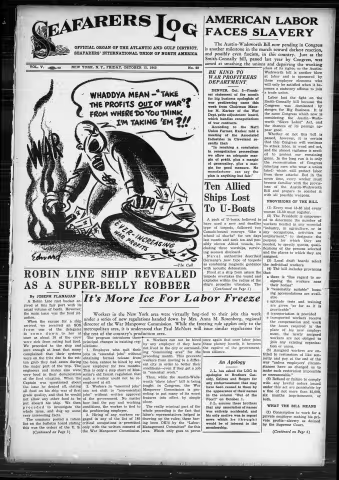
WHAOOYA M6AN - TAia
tne pROFits sal OF IVAR'T
FISOM W»KR€^Vool«iMK^
TAKIMG 'EM f/r
AMERICAN LABOR
FACES SLAVERY
The Austin-Wadsworth Bill now pending in Congress
is another milestone in the march toward darkest reaction,
and possibly even fascism, in this country. Just as the
Smith-Connally bill, passed last year by Congress, was
aimed at smashing the unions and depriving the working
class of its rights, so the Austin-
BE KIND TO
WAR PROFITEERS
DEPARTMENT
DENVER. Oct. 2—Frank
est statement of the month
for big business apologists of
war profiteering came this
week from Chairman Maur
ice H. Karker of the War
Dept. pri&e adjustment board,
which handles renegotiations
of war contracts.
According to the Nat'l
Union Farmer. Karker told a
meeting of the Associated
Industries in Cleveland re
cently that:
"In reaching a conclusion
in renegotiation proceedings
we allow an adequate mar
gin of profit, plus a margin
of generositey. plus a mar
gin for good measure. No
manufacturer can say the
plan is anything but fair."
—The Call
ROBIN LINE SHIP REVEALED
AS A SUPER-BELLY ROBBER
By JOSEPH FLANAGAN
A Robin Line rust bucket ar
rived at this fair port with its
usual volume of beefs. However,
the main issue was the food sit
uation.
When the excuse for a ship
arrived, we received an SOS
from one of the delegates
to come down to her at
once as about 10 of the crew
were sick from eating bad food.
We preceded to the ship and
sure enough at least that many
complained that their systems
were on the fritz due to the rot
ten grub they had eaten during
the major part of the trip. The
engineers and mates also were
very loud in their denunciation
of the food situation. When the
Captain was questioned about
the issue he denied all, stating
all food on his ship was of first
grade quality, and that he would
not allow any other food to be
put aboard his ship. We then
preceded to investigate the
whole issue, and dug up some
very interesting facts.
The company posted a ration
list on the .bulletin board stating
{Continued on Page 3)
Ten Allied
Ships Lost
To U-Boats
A pack of U-boats, believed to
have used a new and deadlier
type of torpedo, followed two
Canada-bound convoys "like a
school of sharks" for ten days
last month and sank ten and pos
sibly eleven Allied vessels, in
cluding three warships, surviv
ing seamen disclosed.
Naval authorities described
Germany's .new type of torpedo
as combining magnetic guidance
with acoustic detonation.
Fired at a ship from astern the
torpedo overtakes the vessel and
explodes within the radius of the
ship's propeller vibration. The
{Continued on Page 3)
It's More Ice For Labor Freeze
"Workers in the New York area were virtually hog-tied to their jobs this week
under a series of new regulations handed down by Mrs. Anna M. Rosenberg, regional
director of the War Manpower Commission. While the freezing rule applies only to the
metropolitan area, it is understood that Paul McNutt will issue similar regulations for
the rest of the country's production area.
The program introduces three •
principal changes in existing reg
ulations:
1. Employes who quit their
jobs in "essential jobs" without
obtaining formal release from
the boss, cannot be hired by any
new employer for two months.
This is only a step short of Mus
solini's old fascist regulation that
such a worker c.ould not be re
employed at all.
2. Workers in "essential jobs"
can not shift to "non-essential
jobs" without written approval
of the government. No matter
how bad the pay and working
conditions, the worker is tied to
the profiteering employer.
3. Hiring of any workers en
gaged in any of the list of 149
critical occupations is - permitted
only with the written consent of
the War Manpower Commission.
4. Workers can not be hired
by any employer if they have
not lived in the city or surround
ing "commuting area" for the
preceding month. This prevents
workers from moving to a differ
ent city in order to better their
conditions—even if they get a job
in "essential work."
Thus, while the Austin-Wads-
worth "slave labor" bill is being
fought in Congress, the War
Manpower Commission is pro-
ceding to put many of its worst
features into effect by simple
ukase.
The really criminal part of the
whole preceding is the fact that
labor's representatives helped in
drawing up the rules; these hav
ing been OK'd by the "Labor-
Management Committee" for this
area. Which only goes to prove.
once again that once labor joins
these phoney boards, it becomes
the captive of the government-
boss alliance.
An Apology
J. L. has asked the LOG to
apologize to Brothers Cas-
sidy. Grimes and Rogers for
any embarrassment that may
have been caused to them by
the appearance of their names
in the column "Out of the
Focs'l" on October 1.
J. L. assures these brothers
that any association of names
was entirely accidental, and
his only motive was to report
news which he thought
would be of interest to the
membership.
Wadsworth bill is another blow
at labor and is sponsored by
those employer elements who
will only be satisfied when it be
comes a statutory offense to join
a trade union.
Labor lost the fight on the
Smith-Connally bill because the
Congress was dominated by
stooges for Big Business. It is
the same Congress which now is
considering the Austin - Wads-
worth "Slave Labor" Act, and
the chances of its passage ap
pear good.
Whether or not this bill is
passed, however, it is certain
that this Congress wiU continue
to attack labor, in word and act,
and the utmost vigilance is need
ed to protect our remaining
gains. In the long run it is only
the reconstitution of Congress
(electing men who wear a union
label) which will protect labor
from these attacks. But in the
mean time, every worker must
become familiar with the provis
ions of the Austin-Wadsworth
Bill and prepare to combat it
with all possible weapons.
PROVISIONS OF THE BILL
(1) Every man 18-65 and every
woman 18-50 must register.
(2) The President is empower
ed to determine the number of
workers needed in any essential
"industry, in agriculture, or in
any occupations, activities or
employment," to designate the
purpose for which they are
needed, to specify quotas, quali
fications of the persons selected
and the places to which they are
assigned.
(3) Local draft boards select
the individual workers.
(4) The bill includes provisions
that:
a there is "due regard to as
signing the workers near
their homes"
b "reasonably suitable" housr'"
ing accomodations are avail
able
c aptitude tests and training
are given "as far as it is
practicable"
d transportation is provided
e transported workers receive
the compensation and work
the hours required in the
place of his new employ
ment, the newly assigned
workers are not obliged to
join any existing organiza
tion or union.
(5) Assigned workers are en
titled to restoration of like sen
iority and pay at the end of the
war "unless employers' circum
stances have so changed as to
make such restoration impossible
or tmreasonable."
(6) Refusal or failure to comply
with any lawful orders issued
under this act are punishable by
a fine of not more than $1,000,
six months imprisonment, or
both.
WHAT THE BILL MEANS
(1) Conscription to work for a
private employer making his pri
vate profits—slavery as defmed
by the Supreme Court.
{Continued on Page 2)
^2
http://www.pdfcompressor.org/buy.html
•vrwy.vr'
Page Two THE SEAFARERE LOG Friday, October 15, 1943
SEAFARERS LOG
'Published by the
SEAFARERS' INTERNATIONAL UNION
OF NORTH AMERICA
Atlantic and Gulf District
•Affiliated with the American Federation of Labor
HARRY LUNDEBERG ------ "President.
110 Market Street, San Francisco, Calif. .
JOHN HAWK Secy-Treas.
P. O. Box 25, Station P., New York Qty
MATTHEW DUSHANE - - - Washington Rep.
424 5 th Street, N. W., Washington, D. C,
• w
Directory of Branches
BRANCH ADDRESS PHONE
NEW YORK (4) 2 Stone St BOwHng Green 9-3437
BOSTON (10) 330 Atlantic Ave Liberty 4057
BALTIMORE (2) 14 North Cay St Calvert 4539
PHILADELPHIA 6 North 6th St Lombard 765!
NORFOLK 25 Commercial PI... Norfolk 4-1083
NEW ORLEANS (16) ..309 Chartres St Canal 3336
SAVANNAH 218 East Bay St .Savannah 3-1728
TAMPA 423 East Piatt St Tampa MM-1323
MOBILE 55 So. Conception St Dial 2-1392
PUERTO RICO 45 Ponce de Leon ,Puerto de Tierra
GALVESTON 219 20lh Street Galveston 2,6043
FT. LAUDERDALE 2021 S. Federal Highway... Ft. Lauderdale 1601
PUBLICATION OFFICE;
ROOM 213, 2 STONE STREET
New York City BOwUng Green 9-8345
;^ifR€POT?T orv.
^ASHItXGTOIV:
• av MATT44ftW DUSUAN&«
AMERICAN LABOR
FACES SLAVERY
'{Continued from Page 1)
(2) American citizens give up
their right to choose the work,
the place they live in and the
condition under which they
work.
(3) Capital and industry are
left free to act as they wish—un-
conscripted. , ^
(4) Possible injustices:
a to Negroes—Southern draft
boards can easily use their
power to bind the Negroes
even more firmly to the soil
or to their underpaid jobs
i) to minorities—individuals of
unpopular opinions' can be
threatened with removal for
expression of their opinions
c to all citizens—loss of voting
privileges until a new resi
dence is established
(5) A tremendous setback to
m
|,V' ' •vv--=
the improved working conditions
of the past 15 years through:
a forcing transferred people to
work under any conditions
existing in their assigned
occupation
b a blow to the democratic
trade union movement by
transfer of militant union
leaders to other jobs
c the destruction of unions
where membership mainten
ance clauses and union shop
agreements exist becau.se of
the fact that new workers
would not be obliged to join
any existing labor union.
(6) Break up of the home
^ough:
a one member of the family
moving to another area
b complete readjustment for
the whole family if it moves
together.
(7) The proponents of the bill
Imply that the imdemocratic
jtaettiod of coercion by the state
Kather than consent by the people
is the only method of getting the
American people to work in oc
cupations essential to the war
effort.
AUSTIN-WADSWORTH BILL
WON'T SOLVE THE PROBLEMS
It does not accomplish its
stated purpose to "provide for
the successful prosecution of the
war." It assumes that the only
hindrance to further increase in
production (which has more than
doubled since 1939) is a man
power shortag-. This does not
get at the basic causes which
are:
(1) lack of overall planning:
a improper allocation of raw
materials, so that some plants
have an over-abundance and
others maintain their em
ployees idle through lack of
material
b concentration of 75% of war
contracts with 100 large cor
porations causing many
small businesses to fail, and
creating unnecessary short
ages of labor in specific
areas
(2) no real statement of the
neds of the armed forces in re
lation to the available man
power.
(3) failure to use large groups
of available manpower.
(4) failure to remedy the bad
housing, transportation, etc., in
war areas which create or inten
sify labor shortages.
I attended the SIU's executive
board aimual meeting in -San
Francisco, results of the prdceed-
ings will be submitted to the
membership by your respective
secretary-treasurers.
The following bills have been
introduced in Congress, aUd hear
ings are scheduled for October
12, 1943.
HR.3257 — To amend subtitle-
Insurance of title II of the mer
chant marine act, 1936, as amend
ed, to authorize suspension of the
statue of limitations in certain
cases, and for other purposes.
The purpose of the bill is to
affirm and clarify the authority
of the WSA; to agree on a waiver
of the statue of limitations in
connection with claims arising
from insurance agreements in
cases of missing vessels, in order
to provide prompt settlement of
30th marine risks and war risks
involved.
on merchant marine and fisher
ies. Haven't had the time to
thoroughly check these biUs —
will forward all bills to the re
spective HQ of the SIU affiliates.
JVeiv Orleans Mailing
Address
All mail for union brothers
in New Orleans should be ad
dressed in the following man
ner:
John Doe
General Delivery
Seamen's Postal Unit
Custom House Station
New Orleans 16, La.
NO DOUBLE RECOVERY
HR.3258—^To prevent recovery
on claims under section 1 (a) of
public law No. 17, seventy-eight
Congress, relating to -seamen em
ployed by the United States
through the War Shipping Ad
ministration.
The purpose of the bill is to
limit the possibility of double or
over lapping recovery on account
of death or injury to seamen as
employes of the U. S. by the
WSA. The possibility of such
overlapping recovery arises in
cases of seamen who are entitled
to sue under the law of the U. S,
in case of death or injury and
may also be entitled to sue under
foreign law on account of the
same casualty.
UNIFORM INSURANCE
HR.3259—To clarify the appli
cation of section 1 (b) of public
law No. 17 seventy-eight Con
gress, to certain services per
formed by seamen as employes of
the U. S., through the War Ship
ping Administration. -
The purpose of the bill is to
exclude from consideration for
the puiposes of old age and sur
vivors insurance benefits, services
of seamen employed as employes
of the U. S., by the WSA, on for
eign flag vessels or contracted
for and performed wholly out
side the U. S., so that coverage
for such benefits for seamen em
ployes of the WSA shall be in
line with the coverage in cases
of similiar services by seamen
employed by private shipping
operators.
HR.3262—^To amend section 2
(b) of public law No. 17, seventy-
eight Congress—^relating to func
tions of the WSA, and for other
purposes.
The purpose of the bill is to
expressly authorize the waiver
of recovery of seamen's insurance
payments by the WSA, particu
larly in cases where insurance
has been paid to beneficiaries on
the assumption that the missihg
seamen were dead, but were la
ter found to be alive. The bill
follows a similiar provision with
respect to recoxrery of benefits
paid by the veterans administra
tion.
The analysis on the above bills
was prepared by the committee
MARITIME PANEL MEETING
Attended a conference of pan
el memljers of the War Shipping
Panel — (Maritime Panel of the
War Labor Board); The National
War Labor Board approved of all
but three of the voluntary agree
ments that the panel recom
mended approval in the meetings
that were held on August 16, 17,
and 18th.
The three cases that the board
did not take action on involved
the MM&P and the MEBA. The
board recommended that a com
mittee from the Panel have a
conference with Mr. Vinson, sta
bilization director, to discuss the
possibility of him granting tem
porary approval of the agree
ments pending the outcome of
the present negotiations of the
MM&P-MEBA and the employ
ers for a uniform agreement.
The agreements in question,
call for increases above what is
termed the mode. Under execu
tive order No. 9328, the board
cannot approve of the agree
ments without the approval of
Mr. Viii.son.
WAGE FREEZE
For the information of the
membership, I'll try and explain
what is meant by the mode. It
is the most frequent rate of
wages paid in any locality or in
dustry. For instance, if the ma
jority of the AB's receive a
monthly wage of $100. per month 19328.
and a union and the employe?
agree to a wage rate for AB's at
$125.00 per month, this new wqge
rate would be alsove the mode
for the industry, and under ex
ecutive order No. 9328 the board
cannot grant approval of the
agreement.
Should any employer pay S
wage rate above the mode, and
they hold government contracts
or are agents for the government
and pay any wages that are
above the mode and the agree
ments are not approved by the
War Labor Board, the employer,
would not be able to collect from
the government on any payments
that he may have made.
That is the club that the War,
Labor Board holds over the em
ployers' head when he makes an'
agreement with a union. If they
do not comply with the rulings
and dijjectives of the board, and
executive orders, they are not
reimbursed by the government
for any expenditures that they
make as per the terms of their]
agreements.
A committee from the panel
had an appointment with Mr.
Vinson yesterday afternoon, and
the case is now back in the lap
of the National War Labor Board
for action. The board did not
want to act on this case with]
having a conference with Mr.
Vinson, due to the fact that the
new wage schedule is above the
Mode. It now remains to be
seen what action the board will
take on this case, their decision
may set a precedent under the
'RARE AND UNUSUAI. CASE"
clause in executive order No.
Texas Jails Labor Leader
When He Talks Of Union
This week witnessed the spec
tacle of a labor leader being
flung into jail because he urged
workers to join - a union. This
didn't happen in Hitlerland, but
deep in the heart of Texas."
R. J. Thomas, president of the
United Automobile Workers, was
the victim of this startling inva
sion of civil rights. AU he did
was speak at a rally in Pelly,
Texas, an oil-producing center,
and make this plea:
"I earnestly ask those who
are not now members of the
Oil Workers' International
Union to join now."
As soon as he finished, deputy
sheriflfs "nailed him" anci hauled
him off to the Travis county
lockup. In double-quick time.
County Judge J. Harris Gardner
sentenced him to three days' im
prisonment and a $100 fine. How
ever, he was later released on
bond, pending a trial on his ap
peal, October 20.
VICIOUS
ANTI-UNION LAW
AHr of this arose because the
Lone Star state has a vicious
anti-union law which, among
other features, specifies that no
one may seek to organize work
ers without a license. At least
four other states have similar
repressive laws.
When Thomas announced he
was to speak at the Texas rally
on behalf of the right to organ
ize, which is guaranted by Fed
eral statues. Attorney General
Gerald Mann rushed into court
and got an injunction to "gag"
Thomas unless he secured a li
cense.
Thomas replied that he didn't
think he should be compelled to
obtain a license to exercise hia
constitutional rights.
READY TO FACE ISSUE
"I didn't come here to violate
any law," he said. "But since the
issue has arisen I don't want
anybody to say I'm evading it."
Thomas declared bluntly he
would speak and thus test the
validity of the Texas act.
MONEY DUE
Following Brothers have money
coming from the Bull Line. Col
lect at New York office:
FRANK SWIFT i
DEBERT SHIELDS f j
FRED LEWIS f !
BERNARD BOLi^D " i
OTTO PETERSEN "I
C. MCWITZ jrj
.-A
http://www.pdfcompressor.org/buy.html
Fujida^' Ocl^r 15, 1943
,-5, v
THE SEAFARERS LOG
'Hi
Page Three
Robin Line Revealed
Super-Belly Robber
,1:'
'{Continued from Page 1)
Governmejit that v.'hcn the chief
steward of ship put in his requis
ition for stores, every item on his
list was cut at least 50% and
some as high as 80% by the com^
pany purchasing agent. Steward
notified company before ship
Bailed that some of the stores
iaboard the ship were unfit fQ£.
consumption. This was ignored
by the company, and the prize of
them all was a letter to the com
pany from the Captain which
specified the food was unfit to
eat.
This letter was signed by the
same Captain who made the
statement his ship carried noth
ing but first grade food.
Here is a copy of the skipper's
letter:
Seas Shipping Company, Inc.
39 Corllandt Street
New York, N.Y.
, Aiij Mr. P. P. Lanning,
Operating Manager
Dear Sir:
Please be advised that we
found it necessary to pur
chase potatoes and yeast in
Trinidad; the former because
more than 50% of those ob
tained in Norfolk were no
good (see letter dated June
7); the later because the 32
lbs. on hand from the last
voyage were useless. The
steward ordered 40 lbs. of
yeast in Norfolk, but all he
received was 10 lbs.
In addition, the following
items on hand from last voy
age were found . to be no
•• »
U
J- '
jgood: 20 cases of eggs, 400
lbs. frozen beef, 200 lbs. corn
ed shoulder, 170 lbs. frank
furters. 100 lbs. ox livers, 200
lbs. veal, 175 lbs. sausages,
268 lbs. chickens, 100 lbs.
ducks, and 75 lbs. turkeys.
With regard to the first three
items listed above, the exact
quantities are questionable,
as some of these may be sal
vaged.
Respectfully yours,
K. Gunderson,
Master, S.S.
To top this, the new stores
they took aboard were also of
such poor quality and far less in
quantity that the food that had
to be disposed of, that the crew
almost starved for the rest of the
trip.
To further their aim towards a
quick demise for the crew, the
chief engineer of said ship shut
off all the fresh water, and let
the crew drink some kind of
blackish salty water for ten days.
I advised the entire crew^o have
a thorough examination from a
doctor as soon as they possibly
could. I hope this advice was
taken seriously.
As a final suggestion to the
crews of these ships where a ra
tion system has been imposed by
the company, the War Shipping
Administration has ruled the ra
tion system as proposed by them
was to become effective only
when the ships were in areas
where food was unobtainable.
Also the provisions therein were
based on the minimum and not
the maximum allotment per
man. Stewards take notice.
SIU And Tanker Members
On West Coast
Central Registering and Dispatching Office
Open in SUP Headquarters at San Francisco
For SIU Members and T, C's in
Deck, Engine and Steward Departments
Increased shipping on West Coast by SIU members
hyas made it necessary to oi>en a separate and complete
business office to be devoted solely to registering and car
ing for the needs of SIU members in all departments.
All SIU members in San Francisco are required to im
mediately register in SIU office at 59 Clay St. SIU members
in SUP Branches on the West Coast are to register in the
respective SUP Office and receive an SIU shipping card.
SIU shipping cards will have preference on SIU ships and
will be recognized by all SUP Dispatchers. SIU Deck mem
bers will have second preference when SUP members are
available.
For Further Information:
Call your union offices and tanker organizers at the
addresses listed below. You will always finds somebody at
these numbers excepting at night.
SEATTLE, WASH.—86 Seneca St.—Phone Elliott 6752.
—E. Coaster or Johnson.
PORTLAND, OREGON—111 West Burnside St.—Phone
Beacon 4336—John Massey or C. Atkins.
RICHMOND, CAUFORNTA-257 Fifth St.—Phone Rich
mond 4021—Louie Glebe or Banks.
VANCOUVER, B. C.—340 B. Cambie St.—Phone Pacific
7824—Hugh Murphy.
WILMINGTON, California — 440 Avalon Blvd. —Phone
4449.
NEW YORK CITY — 105 Broad St. — Phone BOwling
Green 0-9530—Morris Weisbei^er.
SAN FRANCISCO—59 Clay St.-Phone Exbrook 8229—
PhU Conley.
Ten Allied
Ships Lost
To U-Boats
{Continued from Page 1)
ship, totally disabled with her"
propeller gone, is then an easy
mark for^ a point-blank torpedo.
The Germans have long been
using torpedoes powered with
electric batteries, which leave no
tell-tale wakes of bubbles.
The enemy submarines, return
ing to the North Atlantic in ap-,
parently great numbers after
several months of comparative
inactivity, continued the attacks
until the convoys were almost
within sight of the Canadian
coast line.
With their increased armament
and their superiority in numbers
to the four to ten escort vessels
ordinarUy provided for an Allied
convoy, the U-boats ^probably
will not hesitate, if they are
caught by surprise, to stay on the
surface and fight both surface
vessels and planes with gunfire.
This, indeed, may be the func
tion of some of the pack—^to at
tack the escort vessels and pick
them off with .guns and torpe
does. Another portion may fire
sonic or magnetic torpedoes into
the midst of the convoy in an at
tempt to sink ships and make
the convoy scatter. Still another
portion may take position to pick
off stragglers or isolated ships.
At least two of the U-boats
were believed to have been des
troyed and six others probably
were damaged, the survivors
said.
Except for the warships, which
included the Canadian destroyer
St. Croix, formerly the U.S.S.
McCook, no official annotmce-
ment was made of the sinkings.
The battle began Sept. 19.
It was not disclosed whether
the attack was the same action
reported by the Royal Canadian
Air Force Sept. 28 in which
R 0 A long - range Liberators
battled six surfaced U-boats.
Survivors of two American
and one Norwegian cargo ships
gave a word picture of one of
the starkest sea fights since the
war began. They told of ships
breaking in half as torpedoes
ripped into their hulls, of injured
and dying men struggling for
hours in the icy, oil-thick Water
on the outer rim of the Arctic
circle, of exploding depth charges
and of one U-boat being blasted
out of the water after being
caught in the beam of a war
ship's searchlight.
Around The Ports
GALVESTON
Things around Texas ports are
pretty good, have two new ships
to crew up in the next few days.
Have had a few of the boys come
over from New Orleans to ship
out. Had the pleasure of going
aboard a new ship where I had
to call the RMO for two ordin
aries and two acting AB's. These
birds would be turned to by the
Bos'n on a job, and in a few min
utes he would go looking for
them. When he did find them
they were either in the mess-
room or in their bunks. That
crap was stopped once and for
all times. The point is this, you
new men that have graduated
out of the training schools, you
are going to sea to make a liv
ing like aU of us have done in
the past. There is a strong
union, and things are pretty good,
wages, working conditions, and
living conditions. Don't for one
minute think that they have al
ways been that way, or that they
will stay that way. For unless
you stand up and protect what
the old timers have built and
handed down to you, you can
lose in a few months what it has
taken years of sacrifice to build.
It is said that history repeats.
Read back during the last War.
The wages, conditions and bonus
was not no where near what you
are receiving today. Then after
the shipowner had made his,
along with the help of the sea-
service bureau, we were forced
to call a strike in 1921, which we
lost to our sorrow. Then the
wages and conditions started to
go down until they finally got so
low that you either had to ac
cept them or work ashore, and
there are many who still remem
ber that there were some com
panies that you had to work
away at one cent a month, to get
a job.
You are faced with the same
dose after this • war. The old
heads of the seaservice bureau
are right in the saddle of the
RMO to take over and break up
your union. And remember that
it took from 1921 until 1934 to
bring back what was lost. Men
were killed, jailed, and crippled
to help make the conditions that
In Memory of
Brother
JOE MOHOWSKI
(Able Seaman)
Born Jan., 1914. Died Aug. 1943
aboard Rufus W. Peckham.
you are enjoying today. And
just a few days ago another;
maritime union (NMU) was ne
gotiating for the same wages
and conditions that you enjoy in
the SIU which they do not get
in their contracts and which
their leadership did not fight for
as your leadership has done.
Remember, in union there is
strength. With yom help you
can look back some day and say,
I was one of the buUdcrs of the
Seafarers' International Union.
E. R. WALLACE. Agent
TAMPA f"'
Every since I have been Agent
in this port and the S.S. ( )
was coming in here there were
no beefs on her, but for the past
six months every trip there are
beefs galore.
That ship has had more AB's
and Boatswains aboard her in
that length of time than ever be
fore. From my point of view
there must be some two legged
rats aboard her.
I understand that there are
two, but they are so damn slick
that it is hard to catch them. I
suppose that Bro. Army will have
to contend with her for awhile;
luck to you lad.
There is one sure way of tell
ing when winter is approaching
and that is when you see all of
the Tampa boys drifting in to
soak up some of this hot .sun
shine, and vitimin B—eer.
Things here are very slow for
the present time although we
are looking forward to a pickup
in shipping.
The USS has opened up' a ho
tel and recreation center here
for the boys that drift down this
way and from the looks of things
it may turn out OK, but it is too
close to the Maritime training
school for much benefit to the
bonified men that go to sea.
D. L. PARKER, Ageni
m •
"THE WORKMEN HAVE DECIDED rr^ TIME YOU DID
SOMETHING ABOUT THE/R TKAMSPORTATTON PROBLEMSi" J*--
'•^SOHa/s
Will all members of the crew
of the S. S. Norwalk. particularly
H. Jayner, A. Page, E. Olsen, C.
Kampf. H. Clements, R. Holte
and J. Dogart, for a voyage com
mencing June 5, 1942. get in
touch with Paul C. Matthews, 11
Broadway. New York City.
OSCAR HEIL
Stop in the office of the Sec
retary-Treasurer next time you
are in New York.
I
LESNIAK, ORGS and
WOODBURY
Your log beef has been settled
in your favor. Collect from Mr.
Daily, New York shipping com
missioner.
SIDNEY DAY GREY
You have $43.71 coming from
McCormick Line. Collect in
New York.
LESLIE C. TAYLOR. No. 27991
Stop in the office of the Secre
tary-Treasurer next time you are
in New York.
JULIUS WONTOR
Stop in the office of the Secre
tary-Treasurer next time you axe
in New York.
EDWARD P. MALUE, 23469
Your discharges are in the of
fice of the Secretary-Treasurer.
•i?l
4\
1
http://www.pdfcompressor.org/buy.html
Page Four- THE SEAFARERS LOG Friday, Odober 15. 1943
If.-
1.
|b
Admiral Reveals British - American
Ship Rivalry
Seeds of a shurp post war conflict between the United
States and Great Britain are contained in the gigantic ship
building program conducted by both nations during the
war. That the two "United Nations" view each otheig
suspiciously was revealed this week by Admiral Howard L,
•Vickery who returned fi-om a
tour of British shipyards. Speak
ing to a correspondent for the
New York Times, the Vice Chair-
Nazi Prisoners Used In Attempt
To Break Down Shoreside Union
•v
The LOG has twice reported the fact that shipowners
are using Nfixi prisoners to do seamen's work, thus hoping
to undermine the contract and the union. This week comes
word that prisoners are also being used by shoreside em
ployers in their offensives against organized labor. In El-
wood, Indiana an employers is»
using prisoners in a canning
an
in a
plant to try to break a local
which has gone on record to
support the war 100%!
The plant is the local Frazier
Packing Co., which is using 100
prisoners to relieve a "labor
shortage" which the United Can
nery, Agricultural Packing & Al
lied Workers Union claims is
non-existant.
The Union said that it will
press unfair labor practice
charges against the firm, through
the National Labor Relations
Board, contending that local
union labor which has been
available to the management has
been turned down in favor of
Nazi employes.
The "super-men" from the fa
therland are not only treated to
special consideration as employ-
Communities Plan To
Honor Merchantmen
WASHINGTON
pledging
-Governors are
wholehearted support
to an appeal by Admiral Emory
S. Land, War Shipping Adminis
trator, to give merchant seamen
a place of equality with other
members of the armed forces on
town and community honor roUs.
Admiral Land made his appeal
in personal letters to Governors
of the 48 States and to Governor
Generals of United States Terri
tories and Possessions as a result
of a fiood of letters from famil
ies and friends of merchant sea
men who said that in many com
munities they were not counted
among the Nation's war heroes.
Land pointed out that Congress
has officially recognized the out
standing services. of these men
. by providing medals for distin
guished service and other honor
awards. He also called attention
to a declaration by President
Roosevelt that the work of our
merchant seamen is just as vital
to our ultimate victory as that of
the men in the armed forces.
That their's is a most dangerous
job. Admiral Land declared, is
attested by the grim toll of their
lost and injured.
DUTCH SEAMEN'S
UNION OPENS NEW
WEST COAST OFFICE
Following a tour of the West
Coast, Peter J. Vandcnbcrgo, .-.cc-
retary of the American section
of the Dutch Central Transport,
Workers' Federation, has report
ed that the union's new office in
San Francisco is speeding up
shipping and furnishing neces
sary manpower to merchant
ships sailing under the Dutch
flag.
The Dutch union is an affiliate
of the International Transport
Workers' Federation.
Growing Netherlands shipping
activities in the Pacific necessit
ated the establishment of new
quarters, Vandenberge said.
The Netherlands labor official
also said that the training school
for able-bodied seamen conduct
ed by the SUP has met with
considerable success in San Fran
cisco. *
SIU Prisoner Of
War Receives Our
Correspondence
Brother John Monteverde is
someplace in Nazi Germany, a
prisoner of war. His ship was
torpedoed last year and he was
fished out of the water by the
Germans and taken to the land
of "Supermen." Several months
ago he wrote to the union de
manding to know some details
concerning overtime in our
agreements. The prison camp
didn't stop him fr^m thinking of
union problems and conditions.
John Hawk sent him a reply,
giving what details were possible
under the circumstances, and
this week a second letter came
from Monteverde. Here it is:
Dear BrothoK Hawk:
Received your letter today
and was glad to hear from
you. All of us here are Am
ericans and seem to be en
joying good health and are
sure we won't be here much
longer. We were also glad to
hear that everything is go
ing good back there in re
gard to our agreements. I
am personally glad to know -
that you are keeping my rec
ords up to date so that I can
square away after the war.
All members here join me
in wishing everyone lots of
luck. Well, this is about all
I can think of now so I'll
close. Hoping to hear from
you as often as possible, I
remain,
John Monteverde,
Prisoner of War No. 2998
P.S. Best regards to Charlie
Waid if you see him.
What Is a
SCAB?
"After the God had finished the
rattlesnake, the toad, the vam
pire, He had some awful sub
stance left with which he made
a scab. A scab is a two-legged
animal with a corkscrew soul—
a water-logged brain, a combin
ation backbone made of jelly
and glue."—Jack London. L
es, but also apparently are al
lowed to scrawl expressions of
their distorted philosophy on
company property.
Company property has been
decorated with swastikas, iron
crosses, and slogans such as "Heil
Hitler," and "Germany Today,
Tomorrow and Forever,"
, The Union said that the Nazis
work eight hours a day, are given
a five minute rest period every
hour, get one hour for lunch, and
are treated to fresh tomatoes and
catsup. American union workers
slave 12, 14 and up to 17 hours
per day, get half an hour for
lunch, and are treated to no "to
mato surprises."
Limit Union
Maintenance
WASHINGTON, Sept. 22. — A
maintenance of union member
ship provision ordered by the
National War Labor Board is ef
fective only for the duration of
a union contract and, if ordered
renewed by the board must con
tain a 15-day "escape" clause, un
der present WLB policy, accord
ing to an opinion by William E.
Simkin, chairman of the WLB
Shipbuilding Commission, in the
first case before the National
Board or the Shipbuilding Com
mission in which the issue was
raised.
The commission, in an order
released Monday, granted the
request of the Federal Ship
building & Drydock Co. that pro
visions be made in the contract
with the Industrial Union of
Marine and Shipbuilding Work
ers (CIO) for a 15-day period in
which members of the union
may resign if they do not wish
to remain in the union for dura
tion of the contract.
Labor members of the com
mission dissented. The union had
requested that a union shop
clause be substituted for the
maintenance of membership pro
vision.
B. B. Parson
Gilbert T. Arnetl
L. W. Beeby—No. 3167
E. J. Noonan—TO 1232
James Reaves—^No. 22983
Joe H. Boyle
I. Rodriguez—^TC 149
Keep In Touch With
Your Local Draft Board.
Two Union
Ships For
The Greeks
With the change of name and
registry last week of the Liberty
ship William H. Todd to Greek
ownership the . Greek Maritime
Union now has, for the first time
in its history, two completely
unionized vessels. This was
made possible by the recent af
firmation in England of a collec
tive agreement between the
union and the Greek Government
and shipowners.
The Amerike, as the ship
henceforth will be known, is the
second of two such vessels turn
ed oyer to the Greeks for opera
tion for the duration of the war
under lend-lease agreements. The
first was the DeWitt Hyde, which
was renamed the HeUas.
EQUALITY IS GOAL
Commenting on the acquisition
of the latest additions to the
Greek Merchant Marine, Petros
Spiridacos, s e c r e tary of the
Greek Maritime Union said that
the new collective agreement
marked the first real step made
by his union toward achieving
equality with the seamen of the
other United Nations. He as
serted that he looked forward to
great improvement in wages and
working conditions for Greek
seamen.
"The Greek seamen," he de
clared, "have been right in the
thick of things in this war. Dur
ing the past three years Greek
shipping losses in enemy action
have exceeded 1,500,000 tons.
With this loss over 4,000 Greek
seamen have given up their
lives.
"Though nearly one-fifth of
the total number of Greek sea
men have been lost, we stiU have
more than 10,000 who continue
to serve aboard Greek ships and
the vessels of the Allied nations.
ENORMOUS LOSSES
RECOUNTED
"The Liberty ships we have
received are a welcome addition
to the replacements from Great
Britain, but they are by no means
enough to make good even a
small percentage of the" terrific
losses sustained by the Greek
merchant fleet. Today, after three
years of war, we have only about
seventy ships, representing some
500,000 tons, out of a pre-war to
tal of over 500 vessels.
ATLANTIC AND GULF SHIPPING FOR
WEEK OF SEPTEMBER 20th TO 25th
DECK ENGINE STEWARD TOTAL
SHIPPED 340 272 291 903
REGISTERED 265 200 190 655
man of the Maritime Commission
said, "I told them we intend to
become a maritime nation and
intend to stay one. I said we
would do it by cooperation, but il
they didn't want to cooperate
we'd stay one anyhow."
This blunt talk has brought in
to the open the commercial riv
alries which have been submerg
ed by the necessities of war—but
never eliminated.
Vickery was concerned over*
the fact that Britain is concen
trating on larger, faster commer-^
cial ships while the United
State.s has been building Liberty
ships which will hardly be able
to compete with other maritime
nations after the war. While the
British produced ships are in the
category of "competitive ships,"
the Admiral said, "the American
overall shipbuilding program
was so much greater that we are
producing about ten times as
many ships as the British—even
of the 'competitive' type."
Vickery pointed out that as a
result of this shipbuilding record,
England after the war would be
unable to maintain the suprem
acy of the .merchant sea" lanes
which she previously held, and
slie would find it "advisable" to
cooperate with the United States.
Vickery was asked by report
ers how it was that England con
tinued to build merchant ships in
face of a recently announced
agreement between President
Roosevelt and Prime Minister
Churchill that England would
produce warships with the build
ing of merchant ships left to the
United States.
"I'd better skip that," he said.
Seamen's Institute ^
Opened In Etrooklyri
Bishop Thomas E. Molloy of
Brooklyn dedicated yesterday af
ternoon the new $250,000 Cath
olic Seamen's Institute of Brook
lyn, Hicks and Rapelye Streets,
a non-sectarian recreation center
for men of the merchant marine.
Five thousands persons crowded
the auditorium, filled upstair
rooms where loudspeakers had
been installed and gathered in
the street.
Bishop Molloy paid tribute in
his speech to the late Rev. Al-
phonse Rickert, who founded the
institute in 1936, and to Rev.
William Farrell, port chaplain
and institute director.
Mgr. James H. Griffiths, vice
chancellor of the Brooklyn Dio
cese, in his address, praised "the
unsung heroes of the deep—the
men of the merchant marine"
Mgr. Richard B. McHugh pre
sided.
Keep In Touch With
Your Local Draft Board,
: .
http://www.pdfcompressor.org/buy.html
f
if
• i
li
OFFICIAL ORGAN OF THE ATLANTIC AND GULF DISTRICT,
^ SEAFARERS' INTERNATIONAL UNION OP NORTH AMERICA
VOL. V. 267 NEW YORK. N. Y.. FRIDAY, OSTOBER 15. 1943 No. 28
WHAOOYA M6AN - TAia
tne pROFits sal OF IVAR'T
FISOM W»KR€^Vool«iMK^
TAKIMG 'EM f/r
AMERICAN LABOR
FACES SLAVERY
The Austin-Wadsworth Bill now pending in Congress
is another milestone in the march toward darkest reaction,
and possibly even fascism, in this country. Just as the
Smith-Connally bill, passed last year by Congress, was
aimed at smashing the unions and depriving the working
class of its rights, so the Austin-
BE KIND TO
WAR PROFITEERS
DEPARTMENT
DENVER. Oct. 2—Frank
est statement of the month
for big business apologists of
war profiteering came this
week from Chairman Maur
ice H. Karker of the War
Dept. pri&e adjustment board,
which handles renegotiations
of war contracts.
According to the Nat'l
Union Farmer. Karker told a
meeting of the Associated
Industries in Cleveland re
cently that:
"In reaching a conclusion
in renegotiation proceedings
we allow an adequate mar
gin of profit, plus a margin
of generositey. plus a mar
gin for good measure. No
manufacturer can say the
plan is anything but fair."
—The Call
ROBIN LINE SHIP REVEALED
AS A SUPER-BELLY ROBBER
By JOSEPH FLANAGAN
A Robin Line rust bucket ar
rived at this fair port with its
usual volume of beefs. However,
the main issue was the food sit
uation.
When the excuse for a ship
arrived, we received an SOS
from one of the delegates
to come down to her at
once as about 10 of the crew
were sick from eating bad food.
We preceded to the ship and
sure enough at least that many
complained that their systems
were on the fritz due to the rot
ten grub they had eaten during
the major part of the trip. The
engineers and mates also were
very loud in their denunciation
of the food situation. When the
Captain was questioned about
the issue he denied all, stating
all food on his ship was of first
grade quality, and that he would
not allow any other food to be
put aboard his ship. We then
preceded to investigate the
whole issue, and dug up some
very interesting facts.
The company posted a ration
list on the .bulletin board stating
{Continued on Page 3)
Ten Allied
Ships Lost
To U-Boats
A pack of U-boats, believed to
have used a new and deadlier
type of torpedo, followed two
Canada-bound convoys "like a
school of sharks" for ten days
last month and sank ten and pos
sibly eleven Allied vessels, in
cluding three warships, surviv
ing seamen disclosed.
Naval authorities described
Germany's .new type of torpedo
as combining magnetic guidance
with acoustic detonation.
Fired at a ship from astern the
torpedo overtakes the vessel and
explodes within the radius of the
ship's propeller vibration. The
{Continued on Page 3)
It's More Ice For Labor Freeze
"Workers in the New York area were virtually hog-tied to their jobs this week
under a series of new regulations handed down by Mrs. Anna M. Rosenberg, regional
director of the War Manpower Commission. While the freezing rule applies only to the
metropolitan area, it is understood that Paul McNutt will issue similar regulations for
the rest of the country's production area.
The program introduces three •
principal changes in existing reg
ulations:
1. Employes who quit their
jobs in "essential jobs" without
obtaining formal release from
the boss, cannot be hired by any
new employer for two months.
This is only a step short of Mus
solini's old fascist regulation that
such a worker c.ould not be re
employed at all.
2. Workers in "essential jobs"
can not shift to "non-essential
jobs" without written approval
of the government. No matter
how bad the pay and working
conditions, the worker is tied to
the profiteering employer.
3. Hiring of any workers en
gaged in any of the list of 149
critical occupations is - permitted
only with the written consent of
the War Manpower Commission.
4. Workers can not be hired
by any employer if they have
not lived in the city or surround
ing "commuting area" for the
preceding month. This prevents
workers from moving to a differ
ent city in order to better their
conditions—even if they get a job
in "essential work."
Thus, while the Austin-Wads-
worth "slave labor" bill is being
fought in Congress, the War
Manpower Commission is pro-
ceding to put many of its worst
features into effect by simple
ukase.
The really criminal part of the
whole preceding is the fact that
labor's representatives helped in
drawing up the rules; these hav
ing been OK'd by the "Labor-
Management Committee" for this
area. Which only goes to prove.
once again that once labor joins
these phoney boards, it becomes
the captive of the government-
boss alliance.
An Apology
J. L. has asked the LOG to
apologize to Brothers Cas-
sidy. Grimes and Rogers for
any embarrassment that may
have been caused to them by
the appearance of their names
in the column "Out of the
Focs'l" on October 1.
J. L. assures these brothers
that any association of names
was entirely accidental, and
his only motive was to report
news which he thought
would be of interest to the
membership.
Wadsworth bill is another blow
at labor and is sponsored by
those employer elements who
will only be satisfied when it be
comes a statutory offense to join
a trade union.
Labor lost the fight on the
Smith-Connally bill because the
Congress was dominated by
stooges for Big Business. It is
the same Congress which now is
considering the Austin - Wads-
worth "Slave Labor" Act, and
the chances of its passage ap
pear good.
Whether or not this bill is
passed, however, it is certain
that this Congress wiU continue
to attack labor, in word and act,
and the utmost vigilance is need
ed to protect our remaining
gains. In the long run it is only
the reconstitution of Congress
(electing men who wear a union
label) which will protect labor
from these attacks. But in the
mean time, every worker must
become familiar with the provis
ions of the Austin-Wadsworth
Bill and prepare to combat it
with all possible weapons.
PROVISIONS OF THE BILL
(1) Every man 18-65 and every
woman 18-50 must register.
(2) The President is empower
ed to determine the number of
workers needed in any essential
"industry, in agriculture, or in
any occupations, activities or
employment," to designate the
purpose for which they are
needed, to specify quotas, quali
fications of the persons selected
and the places to which they are
assigned.
(3) Local draft boards select
the individual workers.
(4) The bill includes provisions
that:
a there is "due regard to as
signing the workers near
their homes"
b "reasonably suitable" housr'"
ing accomodations are avail
able
c aptitude tests and training
are given "as far as it is
practicable"
d transportation is provided
e transported workers receive
the compensation and work
the hours required in the
place of his new employ
ment, the newly assigned
workers are not obliged to
join any existing organiza
tion or union.
(5) Assigned workers are en
titled to restoration of like sen
iority and pay at the end of the
war "unless employers' circum
stances have so changed as to
make such restoration impossible
or tmreasonable."
(6) Refusal or failure to comply
with any lawful orders issued
under this act are punishable by
a fine of not more than $1,000,
six months imprisonment, or
both.
WHAT THE BILL MEANS
(1) Conscription to work for a
private employer making his pri
vate profits—slavery as defmed
by the Supreme Court.
{Continued on Page 2)
^2
http://www.pdfcompressor.org/buy.html
•vrwy.vr'
Page Two THE SEAFARERE LOG Friday, October 15, 1943
SEAFARERS LOG
'Published by the
SEAFARERS' INTERNATIONAL UNION
OF NORTH AMERICA
Atlantic and Gulf District
•Affiliated with the American Federation of Labor
HARRY LUNDEBERG ------ "President.
110 Market Street, San Francisco, Calif. .
JOHN HAWK Secy-Treas.
P. O. Box 25, Station P., New York Qty
MATTHEW DUSHANE - - - Washington Rep.
424 5 th Street, N. W., Washington, D. C,
• w
Directory of Branches
BRANCH ADDRESS PHONE
NEW YORK (4) 2 Stone St BOwHng Green 9-3437
BOSTON (10) 330 Atlantic Ave Liberty 4057
BALTIMORE (2) 14 North Cay St Calvert 4539
PHILADELPHIA 6 North 6th St Lombard 765!
NORFOLK 25 Commercial PI... Norfolk 4-1083
NEW ORLEANS (16) ..309 Chartres St Canal 3336
SAVANNAH 218 East Bay St .Savannah 3-1728
TAMPA 423 East Piatt St Tampa MM-1323
MOBILE 55 So. Conception St Dial 2-1392
PUERTO RICO 45 Ponce de Leon ,Puerto de Tierra
GALVESTON 219 20lh Street Galveston 2,6043
FT. LAUDERDALE 2021 S. Federal Highway... Ft. Lauderdale 1601
PUBLICATION OFFICE;
ROOM 213, 2 STONE STREET
New York City BOwUng Green 9-8345
;^ifR€POT?T orv.
^ASHItXGTOIV:
• av MATT44ftW DUSUAN&«
AMERICAN LABOR
FACES SLAVERY
'{Continued from Page 1)
(2) American citizens give up
their right to choose the work,
the place they live in and the
condition under which they
work.
(3) Capital and industry are
left free to act as they wish—un-
conscripted. , ^
(4) Possible injustices:
a to Negroes—Southern draft
boards can easily use their
power to bind the Negroes
even more firmly to the soil
or to their underpaid jobs
i) to minorities—individuals of
unpopular opinions' can be
threatened with removal for
expression of their opinions
c to all citizens—loss of voting
privileges until a new resi
dence is established
(5) A tremendous setback to
m
|,V' ' •vv--=
the improved working conditions
of the past 15 years through:
a forcing transferred people to
work under any conditions
existing in their assigned
occupation
b a blow to the democratic
trade union movement by
transfer of militant union
leaders to other jobs
c the destruction of unions
where membership mainten
ance clauses and union shop
agreements exist becau.se of
the fact that new workers
would not be obliged to join
any existing labor union.
(6) Break up of the home
^ough:
a one member of the family
moving to another area
b complete readjustment for
the whole family if it moves
together.
(7) The proponents of the bill
Imply that the imdemocratic
jtaettiod of coercion by the state
Kather than consent by the people
is the only method of getting the
American people to work in oc
cupations essential to the war
effort.
AUSTIN-WADSWORTH BILL
WON'T SOLVE THE PROBLEMS
It does not accomplish its
stated purpose to "provide for
the successful prosecution of the
war." It assumes that the only
hindrance to further increase in
production (which has more than
doubled since 1939) is a man
power shortag-. This does not
get at the basic causes which
are:
(1) lack of overall planning:
a improper allocation of raw
materials, so that some plants
have an over-abundance and
others maintain their em
ployees idle through lack of
material
b concentration of 75% of war
contracts with 100 large cor
porations causing many
small businesses to fail, and
creating unnecessary short
ages of labor in specific
areas
(2) no real statement of the
neds of the armed forces in re
lation to the available man
power.
(3) failure to use large groups
of available manpower.
(4) failure to remedy the bad
housing, transportation, etc., in
war areas which create or inten
sify labor shortages.
I attended the SIU's executive
board aimual meeting in -San
Francisco, results of the prdceed-
ings will be submitted to the
membership by your respective
secretary-treasurers.
The following bills have been
introduced in Congress, aUd hear
ings are scheduled for October
12, 1943.
HR.3257 — To amend subtitle-
Insurance of title II of the mer
chant marine act, 1936, as amend
ed, to authorize suspension of the
statue of limitations in certain
cases, and for other purposes.
The purpose of the bill is to
affirm and clarify the authority
of the WSA; to agree on a waiver
of the statue of limitations in
connection with claims arising
from insurance agreements in
cases of missing vessels, in order
to provide prompt settlement of
30th marine risks and war risks
involved.
on merchant marine and fisher
ies. Haven't had the time to
thoroughly check these biUs —
will forward all bills to the re
spective HQ of the SIU affiliates.
JVeiv Orleans Mailing
Address
All mail for union brothers
in New Orleans should be ad
dressed in the following man
ner:
John Doe
General Delivery
Seamen's Postal Unit
Custom House Station
New Orleans 16, La.
NO DOUBLE RECOVERY
HR.3258—^To prevent recovery
on claims under section 1 (a) of
public law No. 17, seventy-eight
Congress, relating to -seamen em
ployed by the United States
through the War Shipping Ad
ministration.
The purpose of the bill is to
limit the possibility of double or
over lapping recovery on account
of death or injury to seamen as
employes of the U. S. by the
WSA. The possibility of such
overlapping recovery arises in
cases of seamen who are entitled
to sue under the law of the U. S,
in case of death or injury and
may also be entitled to sue under
foreign law on account of the
same casualty.
UNIFORM INSURANCE
HR.3259—To clarify the appli
cation of section 1 (b) of public
law No. 17 seventy-eight Con
gress, to certain services per
formed by seamen as employes of
the U. S., through the War Ship
ping Administration. -
The purpose of the bill is to
exclude from consideration for
the puiposes of old age and sur
vivors insurance benefits, services
of seamen employed as employes
of the U. S., by the WSA, on for
eign flag vessels or contracted
for and performed wholly out
side the U. S., so that coverage
for such benefits for seamen em
ployes of the WSA shall be in
line with the coverage in cases
of similiar services by seamen
employed by private shipping
operators.
HR.3262—^To amend section 2
(b) of public law No. 17, seventy-
eight Congress—^relating to func
tions of the WSA, and for other
purposes.
The purpose of the bill is to
expressly authorize the waiver
of recovery of seamen's insurance
payments by the WSA, particu
larly in cases where insurance
has been paid to beneficiaries on
the assumption that the missihg
seamen were dead, but were la
ter found to be alive. The bill
follows a similiar provision with
respect to recoxrery of benefits
paid by the veterans administra
tion.
The analysis on the above bills
was prepared by the committee
MARITIME PANEL MEETING
Attended a conference of pan
el memljers of the War Shipping
Panel — (Maritime Panel of the
War Labor Board); The National
War Labor Board approved of all
but three of the voluntary agree
ments that the panel recom
mended approval in the meetings
that were held on August 16, 17,
and 18th.
The three cases that the board
did not take action on involved
the MM&P and the MEBA. The
board recommended that a com
mittee from the Panel have a
conference with Mr. Vinson, sta
bilization director, to discuss the
possibility of him granting tem
porary approval of the agree
ments pending the outcome of
the present negotiations of the
MM&P-MEBA and the employ
ers for a uniform agreement.
The agreements in question,
call for increases above what is
termed the mode. Under execu
tive order No. 9328, the board
cannot approve of the agree
ments without the approval of
Mr. Viii.son.
WAGE FREEZE
For the information of the
membership, I'll try and explain
what is meant by the mode. It
is the most frequent rate of
wages paid in any locality or in
dustry. For instance, if the ma
jority of the AB's receive a
monthly wage of $100. per month 19328.
and a union and the employe?
agree to a wage rate for AB's at
$125.00 per month, this new wqge
rate would be alsove the mode
for the industry, and under ex
ecutive order No. 9328 the board
cannot grant approval of the
agreement.
Should any employer pay S
wage rate above the mode, and
they hold government contracts
or are agents for the government
and pay any wages that are
above the mode and the agree
ments are not approved by the
War Labor Board, the employer,
would not be able to collect from
the government on any payments
that he may have made.
That is the club that the War,
Labor Board holds over the em
ployers' head when he makes an'
agreement with a union. If they
do not comply with the rulings
and dijjectives of the board, and
executive orders, they are not
reimbursed by the government
for any expenditures that they
make as per the terms of their]
agreements.
A committee from the panel
had an appointment with Mr.
Vinson yesterday afternoon, and
the case is now back in the lap
of the National War Labor Board
for action. The board did not
want to act on this case with]
having a conference with Mr.
Vinson, due to the fact that the
new wage schedule is above the
Mode. It now remains to be
seen what action the board will
take on this case, their decision
may set a precedent under the
'RARE AND UNUSUAI. CASE"
clause in executive order No.
Texas Jails Labor Leader
When He Talks Of Union
This week witnessed the spec
tacle of a labor leader being
flung into jail because he urged
workers to join - a union. This
didn't happen in Hitlerland, but
deep in the heart of Texas."
R. J. Thomas, president of the
United Automobile Workers, was
the victim of this startling inva
sion of civil rights. AU he did
was speak at a rally in Pelly,
Texas, an oil-producing center,
and make this plea:
"I earnestly ask those who
are not now members of the
Oil Workers' International
Union to join now."
As soon as he finished, deputy
sheriflfs "nailed him" anci hauled
him off to the Travis county
lockup. In double-quick time.
County Judge J. Harris Gardner
sentenced him to three days' im
prisonment and a $100 fine. How
ever, he was later released on
bond, pending a trial on his ap
peal, October 20.
VICIOUS
ANTI-UNION LAW
AHr of this arose because the
Lone Star state has a vicious
anti-union law which, among
other features, specifies that no
one may seek to organize work
ers without a license. At least
four other states have similar
repressive laws.
When Thomas announced he
was to speak at the Texas rally
on behalf of the right to organ
ize, which is guaranted by Fed
eral statues. Attorney General
Gerald Mann rushed into court
and got an injunction to "gag"
Thomas unless he secured a li
cense.
Thomas replied that he didn't
think he should be compelled to
obtain a license to exercise hia
constitutional rights.
READY TO FACE ISSUE
"I didn't come here to violate
any law," he said. "But since the
issue has arisen I don't want
anybody to say I'm evading it."
Thomas declared bluntly he
would speak and thus test the
validity of the Texas act.
MONEY DUE
Following Brothers have money
coming from the Bull Line. Col
lect at New York office:
FRANK SWIFT i
DEBERT SHIELDS f j
FRED LEWIS f !
BERNARD BOLi^D " i
OTTO PETERSEN "I
C. MCWITZ jrj
.-A
http://www.pdfcompressor.org/buy.html
Fujida^' Ocl^r 15, 1943
,-5, v
THE SEAFARERS LOG
'Hi
Page Three
Robin Line Revealed
Super-Belly Robber
,1:'
'{Continued from Page 1)
Governmejit that v.'hcn the chief
steward of ship put in his requis
ition for stores, every item on his
list was cut at least 50% and
some as high as 80% by the com^
pany purchasing agent. Steward
notified company before ship
Bailed that some of the stores
iaboard the ship were unfit fQ£.
consumption. This was ignored
by the company, and the prize of
them all was a letter to the com
pany from the Captain which
specified the food was unfit to
eat.
This letter was signed by the
same Captain who made the
statement his ship carried noth
ing but first grade food.
Here is a copy of the skipper's
letter:
Seas Shipping Company, Inc.
39 Corllandt Street
New York, N.Y.
, Aiij Mr. P. P. Lanning,
Operating Manager
Dear Sir:
Please be advised that we
found it necessary to pur
chase potatoes and yeast in
Trinidad; the former because
more than 50% of those ob
tained in Norfolk were no
good (see letter dated June
7); the later because the 32
lbs. on hand from the last
voyage were useless. The
steward ordered 40 lbs. of
yeast in Norfolk, but all he
received was 10 lbs.
In addition, the following
items on hand from last voy
age were found . to be no
•• »
U
J- '
jgood: 20 cases of eggs, 400
lbs. frozen beef, 200 lbs. corn
ed shoulder, 170 lbs. frank
furters. 100 lbs. ox livers, 200
lbs. veal, 175 lbs. sausages,
268 lbs. chickens, 100 lbs.
ducks, and 75 lbs. turkeys.
With regard to the first three
items listed above, the exact
quantities are questionable,
as some of these may be sal
vaged.
Respectfully yours,
K. Gunderson,
Master, S.S.
To top this, the new stores
they took aboard were also of
such poor quality and far less in
quantity that the food that had
to be disposed of, that the crew
almost starved for the rest of the
trip.
To further their aim towards a
quick demise for the crew, the
chief engineer of said ship shut
off all the fresh water, and let
the crew drink some kind of
blackish salty water for ten days.
I advised the entire crew^o have
a thorough examination from a
doctor as soon as they possibly
could. I hope this advice was
taken seriously.
As a final suggestion to the
crews of these ships where a ra
tion system has been imposed by
the company, the War Shipping
Administration has ruled the ra
tion system as proposed by them
was to become effective only
when the ships were in areas
where food was unobtainable.
Also the provisions therein were
based on the minimum and not
the maximum allotment per
man. Stewards take notice.
SIU And Tanker Members
On West Coast
Central Registering and Dispatching Office
Open in SUP Headquarters at San Francisco
For SIU Members and T, C's in
Deck, Engine and Steward Departments
Increased shipping on West Coast by SIU members
hyas made it necessary to oi>en a separate and complete
business office to be devoted solely to registering and car
ing for the needs of SIU members in all departments.
All SIU members in San Francisco are required to im
mediately register in SIU office at 59 Clay St. SIU members
in SUP Branches on the West Coast are to register in the
respective SUP Office and receive an SIU shipping card.
SIU shipping cards will have preference on SIU ships and
will be recognized by all SUP Dispatchers. SIU Deck mem
bers will have second preference when SUP members are
available.
For Further Information:
Call your union offices and tanker organizers at the
addresses listed below. You will always finds somebody at
these numbers excepting at night.
SEATTLE, WASH.—86 Seneca St.—Phone Elliott 6752.
—E. Coaster or Johnson.
PORTLAND, OREGON—111 West Burnside St.—Phone
Beacon 4336—John Massey or C. Atkins.
RICHMOND, CAUFORNTA-257 Fifth St.—Phone Rich
mond 4021—Louie Glebe or Banks.
VANCOUVER, B. C.—340 B. Cambie St.—Phone Pacific
7824—Hugh Murphy.
WILMINGTON, California — 440 Avalon Blvd. —Phone
4449.
NEW YORK CITY — 105 Broad St. — Phone BOwling
Green 0-9530—Morris Weisbei^er.
SAN FRANCISCO—59 Clay St.-Phone Exbrook 8229—
PhU Conley.
Ten Allied
Ships Lost
To U-Boats
{Continued from Page 1)
ship, totally disabled with her"
propeller gone, is then an easy
mark for^ a point-blank torpedo.
The Germans have long been
using torpedoes powered with
electric batteries, which leave no
tell-tale wakes of bubbles.
The enemy submarines, return
ing to the North Atlantic in ap-,
parently great numbers after
several months of comparative
inactivity, continued the attacks
until the convoys were almost
within sight of the Canadian
coast line.
With their increased armament
and their superiority in numbers
to the four to ten escort vessels
ordinarUy provided for an Allied
convoy, the U-boats ^probably
will not hesitate, if they are
caught by surprise, to stay on the
surface and fight both surface
vessels and planes with gunfire.
This, indeed, may be the func
tion of some of the pack—^to at
tack the escort vessels and pick
them off with .guns and torpe
does. Another portion may fire
sonic or magnetic torpedoes into
the midst of the convoy in an at
tempt to sink ships and make
the convoy scatter. Still another
portion may take position to pick
off stragglers or isolated ships.
At least two of the U-boats
were believed to have been des
troyed and six others probably
were damaged, the survivors
said.
Except for the warships, which
included the Canadian destroyer
St. Croix, formerly the U.S.S.
McCook, no official annotmce-
ment was made of the sinkings.
The battle began Sept. 19.
It was not disclosed whether
the attack was the same action
reported by the Royal Canadian
Air Force Sept. 28 in which
R 0 A long - range Liberators
battled six surfaced U-boats.
Survivors of two American
and one Norwegian cargo ships
gave a word picture of one of
the starkest sea fights since the
war began. They told of ships
breaking in half as torpedoes
ripped into their hulls, of injured
and dying men struggling for
hours in the icy, oil-thick Water
on the outer rim of the Arctic
circle, of exploding depth charges
and of one U-boat being blasted
out of the water after being
caught in the beam of a war
ship's searchlight.
Around The Ports
GALVESTON
Things around Texas ports are
pretty good, have two new ships
to crew up in the next few days.
Have had a few of the boys come
over from New Orleans to ship
out. Had the pleasure of going
aboard a new ship where I had
to call the RMO for two ordin
aries and two acting AB's. These
birds would be turned to by the
Bos'n on a job, and in a few min
utes he would go looking for
them. When he did find them
they were either in the mess-
room or in their bunks. That
crap was stopped once and for
all times. The point is this, you
new men that have graduated
out of the training schools, you
are going to sea to make a liv
ing like aU of us have done in
the past. There is a strong
union, and things are pretty good,
wages, working conditions, and
living conditions. Don't for one
minute think that they have al
ways been that way, or that they
will stay that way. For unless
you stand up and protect what
the old timers have built and
handed down to you, you can
lose in a few months what it has
taken years of sacrifice to build.
It is said that history repeats.
Read back during the last War.
The wages, conditions and bonus
was not no where near what you
are receiving today. Then after
the shipowner had made his,
along with the help of the sea-
service bureau, we were forced
to call a strike in 1921, which we
lost to our sorrow. Then the
wages and conditions started to
go down until they finally got so
low that you either had to ac
cept them or work ashore, and
there are many who still remem
ber that there were some com
panies that you had to work
away at one cent a month, to get
a job.
You are faced with the same
dose after this • war. The old
heads of the seaservice bureau
are right in the saddle of the
RMO to take over and break up
your union. And remember that
it took from 1921 until 1934 to
bring back what was lost. Men
were killed, jailed, and crippled
to help make the conditions that
In Memory of
Brother
JOE MOHOWSKI
(Able Seaman)
Born Jan., 1914. Died Aug. 1943
aboard Rufus W. Peckham.
you are enjoying today. And
just a few days ago another;
maritime union (NMU) was ne
gotiating for the same wages
and conditions that you enjoy in
the SIU which they do not get
in their contracts and which
their leadership did not fight for
as your leadership has done.
Remember, in union there is
strength. With yom help you
can look back some day and say,
I was one of the buUdcrs of the
Seafarers' International Union.
E. R. WALLACE. Agent
TAMPA f"'
Every since I have been Agent
in this port and the S.S. ( )
was coming in here there were
no beefs on her, but for the past
six months every trip there are
beefs galore.
That ship has had more AB's
and Boatswains aboard her in
that length of time than ever be
fore. From my point of view
there must be some two legged
rats aboard her.
I understand that there are
two, but they are so damn slick
that it is hard to catch them. I
suppose that Bro. Army will have
to contend with her for awhile;
luck to you lad.
There is one sure way of tell
ing when winter is approaching
and that is when you see all of
the Tampa boys drifting in to
soak up some of this hot .sun
shine, and vitimin B—eer.
Things here are very slow for
the present time although we
are looking forward to a pickup
in shipping.
The USS has opened up' a ho
tel and recreation center here
for the boys that drift down this
way and from the looks of things
it may turn out OK, but it is too
close to the Maritime training
school for much benefit to the
bonified men that go to sea.
D. L. PARKER, Ageni
m •
"THE WORKMEN HAVE DECIDED rr^ TIME YOU DID
SOMETHING ABOUT THE/R TKAMSPORTATTON PROBLEMSi" J*--
'•^SOHa/s
Will all members of the crew
of the S. S. Norwalk. particularly
H. Jayner, A. Page, E. Olsen, C.
Kampf. H. Clements, R. Holte
and J. Dogart, for a voyage com
mencing June 5, 1942. get in
touch with Paul C. Matthews, 11
Broadway. New York City.
OSCAR HEIL
Stop in the office of the Sec
retary-Treasurer next time you
are in New York.
I
LESNIAK, ORGS and
WOODBURY
Your log beef has been settled
in your favor. Collect from Mr.
Daily, New York shipping com
missioner.
SIDNEY DAY GREY
You have $43.71 coming from
McCormick Line. Collect in
New York.
LESLIE C. TAYLOR. No. 27991
Stop in the office of the Secre
tary-Treasurer next time you are
in New York.
JULIUS WONTOR
Stop in the office of the Secre
tary-Treasurer next time you axe
in New York.
EDWARD P. MALUE, 23469
Your discharges are in the of
fice of the Secretary-Treasurer.
•i?l
4\
1
http://www.pdfcompressor.org/buy.html
Page Four- THE SEAFARERS LOG Friday, Odober 15. 1943
If.-
1.
|b
Admiral Reveals British - American
Ship Rivalry
Seeds of a shurp post war conflict between the United
States and Great Britain are contained in the gigantic ship
building program conducted by both nations during the
war. That the two "United Nations" view each otheig
suspiciously was revealed this week by Admiral Howard L,
•Vickery who returned fi-om a
tour of British shipyards. Speak
ing to a correspondent for the
New York Times, the Vice Chair-
Nazi Prisoners Used In Attempt
To Break Down Shoreside Union
•v
The LOG has twice reported the fact that shipowners
are using Nfixi prisoners to do seamen's work, thus hoping
to undermine the contract and the union. This week comes
word that prisoners are also being used by shoreside em
ployers in their offensives against organized labor. In El-
wood, Indiana an employers is»
using prisoners in a canning
an
in a
plant to try to break a local
which has gone on record to
support the war 100%!
The plant is the local Frazier
Packing Co., which is using 100
prisoners to relieve a "labor
shortage" which the United Can
nery, Agricultural Packing & Al
lied Workers Union claims is
non-existant.
The Union said that it will
press unfair labor practice
charges against the firm, through
the National Labor Relations
Board, contending that local
union labor which has been
available to the management has
been turned down in favor of
Nazi employes.
The "super-men" from the fa
therland are not only treated to
special consideration as employ-
Communities Plan To
Honor Merchantmen
WASHINGTON
pledging
-Governors are
wholehearted support
to an appeal by Admiral Emory
S. Land, War Shipping Adminis
trator, to give merchant seamen
a place of equality with other
members of the armed forces on
town and community honor roUs.
Admiral Land made his appeal
in personal letters to Governors
of the 48 States and to Governor
Generals of United States Terri
tories and Possessions as a result
of a fiood of letters from famil
ies and friends of merchant sea
men who said that in many com
munities they were not counted
among the Nation's war heroes.
Land pointed out that Congress
has officially recognized the out
standing services. of these men
. by providing medals for distin
guished service and other honor
awards. He also called attention
to a declaration by President
Roosevelt that the work of our
merchant seamen is just as vital
to our ultimate victory as that of
the men in the armed forces.
That their's is a most dangerous
job. Admiral Land declared, is
attested by the grim toll of their
lost and injured.
DUTCH SEAMEN'S
UNION OPENS NEW
WEST COAST OFFICE
Following a tour of the West
Coast, Peter J. Vandcnbcrgo, .-.cc-
retary of the American section
of the Dutch Central Transport,
Workers' Federation, has report
ed that the union's new office in
San Francisco is speeding up
shipping and furnishing neces
sary manpower to merchant
ships sailing under the Dutch
flag.
The Dutch union is an affiliate
of the International Transport
Workers' Federation.
Growing Netherlands shipping
activities in the Pacific necessit
ated the establishment of new
quarters, Vandenberge said.
The Netherlands labor official
also said that the training school
for able-bodied seamen conduct
ed by the SUP has met with
considerable success in San Fran
cisco. *
SIU Prisoner Of
War Receives Our
Correspondence
Brother John Monteverde is
someplace in Nazi Germany, a
prisoner of war. His ship was
torpedoed last year and he was
fished out of the water by the
Germans and taken to the land
of "Supermen." Several months
ago he wrote to the union de
manding to know some details
concerning overtime in our
agreements. The prison camp
didn't stop him fr^m thinking of
union problems and conditions.
John Hawk sent him a reply,
giving what details were possible
under the circumstances, and
this week a second letter came
from Monteverde. Here it is:
Dear BrothoK Hawk:
Received your letter today
and was glad to hear from
you. All of us here are Am
ericans and seem to be en
joying good health and are
sure we won't be here much
longer. We were also glad to
hear that everything is go
ing good back there in re
gard to our agreements. I
am personally glad to know -
that you are keeping my rec
ords up to date so that I can
square away after the war.
All members here join me
in wishing everyone lots of
luck. Well, this is about all
I can think of now so I'll
close. Hoping to hear from
you as often as possible, I
remain,
John Monteverde,
Prisoner of War No. 2998
P.S. Best regards to Charlie
Waid if you see him.
What Is a
SCAB?
"After the God had finished the
rattlesnake, the toad, the vam
pire, He had some awful sub
stance left with which he made
a scab. A scab is a two-legged
animal with a corkscrew soul—
a water-logged brain, a combin
ation backbone made of jelly
and glue."—Jack London. L
es, but also apparently are al
lowed to scrawl expressions of
their distorted philosophy on
company property.
Company property has been
decorated with swastikas, iron
crosses, and slogans such as "Heil
Hitler," and "Germany Today,
Tomorrow and Forever,"
, The Union said that the Nazis
work eight hours a day, are given
a five minute rest period every
hour, get one hour for lunch, and
are treated to fresh tomatoes and
catsup. American union workers
slave 12, 14 and up to 17 hours
per day, get half an hour for
lunch, and are treated to no "to
mato surprises."
Limit Union
Maintenance
WASHINGTON, Sept. 22. — A
maintenance of union member
ship provision ordered by the
National War Labor Board is ef
fective only for the duration of
a union contract and, if ordered
renewed by the board must con
tain a 15-day "escape" clause, un
der present WLB policy, accord
ing to an opinion by William E.
Simkin, chairman of the WLB
Shipbuilding Commission, in the
first case before the National
Board or the Shipbuilding Com
mission in which the issue was
raised.
The commission, in an order
released Monday, granted the
request of the Federal Ship
building & Drydock Co. that pro
visions be made in the contract
with the Industrial Union of
Marine and Shipbuilding Work
ers (CIO) for a 15-day period in
which members of the union
may resign if they do not wish
to remain in the union for dura
tion of the contract.
Labor members of the com
mission dissented. The union had
requested that a union shop
clause be substituted for the
maintenance of membership pro
vision.
B. B. Parson
Gilbert T. Arnetl
L. W. Beeby—No. 3167
E. J. Noonan—TO 1232
James Reaves—^No. 22983
Joe H. Boyle
I. Rodriguez—^TC 149
Keep In Touch With
Your Local Draft Board.
Two Union
Ships For
The Greeks
With the change of name and
registry last week of the Liberty
ship William H. Todd to Greek
ownership the . Greek Maritime
Union now has, for the first time
in its history, two completely
unionized vessels. This was
made possible by the recent af
firmation in England of a collec
tive agreement between the
union and the Greek Government
and shipowners.
The Amerike, as the ship
henceforth will be known, is the
second of two such vessels turn
ed oyer to the Greeks for opera
tion for the duration of the war
under lend-lease agreements. The
first was the DeWitt Hyde, which
was renamed the HeUas.
EQUALITY IS GOAL
Commenting on the acquisition
of the latest additions to the
Greek Merchant Marine, Petros
Spiridacos, s e c r e tary of the
Greek Maritime Union said that
the new collective agreement
marked the first real step made
by his union toward achieving
equality with the seamen of the
other United Nations. He as
serted that he looked forward to
great improvement in wages and
working conditions for Greek
seamen.
"The Greek seamen," he de
clared, "have been right in the
thick of things in this war. Dur
ing the past three years Greek
shipping losses in enemy action
have exceeded 1,500,000 tons.
With this loss over 4,000 Greek
seamen have given up their
lives.
"Though nearly one-fifth of
the total number of Greek sea
men have been lost, we stiU have
more than 10,000 who continue
to serve aboard Greek ships and
the vessels of the Allied nations.
ENORMOUS LOSSES
RECOUNTED
"The Liberty ships we have
received are a welcome addition
to the replacements from Great
Britain, but they are by no means
enough to make good even a
small percentage of the" terrific
losses sustained by the Greek
merchant fleet. Today, after three
years of war, we have only about
seventy ships, representing some
500,000 tons, out of a pre-war to
tal of over 500 vessels.
ATLANTIC AND GULF SHIPPING FOR
WEEK OF SEPTEMBER 20th TO 25th
DECK ENGINE STEWARD TOTAL
SHIPPED 340 272 291 903
REGISTERED 265 200 190 655
man of the Maritime Commission
said, "I told them we intend to
become a maritime nation and
intend to stay one. I said we
would do it by cooperation, but il
they didn't want to cooperate
we'd stay one anyhow."
This blunt talk has brought in
to the open the commercial riv
alries which have been submerg
ed by the necessities of war—but
never eliminated.
Vickery was concerned over*
the fact that Britain is concen
trating on larger, faster commer-^
cial ships while the United
State.s has been building Liberty
ships which will hardly be able
to compete with other maritime
nations after the war. While the
British produced ships are in the
category of "competitive ships,"
the Admiral said, "the American
overall shipbuilding program
was so much greater that we are
producing about ten times as
many ships as the British—even
of the 'competitive' type."
Vickery pointed out that as a
result of this shipbuilding record,
England after the war would be
unable to maintain the suprem
acy of the .merchant sea" lanes
which she previously held, and
slie would find it "advisable" to
cooperate with the United States.
Vickery was asked by report
ers how it was that England con
tinued to build merchant ships in
face of a recently announced
agreement between President
Roosevelt and Prime Minister
Churchill that England would
produce warships with the build
ing of merchant ships left to the
United States.
"I'd better skip that," he said.
Seamen's Institute ^
Opened In Etrooklyri
Bishop Thomas E. Molloy of
Brooklyn dedicated yesterday af
ternoon the new $250,000 Cath
olic Seamen's Institute of Brook
lyn, Hicks and Rapelye Streets,
a non-sectarian recreation center
for men of the merchant marine.
Five thousands persons crowded
the auditorium, filled upstair
rooms where loudspeakers had
been installed and gathered in
the street.
Bishop Molloy paid tribute in
his speech to the late Rev. Al-
phonse Rickert, who founded the
institute in 1936, and to Rev.
William Farrell, port chaplain
and institute director.
Mgr. James H. Griffiths, vice
chancellor of the Brooklyn Dio
cese, in his address, praised "the
unsung heroes of the deep—the
men of the merchant marine"
Mgr. Richard B. McHugh pre
sided.
Keep In Touch With
Your Local Draft Board,
: .
http://www.pdfcompressor.org/buy.html