Media
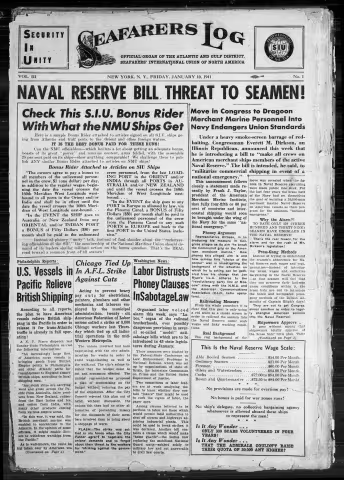
Issue Date
1941-01-10
Volume
3
Issue Number
1
Plaintext
w • ir
rrr
!AKERS JOQ
u
OFFICIAL ORGAN OF THE ATLANTIC AND GULF DISTRICT,
SEAFARERS' INTERNATIONAL UNION OF NORTH AMERICA
VOL. in NEW YORK, N. Y., FRIDAY, JANUARY 10, 1941 440 No. 1
NAVAL RESERVE BILL THREAT TO SEAMEN!
Check This S.f.U. Bonus Rider
With Whot the NMUShips Get
Here is a sample Bonus Rider atlached to articles si{j:ned on all S.I.U. ships go
ing from Atlantic and Onlf ports to the Orient and other foreign waters.
IT IS THE BEST BONUS PAID FOR THESE RUNS!
Call the NMU officialdom—which hollers a lot abont getting an adequate bonus,
boa.sts of its great "power" and remains content, arms folded, with the miserable
25 per cent paid on its ships—show anj'thing comparable? We challenge them to pub
lish ANY .similar Buiius Rider attached to articles on NMU ships!
Bonus Rider Attached to Articles on SW Ships
"The owners agree to pay a bonus to crew personnel, from the last LOAD
all members of the unlicensed person
nel in the crew, $1 (one dollar) per day,
in addition to the regular wages, begin
ning the date the vessel crosses the
IbOlh Meridian West Longitude west
bound to all ports in the Orient and/or
India and shall be in effect until the
date the vessel crosses the 160th Meri
dian of West Longitude eastbound. . .
"In the EVENT the SHIP goes to
Australia or New Zealand from any
ORIENTAL and/or INDIAN PORl^
a BONUS of Fifty Dollars ($50) per
month shall be paid to the unlicensed
Instead of phoney "unity" talk, instead of foul slander about the "racketeer
ing officialdojii of the SlU," the membership of the'National Maritime Union .should de
mand of its leaders similar militant action on the bonus question. That's the REAL
j'oad tOAvard a common front ot*all .seamen!
ING PORT in tlie ORIENT and/or
INDIA through all PORTS in AU
STRALIA and/or NEW ZEALAND
and until the vessel crosses the 160th
Meridian of West Longtitude east
bound. ...
"In the EVENT the sliip goes to any
PORT in Europe as allowed by law, via
the Panama Canal, a BONUS of Fifty
Dollars ($50) per month shall be paid to
the unlicensed personnel of the crew
from the Panama Canal to any such
PORTS in EUROPE and back to the
first PORT in the United States, inclu
sive."
Philadelphia Reports:
U.S. Vessels in
Pacific Relieve
British^ipping
According to all reports,
the plan to have American
vessels relieve British ship
ping in the Pacific in order to
release it for transAtlantic
traffic is already in full oper
ation !
A N, Y. Times dispatch last
Sunday from Philadelphia can ied
the following information:
"An increasingly large fleet
of American cargo vessels is
bringing goods from British
Empire points to Philadelphia
and other Atlantic ports for
transhipment to England aboard
'British ships, according to local
• shipping men.
"An* rican ships are carrying
^ wool and grain across the Pa
cific from Australia, dairy prod
ucts from New Zealand, rubber
from the East Indies and tea.
and cotton from India, with
many other products coming
from various empire areas.
"In this way, it was said, the
British merchant marine was
enabled to concentrate in the
Atlantic. In the'oplnion of some
oiBclals, It might enable Brit
ain to withdraw warships from
the Paclflc."
As Is well-known, the route be:
Ing taken over by American ves-
(Contimicd on Page 4)
Chicago Tied Up
In A.F.L. Strike
Against Cuts
Acting to prevent heavy
pay cuts for electricians,
painters, plumbers and other
mechanics and laborers em
ployed by the municipal
administration, twenty six
American Federation of Labor
unions called a strike of 5,000
Chicago workers last Thurs
day which tied up all indus
trial operations in the mid
Western Metropolis.
Tlie unions involved had been
negotiating with the city admin
istration for weeks in order to
avoid wageslashing as well as
the walkout. The city's solons in
sisted that the budget must be
cut and economies effected. The
unions' representatives proposed
a plan of economizing on the
budget without reducing the pay
of the employees. After the City
Council rejected this plan out of
hand, without discussion, the
unions felt they had no other al
ternative of preventing misery
for the thousands of their mem
bers involved than to bring about
a stoppage of work.
FLASH—The strike was set
tled in six hours when the City
Father agreeJ to negotiate the
unions' demands and to forget
about their threat to fire workers
for "striking against the govern
menti"
Washington News:
Labor Distrusts
Phoney Clauses
InSabotagelaw
Organized labor voiced
alarm this week, says "La
bor," organ of the railroad
brotherhoods, over possibly
dangerous provisions in sever
al socalled "model" anti
sabotage bills which ^re to be
introduced in 43 state legisla
tures during January.
These meaaures were drafted by
the FederalState Conference on
Law Enforcement Problems in
National Defense, which was set
up by organizations of state of
ficials, the Interstate Commission
on Crime and the United States
Department of Justice.
Two committees of labor lead
ers are at work analyzing the
bills to learn whether they con
tain "jokers" that might be used
to curb the rights of labor, the
paper eays.
Among clauses believed to be
perilous to labor are those which
would permit local authorities to
shut off streets and highways ad
joining industrial plants. This
could be used to break strikes; it
was declared. Another bill con
tains a clause which woul J make
"home guards"—the bodies now
replacing the mobilized National
Guard units—subject solely to
military law and not ans'werable
to civil law courts.
Move in Congress to Dragoon
Merchant Marine Personnel into
Navy Endangers Union Standards
Under a heavy smokescreen barrage of red
baitings Congressman Everett M. Dirkson, an
Illinois Republican, announced this week that
be is introducing a bill to "make all crews on
American mercbant ships members of the active
Naval Reserve." The bill is intended, be said, to
"militarize commercial shipping in event of a
national emergency."
This announcement follows
closely a statement made re
cently by Frank J. Taylor,
president of the American
Merchant Marine Institute,
that fully fourfifth or 80 per
cent of coastv/ise and inter
coastal shipping would soon
be brought under the wing of
the Navy for the same "na
tional emergency."
Phoney Argument
Representative Dirksen, in In.
troducing his measure In Con
gress alleges as its aim "to break
the Communist grip on the Amer
ican merchant marine.' How
phoney this alleged aim is and
how serious this "choice of the
peepul" was in investigating the
background of the situation on
which he is acting can be gath
ered from his charge that Joe
Ryan's I.L.A. adheres to the
"revolutionary party line of Mos
cow" along with the N.M.U. and
the. American Communications
Association (C.I.O. radio opera
tors).
, Railroading Measure
From his whole promliire it is
clear that this gent is only using
a red scare as a smoke screen in
order to railroad the seamen into
the Naval Reserve under scab
wages and finky working condi
tions.
Real Background
The real background of the
move was revealed wheii the fig
ures in Naval Reserve recruiting
were made public this week. For
the last four years the brass hats
of the Navy had set themselves
the goal of building a 30,000man
merchant marine Naval Reserve
on American vessels as their pro
gram for the ominous "national
emergency."
Why the Alarm?!
TO DATE ONLY 339 (THREE
HUNDRED AND THIRTYNINE)
SEAMEN HAVE ENROLLED IN
THE NAVAL RESERVE!
That's the real reason,for the
alarm and for the rush of Mr.
Dirksen's legislation!
PressGang Methods
Instead of trying to understand
the seamen's abhorrence for Na
val Reserve scab wages and regi
mentation—instead of introduc
ing union wages and collective
bargaining in the Naval Reserve
—so that seamen will feel that
they can preserve their badwon
union conditions within it, the
brass hats are out to introduce
the hated and antiquated press
gang methods of the Britisli Ad,
miralty of Captain Bligh's days!
They are out to get Congrqs
sional sanction in order to legal
ly shanghai American seamen
Into the Naval Reserve!
Shipowners Approve .
It goes without saying that
shipowners totally approve of
the brass hats' little plan. Their
(Continued on Page 2)
This Is Ihe Naval Reserve Wage Scale:
Able Bodied Seamen .$54.00 Per Month
Ordinary Sefiraen .$21.00 Per Month
Firemen „.$60.00 Per Month
Oilers and AVatertenders $84.00 Per Month
Cooks $72.00 to $84.00 Per Month
Bosun and Quartermaster ..'.$72.50 to $84.00 Per Monht
# # # «
No provisions are made for overtime pay!' >
No bonus is paid for war zones runs!
No ship's delegate, no collective bargaining agency
whatsoever is allowed aboard these ships
to represent the men!
• • •
Is It Any Wonder ..
ONLY 339 SCABS VOLUNT.EERED IN POUR
YEARS!
Is It Any Wonder ...
THAT THE ADMIRALS COULDN*T RAISE
THEIR QUOTA OP 30,000 ANY HIGHER?
'"J
»
A--
I
-vr. i
• ti
'I
m
http://www.pdfcompressor.org/buy.html
T H E S E A F A R E R S ' L O G Friday, January 10, i94i
Published by the
ATLAPmC & GULF DISTRICT
of the
Seafarers' International Union
of North America
Affiliated with the American Tcderation of Labor • <•
HARRY LUNDEBERG, Acting International President
110 Market Street, Room 402, San Francisco, Calif.
ADDRESS ALL CORRESPONDENCE CONCERNING THIS
PUBLICATION TO:
"THE SEAFARERS'LOG"
P. O. Box 522, Church S.t. An.ixex, New York, N. Y.
^ Phone: BOwling Green 93437
iVolaniqry Self'Sf,ratiga,lation
I
More About
Naval Reserve
fiili Tlireatens
A polk:)/ of no strikes- in the metal iiuUistries irorlcinf/ on
notional defense," we read in Tuesday's papers, "was adopted
here (in Waslriiujton) today by the chief officers of thirteen in.
ternational unions in the metal trades affiliated with the Metal
Trades Department of the American Federation of Labor. The, -
' policy is eontinyeyt upon an ayreement by employers to arbU
irate all disputes."
\ow, quite ol'teii, faced \yltli a di.s^troiis situation ahead,
labor unions in tlie past have on oiie or another occasion i)een
forced to settle a strike by agreeing to arbitration. Even in siwdr
cases, arbitration has worked out to the great xletrinient of the
nuions involved. In Maritime, this has been especially evident to
, lab«M ill till coursi' of iiiaiiy tvperieiice.s. Bill, at least, iliere was
aVvays tbe consolation that arhitralion \va.s FOUOEI) upon tlip
niiioiis in point. At the very first opportunity they sought to get
out from under.
But to agree VO.LUXTAKILY to arbitration and to bind the
union not to strike?: AVhat is that hiit labor putting its owm heck
into a strangling noose? That, it appears, is what the Metal
Trades Department is actually doing.'"' Xo one forced them into it,
no govetniiient agency demanded it. Xor are even the employers
affected falling all over themselves to cooperate in this boon to
"national defense."
is what tjie oigan of the industrialists has to say on the
suh.jeet:
, "The metal trades departmeiit of the American Federation
of Labor has set, a desirable precedent. . . The'use of aibiti ation
to settle dispnte.s oyer the interpretation of agreements has been
niajcing rapid headway. . . The most liotable recent agreements
of the kind in industry are those between the United Automobile
WoiivVis (CIO) and the General Motors Corporation and other
automobile companies. Even the (Bridgesrun) International
Longshoremen's and Warehousemen's Union agreed to an arbi
tration clause in a recent agreement reached with employers on
the West Coast.
"In the interests of etneient management, guch arbitration
provisions must except matters that are strictly the concern of
management, such as pioduction schedules and the choice of
supervisory employees. Also, union leaders must make a reason
able use of the right to arbitrate, and not biing up a host of
. controversies in the hope of gainin.g a maximum number of con
ce.ssions through a sufficiently large number of ai'bitration pro
ceedings. In effect, this means that unless there is thorougii
— gcing cooperation between management and labor , . . arbitra
tion provisions alone will not assure peaceful and sound indus
, strial relations. —(Journal of Commerce, Jan 7, 1941)."
AVhat tlioy arc saying l.s that aihitiatiqii will work if labor's
repre.seiitative.s do not intei'fci|e with the employer's speedup
drives and the lenglhening of hours and if union officiaLs do not
.make any attmnpt to get a "mavimmn nninher of conce.s,sion.s" for
labor—Avhicli is their .job! And that is precisely what the em
ployers expectr^nd ii.siia.lly get—from arbitration!, They are foi
"cooperation," hut they keep tlieir powder dry.
If lahoi is to learn from its own past expeiieiice and from the
example s«»t by the employers^ it will not follow in tlie tracks of
the Metal Trailes Department. It will not go in for gridtratipn.
It will keep Its powder dry top. It will regard national defense
from its own interests as the majority of the nation, in the same
way that the oiiiployeis regard it as a ruling minority, it will
(Continuedr from. Page 1)
bottoms aie not to be regimented
into the Naval Resei ve. They are
bought arid paid for by the Ma
ritime Commission a*t a handsome
profit that wipes out all deficits
and takes care of all dividends!
, , Why Not?, They Qain!
Why should the shipowners ob
ject? with 80 per cent of the
ships under the Naval Reserve,
they would have to go plum loo
ney to pay union wages on the
remaining 20 per cent. And they
are as crazy as foxes!
From the point of view of the
shipowners, nothing seems as
Godsent as this move of the
brass hats. They have been buck
ing the seafarers' unions for
years and they might as well
have been bucking a stone wall
Along comes this Naval Reserve
business and if everything goes
well with the little plan—why
the brass hats will just smash
those troublesome unions for
them at one fell blow!
Seamen WilJ Fight
But both the Admii'als and
(heir shipowner pals have an
other think coming if they think
that the seamen" will take this oil
slauglit on their unions lying
down. The seamen have fought
too hard and lost too much Ijlood
in fighting for the wages and con
ditions they have established at
so much sacrifice, just to give
tliem up without a squawk when
some brass hats set their mind
to it.
AR hands in the marine unions
will unitedly oppose' the Dirksen
Bill and work for its defeat! The
seamen will know how, and find'
measures, to preserve and main
tain the union wages and condi
tions wrested ̂ rom the shipown
ers after years of struggle!
Administrator Points to Profits
When Overtime Is Calied.' Unearned"
Anf^vvering dire tl)reat,s from employer,s that unless longer
hours are instituted at onee, inflation and other forms of
catastrophe wonld overtake the country, Col. Philip P>. Piem
ing, adniinistrator of the Wage and Hours Division.,of the
Depaidinent of Imbor cited figures to show that 50 c^etits
l)rofit was made by employers on every (}(] earned by work
ers under tlie fortyhour week in force a^ inesent.
Wjyat Longer WorkVSTeek
The administrator refeired spe
ciflcally to a letter he had re
ceived. from Alfred P. .Slogn, Jr.,
chairman of General Motors. In
it that leading industrialist rec
ominended that "the penalty for
overtime should be canceled dur
ing the emergency to encourage
a longer workweek." He based
his reeommendation on the fol
lowing contentions;
"Spmething for Nothing"
"Now, if we increase the work
week and pay a penalty, the re
sult is to Increase wages about
eight per cent. We get nothing
for this eight per cent because ef
ficiency, manifestly, is not in
creased, therefore, the result is a
step toward inflation. That, in
part, is why I think the penalty
should be waived during the
emergency period. Frankly, I do
not believe in 'something fo
nothing.' I am quite out ef tune
with the general thinking of the
moment on this subject."
"Fantastic Profits"—Earned?
To which Col. Fleming retort
ed: "Mr. Sloan's opinion is im
portant because he is former
president ̂ and present chairman
of America's eighth largest cor
poration. His stewardship o!
the stockholders' interest has
been conducted so brilliantly that
profits have been fantdstioc Gen
eral Motors' last annual state
ment shows a total payroll of
?.386,()()0,0()n and shows proflt,a of
$183,(100,000. For ' every dollar
paid out in uagts and salaries al
most 50 cents was re.ulized in
profits. ^ '
"Which is the more, inflation
ary," Col. Fleming asked, "an
eight per cent increase for the
workers or pi'oflts almost Jis large
as the total payroll?"
Our Own Question
The Colonel did not ask
Sloan a question which we would
have liked to put to him. It is:
"Which is 'something for noth
ing,' the dollar earned by the
worker at the sweat of his brow,
or the 50 cents on this clolim*
cashed in by the shareholders
that occupy the Morris chairs .in
the Union League Club?"
"but Of Tune" . . .
Mr. Sloan and his co"thinkor3"
are hot only "out of tune with the
general thinking of the moment"
but with thinking In general. Ac
cording to them, eight per cept
collected on stock while warming
an easy chair is "efficiency."
Eight per cent overtime collected
on the belt sweating overtime is
"something for nothing!"
... Is Right
Mr. Sloan's "thinking" and lon
ger hours of labor and mass un
employment are ^^ut of tune"
with the needs and interests of
the American working stiff; ^
Gulf Ports Negotiate for New
j^greement with Waterman l,ine
MOBILE
II it.s program of "national ̂ lefcnse" by tenaciously defending
r's own rights and gains."As a majority of the nation it wiR
begin
labor
be far more jiistifiable in its actions—and far more democratic
In spirit—than the greedy group of war profiteers who use the
emergency as a means of cashing in anew.
P.S.—'''b.® fnct tliat the Metal Trades proposal is coupled in
the above quotation with Harry Bridges' Iktesit piece of infamy,
should serve " ' •
true nature!
serve to enlighten maritime workers .siiffieientry as to its'
fllVA? • .1 .
-Preferred Stock Is Patriotic!
Item from the Journal of Commerce, January 7, 1941
"American shipowners are anticipating increased demand
from Great Britain for boats at favorable prices. Advices from
Boston indicate tliat negotiations already have begun between
British interests and the Eastern Steamship Lines for the sale
of at least one, anti probably two, of that ciunpany's ships
Eastern ha.s a total fleet of fifteen boats, Including seven
, freighters, with a combined tonnage o^ slightly over fiO.OOO
tons. Tln^ sale of some of these lioats, it iri'aspwted, wUl per
mit Wqaidatlon of. outsi^inding^ M^ loaas, and primps
the eventual retirement of its small issue of preferred stock."
All aid to Britain, by all means!
th!5 ««t s^man who
makes fhelr divldenas In the cause of ".defehdins deqiocraey!"
J Pfefcrred"£^oc.k ,iis defiriitoly ; patribti^^^^ ' f ? :
• • • ' cv
, They Can't
Bay Union ff^ages
To the Se&nien!
While the Admirals won't
budge an inch to bring wages
the Naval Reserve up to in
union levels, things stand en
tfrely on another level when it
comes to their dealing with the
shipowners. Thus, from an
ifepi. in the New York "Sunday
News" of, january 5, 1941 wi
learn:
"It was reveidecl today
tha^t high prices hiaye
brought the rjavy's ahxijiaiy
purchase program to an end
1'9 ships short of the goal.
"All but $150,000 has been
spent of the $75,000,OOo Con
gress provided for buying
the tankers, the supply and
repair ships vital in' main
taining the battle force at
sea. The Navy expected tri
get 53. large ships with this
money. Only 34 big vessels
were acquired, it was learn
ed. Aij authoritative source
said that the Navy bad
found that the prices for
these boUoiDS had suddenly
(I) akyrocKeted,''
Wb??, jolff
the N.aivai Reserve to work
Wages aaA qqnb't'ons RAR
tApfa *hey are ,aecu»
tomed. to as union merij the
hiW hata back legislation to
therp, ' Vyhen shipovm.
ers: prjces for y««ao.li!j P.^eded
as naYal a^xJJiaries. V«"ddenfy
skyrocket," the brass fiats . v ^
expresssurprise!
January 7, 1941
Editor, Seafarers' Log
Dear Sir and Lrother;
This port was rather handi
capped the past week due to the
fact that the Agent, Olden Banks,
and I were both laid up with in
fluenza for most of the week, but
we are back on the job now.
* * *
There were quite a few ships
in the past "week and Brother
Stevens with fiis usual efficiency
took care of them to the satisfac
tion: of all involved^ The, ELWIfN
C. HAL^ of the Alcoa has been
changed, to the Alcoa Transport
and is at present on another run
to the Islands. The AFOUNDRJA,
tOPA TOPA, and the FLUOR
SPAR were the other' ships in
during the week.
The. pa.8t few days Brqtfier
Biggs was'oyer here from, Nqw
driea'ns for the purpose of nego
tiating an agreement for the
year 1941 with the Waterman
S.^ Co. The, negotiating commit
egn^St;lug of Brgthey StC;
yfnS' apd niyseiG
together with the Agent riiid
Brrither Biggs^ met with the com
pany and qfter a total of eleven
hoAirs we h.ad. the, agreement
Signed, sub^eqt Ifo tfiq ratiflcaUop
of the membership.
AYlthout a doubt, this new
agreement is as good as any
agreqmefit. thgt .hfts, ey.er been ob
tained from a^^Qi^amship Gpnipa,
ny by. any unionl '
Up'to the present time, we havp,.
vofed a total of 134 members' iri
the" ballot for officfalB. I woul^_
like to remind thd mguiherk
that this election should, itriegft q
great deal to' you, Oniy Hay
ing the majority of the members
to vote can we determine how the
membership feels. Voting by a se
cret ballot is guaranteed you by
the democratic procedure of your
Union, and you should take
enough interest In your organiza
tion, to go to the Union haiLarid
cast your ballot.
Brother Gretcher has vo.icsd aff
appeal to the membership as a
vifhole to start writing in articles
to the "Log" and I hope that you
members ahswer his appeal by a
deluge of correspondence, it
makes no difference what you
write in, but write something.
Tqli the other members aiboi^
what is being done In your sfiip|8
meetings, abdgt any gains in liv
ing conditions or working condl
tipns. Let us hear about what
ypju think of the different agree
ments or the, different a,ffgirs of
the union. So far there, hav/s been
only a few of the officials and txo
rank and filers wh,q have b,e)5.n
sending, in communications fpr
the "Log," ' ^
: One cbncession we, obtained
from the company in the new
• agreement was to' the efffi^t
;deck engineers would • he' cairiied '
on all the ships of the comrisny,
and it is backfiring b^arise'T^e .
haVe not been able' to 'get any ' •
deck engineers. We had tp 'sdir'to
Topa Topa shorthanded; for Tacit '''
of 'a deck engineer fo ' take' ftie '
ship out. In fact we are still vefy ''
ishorthanded for all raffngs iff T
this port and would ffprireBats
some new faces down this ririyrl
I'm a little late but aiiyhpiy T
would like to take fhis opportu
nity of Wishing each and' every
one of, you a most prosperous
New Year. That's all" for thi1( •
yfpek;, »? TW, f»ekt time, ibng.
Fraternally ycurg,
^ A, filiifthswt,
'^' Mobile Engine Patrolman
http://www.pdfcompressor.org/buy.html
ss
! y .. '.i I, .J'ryaWWrrr'iT
iFriday, January 10, 1941 „ ' THE SEAFARERS' LOG
W,hat* 8 Doing —
The 'Ports
TEXAS CITY
y December 26, 1940
fedlfor, Seafarers Log
Dear Sir and Brother:
Christmas is over. Maybe now
ve will be able to get men for the
ships. I don't mind having to
hunt men up, but when they get
a their holes and then cover the
lole up, it makes it kinda tough.
W • >1'
Sailed the Glare from Beau
mont 2 A.B.'s short last week.
The Bayou had to lay over for
20 hours while I found men to fill
her up. Established some sort of
a new record on that ship: A man
paid off the Raphael Simms in
Houston had his dough in one
hand and his bag in the other.
I shanghaied him so fast that he
didn't even, get a cKgnce to\drink
one beer before I put him on the
Bayou and watched her headed
out for Galveston.
Now I know* there was no
drinking going on over the holi
days, but I would like to know
who won the footrace on the
tracks amongst the crew of the
floating freight yard. Also would
I ike to know where that green
\'lephant got that battleship it
as pulling around town yester
.?lay.
* * *
The S.S. Francis Salmon had a
lose call, the inspectors looked
er over and she has been in dry
^ock 2 weeks. Loading again this
'X.IVI. So all, ships stay clear,
hat wheezing you will be hear
ing will be the Serang trying to
lean up after, the shoreslde
rkers.
* * *
This is the first chance I've had
his week to drop you a liuCi and
'm signing off now as the agony
ipx just rang. So, Dalveston, fiere
come.
« « «
The' score on the men burnt
Jn the oil fire novw stands at, five
Ijead, and still some of them in
critical condition.
« « e s
Yours till I have a man for
• ach job, not as now three jobs
nd no men.
Armstrong.
down tiie line getting the best
possible for the members, and the
NMU is still leading the way
back to the shipowners' fold. As
long as the men that sail the
ships will put up with this sort of
thing,'file sellouts will continue.
On the coast the Commies jocked
the steamschooners, so that if the
SUP and the MM&P get a raise,
they will also come in for it with
out having to go to bat. Here on
the East Coast and the Gulf we
in the SlU have to make the
wages and also it seems as though
we will have to devise ways and
means for oui own protection to
get them for the NMU members.
Of course, there is one way
that will eliminate all~ the
squawks and fusses that are now
on. This is for the members that
are going to sea to make a living
to come into the SIU. Leave the
great misleaders of labor along
with Jog's disciples on Hoffman's
Island or some such place, where
the plowjockeys and spud pickers
might be in the mood to listen to
their spoutings.
Another way would be for all
hands to take the West Coast
(Bridges) peace plan, sign it for
two years, sit back and watch all
you fouglit for go down the skup
pers. By doing this you will gua
rantee the shipowneis another
chance to treble profits by cutting
wages, chow and increasing work
ing houis.
Still another way i? for all
haiuLs to make sure we hold what
we have. Keep the machinery of
our orjganizatioii full ahead, and.
steady as she goes.
Armstrong.
SAVANNAH
December 28, 1940
Editor, Seafarers' Log
Dear Sir and Brother: '
Activities in the port of Savan
nah have been fairly good this
last week. We are still having a
hard time finding A.B.S to replace
the men who are getting off the
ships for the holidays. Have also
shipped a number of men for en
gine room jobs.
at. * *
Had the S.S. Caroline in last
week and had a number of A.B.
and Engine room replacements on
her. Also had some replacements
on the S.S. West Kiska. The Sa
vannah Line ships were the only
ones in port this week and they
have been calling the hall regu
larly for men. Everytime one of
these ships are in port, we have
one or two replacements on it.
Had fourteen (14) replacements
on the S.S. City of Chattanooga
including all three departments.
* * *
Most of the calls we have are
for A.B.'s, and I have a hard time
trying to fill the vacancies but I
always manage to find a man be
fore sailing time, '
* * *
' Shipping should pick up even
more next week as there will be
other ships in port here besides
the Savannah Line ships.
* * H!
Hoping everyone enjoyed a
good Christmas and. wishing you
all a Happy New Year.
Charles Waid, Agent,
Savannah Branch.
" . December 30, 1940
Iditor, Seafarers' Log
lear Sir and Brother:
Things have been really boom
ng down here for the last week,
)ut now It seems as though there
t going to be tiine to draw our
breath till the next rush. Outside
if stragglers there is nothing due
II the ftrst, and then the rush
ill start over again. Shipped so
lany nien that I don't know who
ent where or v(by.
In Houston last week the S.S.
...phael Simmes w^ laying aft
if the Scottflhurgh. The gang of
Ihe ^pttsburgh came back to
[heck the rider the gang had.
Ihe NMtJ ship was loading. HI
est gas for the prient under a,
{3 pe^ cpnt bonus and the gang
fU) sQuawklhg about it. The Sim
was loading salt under the
jgular SiU bonus clause, and the
Jen of the Sootteburgh couldn't
te the :why and wherefore. Next
lay the local, papers came, opt
Ith th^e, beef, but they stated
jat /was o6'wuawk about
}|u>ney^ How long will it last be
ire the men on the shipd Bet a
iyfull of this sort of stuff?
'he SIU and the SUP are going
tabor
For
Wins Ship's Beef
Conditions
JACKSONVILLE
Deperober 27, 1940
Editor, Seafarers' Log
Dear Sir and Brother:
The S.S. Plow City arrived
Sunday, the 22nd, at8:00 A.M.
and at about 8:15 A.M. contacted
her. The crew informed me that
a meeting was being called at
9.30 A.M. to straighten out a'few
difficulties which have beeli ex
isting on that ship for some time.
After the meeting was over, the
crew presented a list of neces
sary requirements to place this
ship in a sanitary and liveable
coi]iditlon,
On refu.sal of the Master to con
sider any of these requests, .the
crew then decided to give the
Master 24 hours notice that they
were quitting,
The Master then went on the
dock an(^. got hold of the locuj
Agent, and called me o:n the dock,
and logother witli myself and the
local agent pr(^eeded to get a Mr.
Allwine, an ofhciai of the Range
Line In Phila. After tie Master
and I gut aboard the ship, the
Master, theq told the crow what
had transpired over the phoh.e.
Mr, Allwine declare^ that he
had never heard of, thesq requests
before arid said be didn't car®
whether this rustbuckel atgyed
alongside the dWk or not. • The
Master, then asked eabb^ member
whether they wan.ted tft. pay off
or not. The crew told him, they
were giving hloji 2i ioura notice
that they ilvere p^ihg off' and
that they couldn't live under
theseulthy boiiailloua aboard this
ship.
As soon as the longshoremen
heard of^Jthis, they came out of
the holds, hitting the docks at
their own request, no one intimi
dating them. What a splendid
Show of solidarity they showed
when their brothers, the seamen,
were in trouble. The longshore
men then declared the ship hot,
and proceeded to throw a picket
line of their own. And this
picketline was maintained by
the longshoremen until the re
quests wbre granted.
The crew paid off the ship at
1 P.M. on Monday and proceeded
up to the hall in an orderly man
ner.
Along about 6.50 P.M. on Mon
day, the Captain'got a hold of
me at the" hall, and t,old m« a/|
the requests vvould be granted,
and, would like to have the same
crew back. He called m.e up
again at 7.2$ P.M.,and asked me
what, the membership thought of
this, a,ncl I tojd him he could have
the same crew back, if he wishe.d.
'Tlie majority of the same crew,
went back, but the ship did not
sail until the following day at
2:30 IP.M., not thrpuglii the fault
of the union, but on account qf it
raining so hard, the longshore"
men could not unload the, ship.
At this time of writing, I,
yanked a permit,'as some of them
think they are running the union,
ahd can do as they please. Thls.^
man's name Is 6. C. Barndt,
P,38Q4, and this , mqp ' was' ex
peired out of the N.iyi.U. tor 39,
year's for stealing from his ship
mates. i« hot to be shipped
oiit any 8.I.U. hplfs. unrfer 'any
cl'rcurnstahoes.
Steady as she goes.
Fred Lauritano.
SEAFARERS' INTERNATIONAL UNION
OF NORTH. AMERICA ;
Atlantic & Gulj District
HEADQUARTERS
Room 918, Washington Loan & Trust Co. Building,
9th and F Street, N.W., Wa.shington, D. C.
P. O. Box 6180 Pho^e: District 5963
DIRECTORY OF BRANCHES
BFANCH ADDRESS PHONE
NEW YORK 2 Stone St BOwling Green 93437
BOSTON 330 Atlantic Ave. ...LIBerty 4057
PROVIDENCE .. 465 South Main St. ..Manning 3572
BALTIMORE ... 14 North Gay St. ... Calvert 4539
PHILADELPHIA ,6 North 6th St Lombard 7651
NORFOLK 60 Commercial PI. . .Norfolk 41083
NEW ORLEANS 309 Chartres St MAgnolia 3962
SAVANNAH 218 East Bay St Savannah 31728
JACKSONVILLE .136 East Bay Rt Juck.sonville 59724
TAMPA 206 So. Franklin St. .Tampa M1323
MOBILE 55 So. Conception St. Dexter 1449
TEXAS CITY ... 195 4th St.. N Texas City 722
MIAMI 1348 N.E. First Ave.. Miami 22950
SAN .JUAN 8 Covadenga St San Juan 1885
New Orleans Lists Men Sent
Checks for P& O Back Pay
NEW ORLEANS
Januajy 3, 1941.
Editor, Seafaierfs' Log
Dear Sir and Brother:
During the latter part of No
vember and the first part of De
cember theie appeared in the
Seafarers' Log a list of names
which we thought, wereentitled
to divide themoney awarded the
men in tlie P&O case. We also
stated in this article that we
would like to. hear from all men
listed in the Log as well as any
others who felt that tliey were
entitled to a share of this money.
Since that date we have received
letters from practically every man
on the list and in addition num
erous other members who felt
that they weie entitled th a share
of this money.
Florida Branches Act
Due to the fact that a large
majority of all the men involved
were in and around Miami and
Tampa, Florida, or are on the
P&O boats at the present time
we sent all correspondence from
various members as well as all
the information the NLRB and
the Union had received in this
case,^ to the ports of Tampa and
Miami.
We instructed the agents there
to call committees together and
make a final decision of who they
felt was entitled to share in the
division of this money.
These two branches with over
eighty percent of, the men in
volved in tlie P&O case have
dations for tlie division of the
$3,500; tlierefore icc are mailing
out eheck.s of equal amount.• i to
eucU member listeil below incases
where we Itave tlielr addresses.
However, in case your name is
listed below and you fail to re
ceive your check within a reason
able length of time, please notify
tlie Seafarers' International Union
at 309 Chartres Street, New Or
leans, La., and your check will be
mailed out promptly to the ad
dress given us.
We realize tliat it was impo.ssi
ble for these men to distribute
this money to the satisfaction of
all, but we have spent three
months arriving at this decision
and feel certain that it will be
satisfactory to at least 95 percent
of the men who were deprived of
work by the P&O Steamship
Company after the strike termin
ated. "
Changes in List
You will notice by this,new list
that a few of the men who were
listed in the original list pub
lished in the November and De
cember issues of the Log have
been left off the new list entire
ly and numerous other men have
been added who were left out at
the beginning. This can be ex
plained ;hy the membership at
either the Tampa or Miami
branches, and reviewing the com
mittees' reports and recommenda
tions in every case we feel that
they were entirely justified in
either dropping a man from the \
list or placing new names on thq
final list. sent in the following recommen
List of P & 0 Men Entitled to Checks
Childers, J. L.
Leonard, F.
Dampier, E.
Gordon, H.
Tattle, J. L. >
Smith, B.
Boyd, E.
Landy, A.
Barbarossa, L. C.
Bado, C.
Delaney, H. W.
De'Vane, G.
King, J.
Garcia, A.
Stevens, C. F.
Tregler, J.
White, R.
Waterman, A.
Yelvington, E.
Tritt, L.
Honi^an, L.
Hqllner, "C.
Joy, j
Flpneran, J. J.
Dowell, G Ri
Rivodes, S. S.
Shaw, E.
Holcomb, R.
Abreu, R. C.
Sawyer, C.
Stone, H.
Campion, H, J.
Cabaera, D.
<Carri C.
Ardoza, ̂ M.
Timms, O.
Pedro, J.
Beyo, N.
Saffos, P.
McCranie,»J.
Quinpnoes, F.
Gregory, j.
Coleman, W. P.
Capote, A.
Schuler, J. P.
Reddish, O,
Peglpw, L J.
DeVan®, N.
Barber, J. •
Roberts. J.
Tesc.hke, W.
Pauley, R. C.
Hainmond, P.
Cpipmb, S.
Shaw, L. Sheppard, R. C,
Submitted by —
M. E. Biggs,
Gulf District Representative
Hale, G.
Jacobs, J.
Valesquez, A.
Sheppard, A. F.
Delgado, F.
Sheppard, E. (Rull)
Smoke, W.
Segrest, E. A.
Bradley, H.
Abrams, O.
Hyde, A.
Ellii N."
Masters, Al, Sr.
Trainer, M.
Garcia, M.
LePevre, C. D.
M^llloughby. W. B,
Masters, Al, Jt. •
CosteJlo, M.
Burns, G.
Morrison, B.
ICnisdit, Red
qiark. H. B
DeShong, R. E.
Borrejjson, O,
Rudnick, N. Ri
Smith. W;
Stewart, J.
iiiJi
'Mi l l
.icial
..J
• Si • I|
Vr:"
• lit • U
• ff
. ,'t
3
'i;
f 41"
• 11
J
J, S. White,
Tampa Agent
Gordon Hale,
Miami Agent S.!;! "
http://www.pdfcompressor.org/buy.html
THE S E A F A R E R S ' L O G Friday^ January 10, 19^
r" "
V I,
Fli'' '" ' .• ' ,
iir U
ft .;.
SecretaryTreasurer's Report
January 3rd, 1341.
Brothers:
Opening the Books
For the past few weeks I have been studying the feasibility of
suggesting to the membership that they go on record to open the
books for new members. I have noticed in various reports from the
Branches that there is a shortage of men and quite a number of
permits are being issued each week by most of the Brahches, and
because there is the necessity for us to ship outsiders^ by issuing
them permits, then that is all the more reason we should be mighty
careful whom we take in. That is why I believe we should not lower
the requirements that all permit men must first put in six months'
sea service on their permits before they are eligible for member
ship. I believe that by retaining the six months' sea service re
quirement we will be protecting the organization, and when a per
mit man has sailed for six months with regular SlU members It can
then really be ascertained whether or not the permit man will make
a good member. I am quite sure that any new member admitted
into the organization will more or less really appreciate the fact that
he has become a member after having put in six months sea service
on a permit before being allowed to join. He certainly will value
his membership a whole lot more.
Opening the books for new members will not in any way remedy
the situation of there being a shortage of men to sail our ships for
it stands to reason that if the men are not available, and all of our
book members and perm.it men are. sailing, the mere issuance of
membership books to permit men obviously won't solve the shortage
of seamen problem, nor will the lowering of the sea service require
ment on permits from six months to three months solve the problem.
The seamen are not to be had and that's all there is to it.
However, six months have now elapsed since the installation
of the new permit system and since the first permit was Issued;
and due to the fact that some of the permits were backdated for
the reason that a certain few men we^eshipped on trip cards prior
to the issuance of the new permit cards, therefore, there are now
some permit men who have put in their required six months sea
service on their permits and I believe the membership should show
faith in these men by opening the books and admitting all permit
men who have put in six months sea servioe on their permits. The
viewpoint as taken from here in Washington leads me to believe
and recommend the following to the membership:
"Tliat. the membership go on record to open the books and
admit to membership all permit men who have performed the
required six months sea service on their permits, and that the
books remain open until such time as the membership decides
that enough members have been admitted and they see fit to
close the books again. And that all such permit men must first
file application for membership on one of the attached official
"Membership Application" forms, and then both the applicant
and his application must be Investigated by an investigating
• committee elected from the floor, who in turn will either accept
or reject the applicant by filling in the reverse side of the "Mem
ber.ship Application" form known as the investigating commit
' tee's report. Before the applicant is admitted," a membership
meeting, either regular or, special, must concur in the investigat
ing committee's findings and recommendations. "Whem the appli
cant is accepted by the investigating committee and the commit
tee's report pn the applicant is concurred in by.,the membership
assembled in meeting, then, and only then, is the local Agent
• authorized to sign the applicant up for membership upon collec
; tion of the necessary initiation fee, dues and assessments. All
applicants for membership accepted or rejected by the investigat
ing committee shall be sent to Headquarters for filing and ref
. erence work along with the usual forms now used.
, In line with the aljove recommendation that the membership
' go on record to open the books, I further recommend that the
books be orficially opened on January 20. and not sooner, in order
that your offleials will have time to set up the necessary ma
chinery for admitting new members, in a proper, efficient, and
accountable manner."
In checking over the permits already issued I can assure the
membership that by opening the books for new members and leav
Idg them open for an indefinite period, the organization will be only
taking in approximately about 100 members a month, and the way
the membership situation now stands, with many of our members
either! retired or simply dropped out, the organization can stand
quite a few new members providing they are not all taken in at
once. Not all of the present holders of permits will be eligible for
membership at once IJ, the six months sea service requirement Is
retained; they will be eligible for membershipon a gradual basis
with about ICQ members being admitted each month. .
I Would like to have the membership thoroughly discuss this
recommendation of mine and I sincerely hope that they wi|l see
flt to concur in it for I have carefully weighed the whole situation
aiid I firmly believe that the'policy recommended abdve is tbe best
for the organization.
Writing for the LOG
• In looking over the latest is.sue of the "LOG," I notice tliat
• both, the membership and many officials are neglecting to write
and send in articles and opinions for publication in our official
organ. Like everything else in the Union, the "LOG" should be
OP and BY, as well as FOR the seamen. Not only local officials
but rankandfila members .should write in regularly. If there is
Anything in the paper they disagree with, they ought to write in
and it sliall' be printed. If there is anything left unsaid that
should be said in its columns, they should {mint out in letters to
the "LOG" exactly what it is. The "LOG" should be at its best«
Shipbuilding
Program to Cost
350 Miiiion
.1i.")o0,000,000 will be siiont
by the government on Pre.si
dent Koosevelt's .shipbuilding
program, Washington,report
ed thi.s' week, it is to be nsed
in the main for 200 prefabri
cated A^essols. An additional
$36,000,000 has been allocated
for the creation of new faeili
ti|;s and the rehabilitation y)f
ways to he n.sed in the vnsf
.shipconstruction venture.
Tlie ships being built are de
signed to replace • tonnage being
lost In the course of the war.
'With 60 many ships going to
the bottom, anfi the probability
that at the end of the war, soon
er or latei', there will be a world
shortage of tonnage. President
Roosevelt told his press confer
ence, we have taken the first
steps towai'ds a pi'ogi'ain of
building about 200 merchant
ships at a cost somewhere be
tween 300 and 850 million dollars,
in a number of new plants.
Supreme Court Decides Empioyei
Must Sign Contracts with Union
WASfflNCfTON, D. C.—The Supreme Court uphel'd tj
.Nfitiortkl Labor Relatron .Board'.s decision in the H. J, jTIeil
Company ca.se; where the company wa.s required to sign!
written agreement with a union after both sides had arrh|
at an oral understanding. '
Di.scussing the company's re
fusal to sign a written agree
ment, the court said among other
things:
"It is conceded that ^although
petitioner had reached an agree
ment with the union concerning
wages, hours and working condi
tions of the employes, it has
nevertheless refused to sign a
contract embodying the terms of
the agreement. The board sup
ports Its order directing petition
er, on request of the union, to
sign a written contract embody
ing the terms agreed upon on Ihe
ground, among others, that a re
fusal to sign is a refusal to bar
(National Labor Relations) acjl
Pointing out that a written c|
tract is, in fact, the object of
collective bargaining in order
establish union recognition, l|
court ruled;
"Petitioner's iefusal to sign wi
a refusal to bargain collective
and an unfair labor practice tjl
fined by Sec. 8 (5) of the Natl(|
al Labor Relations Act.
The decision Is lujiled in labj
circles as marking an importaf
step in the development of colle
tive bargaining procedure undt|
the NLRB. It sets a preceder
which will solve many simiW
cases which unions now hail
gain within the meaning of the I pending before the Board.
Deaths Due to Negligence
The Crimp Is
At It Again
S.S. William J. Salmon,
Bucksport, Maine,
January 3, 1941.
Editor Seafarers' Log,
Dear Sir and Brother:;
The crew of this ship must
again call to the attention of
the S.I.U. body a repeated at
tempt by a clothing dealer at
Portland to ship some replace
ments aboard this ship after a
resolution had been made at
Boston, on first hearing of this
practice, to put a stop to it.
This man is known as Myer
Jacobson, an obsequious indi*
vidhal wearing glasses, not to
be confused with other dealers
there.
We suggest that you inform
the members ofthe S.I.U. to
prevent , his coming aboard
ships at Portland in the future.
His actual moves on this issue
consisted in coming on the
Salmon on our docking and in
forming the officers that he
would supply the needed re
placements, testified to by the
Chief Engineer of this ship.
Fraternally,
S. J. Flaherty, iNo. 5211
Deck Delegate.
William L. Wallace, No. 3823
Engine Delegate.
(From West Coast Sailor)
The dentil of six seamen from carbon dioxide poisoning
ported by,the Maritime Gommission in Washington due to inadc
iliiale ventliatlon is a piece of criminal negligence that explaii
why union crews have "beefs" with, the shipping companies.
Time and again efforts are made to place the unions In a haj
light because of their endeavor to correct abuses aboard ships,
is made to appear tliat the sailors are unreasonable and their d^
mands trivial. One does not have to go fai* to hear good be<
ridiculed as a stupid fight for a clean pair of sheets.
Sometimes it can even be conceded that overzealousness hil
not been tempered by tlie best of judgment. But wiien s|
men pay witli their live.s needlessly as tlie present case shov
then one cannfit only understand "beef" eagerness on the part
the men but sympathize with it all the way.
If the shipowners want to ieduce "beefs" to a minimum at
put an end to endless loss of time and good energy, they shoulj
first of all stop chiseling on the agreements and live up to ther
And if tliey gave tlie attention that should be madi; compulsoil
toward protecting the lives of the seamen, it would he a slio/
time only before the causes for "beefs" would vanish.
If the six lives lost unnecessarily can't wake up the sliij
owners and make them much more mindful of their responsibilit|
then it is about thne tliat they he told in no uncertain terms th;
tlie Sailors' Union" will see to it that the seamen are given tl|
protection they have coming to them.
Let us hope that the six dead sflamcn have not died in vai,
Texas City Mall List
Editor, Seafarers' Log, . December 30, 1940:
Dear Sir and Brother:
If possible I wish you would print this enclosed mail list.
These are for men that I've lost track of. If they will drop me
a card, I will forward same to their preseiit address.
Walter G. Allen John Cox Jack Kingham
Everett Adams Chas. P. Conquinel A. R. Robinson
Harry Billington Carl C. Couvillion Alton O'Berry^
.Toe C. Broussard Norman S, Curry
Let's get this mail squared up, to start with a clean slate.
Armstrong.
source of useful maritime and labor information, an exchange of
fqrinion on vital matters affecting the men who sail the ships, a
clearing house for suggestions on how best to iqake common head
way; in short, the VOICE of the seamen.
; , Fraternally,
SYDNEY GRETCHEE, SeaTre^.
U.S. Vessels in Pacific
Relieve British Shipping
(Continued from Page 1)
sels from the British is strewq
with raiders and mines. Yet, tho
shipowners expect American sea
men to make these runs under
cohditions and at pay which they
are getting on normal. runS In
home waters.
trhion Safeguards
It is clear that the seamen on
these shipl are faced with two
majdl problems to meet the dan
gers on this route: One is to get
an adequate bonus commensurate
with the risk. The other is to get
aufllclent armed training for pro
tection against the raiders, who
"will not stop because of the
change in flags to attempt accomr
pllshmmit of their aim to block
shipments to Britain. In both
cases, strong union supervision
alone can guarantee the safe
guarding of the seafarers' inter
ests.,
. '.i.y,1. •
Honor Roll
• S.S. SCHODACK $15.00
S.S. SEATRAIN NEW ORLEANS .
Deck Dept. ... 13.20
• Engine Dept. . .. ... y 8.00
Stewards Dept. 5.00
S.S. DELSUD ........ . ....,...... 16:75
^.S. CASSIMIR ..V.100
S.S. DELOELEANS
Deck D6pt. 5.05
Stewards Dept. .' • 7.00
S.S. CATAHULA' ; .515
J. Bryant 1.00
F. Peinart 1.00
A. Gatewodd ............................. ' 1.00
A. W, Lee ;... A 1.60
Robert White ............ ............. 1.00
A. K. Anderson ........... ........... 1.00
S. Day .. ... i . V.................. . . ..;.; 1.00
L. Funk ...... . . .,... 1.00
M. Hairelson . . *,...., ....;.50
Total • • *.» § t $78.65
• it :\
'
http://www.pdfcompressor.org/buy.html
rrr
!AKERS JOQ
u
OFFICIAL ORGAN OF THE ATLANTIC AND GULF DISTRICT,
SEAFARERS' INTERNATIONAL UNION OF NORTH AMERICA
VOL. in NEW YORK, N. Y., FRIDAY, JANUARY 10, 1941 440 No. 1
NAVAL RESERVE BILL THREAT TO SEAMEN!
Check This S.f.U. Bonus Rider
With Whot the NMUShips Get
Here is a sample Bonus Rider atlached to articles si{j:ned on all S.I.U. ships go
ing from Atlantic and Onlf ports to the Orient and other foreign waters.
IT IS THE BEST BONUS PAID FOR THESE RUNS!
Call the NMU officialdom—which hollers a lot abont getting an adequate bonus,
boa.sts of its great "power" and remains content, arms folded, with the miserable
25 per cent paid on its ships—show anj'thing comparable? We challenge them to pub
lish ANY .similar Buiius Rider attached to articles on NMU ships!
Bonus Rider Attached to Articles on SW Ships
"The owners agree to pay a bonus to crew personnel, from the last LOAD
all members of the unlicensed person
nel in the crew, $1 (one dollar) per day,
in addition to the regular wages, begin
ning the date the vessel crosses the
IbOlh Meridian West Longitude west
bound to all ports in the Orient and/or
India and shall be in effect until the
date the vessel crosses the 160th Meri
dian of West Longitude eastbound. . .
"In the EVENT the SHIP goes to
Australia or New Zealand from any
ORIENTAL and/or INDIAN PORl^
a BONUS of Fifty Dollars ($50) per
month shall be paid to the unlicensed
Instead of phoney "unity" talk, instead of foul slander about the "racketeer
ing officialdojii of the SlU," the membership of the'National Maritime Union .should de
mand of its leaders similar militant action on the bonus question. That's the REAL
j'oad tOAvard a common front ot*all .seamen!
ING PORT in tlie ORIENT and/or
INDIA through all PORTS in AU
STRALIA and/or NEW ZEALAND
and until the vessel crosses the 160th
Meridian of West Longtitude east
bound. ...
"In the EVENT the sliip goes to any
PORT in Europe as allowed by law, via
the Panama Canal, a BONUS of Fifty
Dollars ($50) per month shall be paid to
the unlicensed personnel of the crew
from the Panama Canal to any such
PORTS in EUROPE and back to the
first PORT in the United States, inclu
sive."
Philadelphia Reports:
U.S. Vessels in
Pacific Relieve
British^ipping
According to all reports,
the plan to have American
vessels relieve British ship
ping in the Pacific in order to
release it for transAtlantic
traffic is already in full oper
ation !
A N, Y. Times dispatch last
Sunday from Philadelphia can ied
the following information:
"An increasingly large fleet
of American cargo vessels is
bringing goods from British
Empire points to Philadelphia
and other Atlantic ports for
transhipment to England aboard
'British ships, according to local
• shipping men.
"An* rican ships are carrying
^ wool and grain across the Pa
cific from Australia, dairy prod
ucts from New Zealand, rubber
from the East Indies and tea.
and cotton from India, with
many other products coming
from various empire areas.
"In this way, it was said, the
British merchant marine was
enabled to concentrate in the
Atlantic. In the'oplnion of some
oiBclals, It might enable Brit
ain to withdraw warships from
the Paclflc."
As Is well-known, the route be:
Ing taken over by American ves-
(Contimicd on Page 4)
Chicago Tied Up
In A.F.L. Strike
Against Cuts
Acting to prevent heavy
pay cuts for electricians,
painters, plumbers and other
mechanics and laborers em
ployed by the municipal
administration, twenty six
American Federation of Labor
unions called a strike of 5,000
Chicago workers last Thurs
day which tied up all indus
trial operations in the mid
Western Metropolis.
Tlie unions involved had been
negotiating with the city admin
istration for weeks in order to
avoid wageslashing as well as
the walkout. The city's solons in
sisted that the budget must be
cut and economies effected. The
unions' representatives proposed
a plan of economizing on the
budget without reducing the pay
of the employees. After the City
Council rejected this plan out of
hand, without discussion, the
unions felt they had no other al
ternative of preventing misery
for the thousands of their mem
bers involved than to bring about
a stoppage of work.
FLASH—The strike was set
tled in six hours when the City
Father agreeJ to negotiate the
unions' demands and to forget
about their threat to fire workers
for "striking against the govern
menti"
Washington News:
Labor Distrusts
Phoney Clauses
InSabotagelaw
Organized labor voiced
alarm this week, says "La
bor," organ of the railroad
brotherhoods, over possibly
dangerous provisions in sever
al socalled "model" anti
sabotage bills which ^re to be
introduced in 43 state legisla
tures during January.
These meaaures were drafted by
the FederalState Conference on
Law Enforcement Problems in
National Defense, which was set
up by organizations of state of
ficials, the Interstate Commission
on Crime and the United States
Department of Justice.
Two committees of labor lead
ers are at work analyzing the
bills to learn whether they con
tain "jokers" that might be used
to curb the rights of labor, the
paper eays.
Among clauses believed to be
perilous to labor are those which
would permit local authorities to
shut off streets and highways ad
joining industrial plants. This
could be used to break strikes; it
was declared. Another bill con
tains a clause which woul J make
"home guards"—the bodies now
replacing the mobilized National
Guard units—subject solely to
military law and not ans'werable
to civil law courts.
Move in Congress to Dragoon
Merchant Marine Personnel into
Navy Endangers Union Standards
Under a heavy smokescreen barrage of red
baitings Congressman Everett M. Dirkson, an
Illinois Republican, announced this week that
be is introducing a bill to "make all crews on
American mercbant ships members of the active
Naval Reserve." The bill is intended, be said, to
"militarize commercial shipping in event of a
national emergency."
This announcement follows
closely a statement made re
cently by Frank J. Taylor,
president of the American
Merchant Marine Institute,
that fully fourfifth or 80 per
cent of coastv/ise and inter
coastal shipping would soon
be brought under the wing of
the Navy for the same "na
tional emergency."
Phoney Argument
Representative Dirksen, in In.
troducing his measure In Con
gress alleges as its aim "to break
the Communist grip on the Amer
ican merchant marine.' How
phoney this alleged aim is and
how serious this "choice of the
peepul" was in investigating the
background of the situation on
which he is acting can be gath
ered from his charge that Joe
Ryan's I.L.A. adheres to the
"revolutionary party line of Mos
cow" along with the N.M.U. and
the. American Communications
Association (C.I.O. radio opera
tors).
, Railroading Measure
From his whole promliire it is
clear that this gent is only using
a red scare as a smoke screen in
order to railroad the seamen into
the Naval Reserve under scab
wages and finky working condi
tions.
Real Background
The real background of the
move was revealed wheii the fig
ures in Naval Reserve recruiting
were made public this week. For
the last four years the brass hats
of the Navy had set themselves
the goal of building a 30,000man
merchant marine Naval Reserve
on American vessels as their pro
gram for the ominous "national
emergency."
Why the Alarm?!
TO DATE ONLY 339 (THREE
HUNDRED AND THIRTYNINE)
SEAMEN HAVE ENROLLED IN
THE NAVAL RESERVE!
That's the real reason,for the
alarm and for the rush of Mr.
Dirksen's legislation!
PressGang Methods
Instead of trying to understand
the seamen's abhorrence for Na
val Reserve scab wages and regi
mentation—instead of introduc
ing union wages and collective
bargaining in the Naval Reserve
—so that seamen will feel that
they can preserve their badwon
union conditions within it, the
brass hats are out to introduce
the hated and antiquated press
gang methods of the Britisli Ad,
miralty of Captain Bligh's days!
They are out to get Congrqs
sional sanction in order to legal
ly shanghai American seamen
Into the Naval Reserve!
Shipowners Approve .
It goes without saying that
shipowners totally approve of
the brass hats' little plan. Their
(Continued on Page 2)
This Is Ihe Naval Reserve Wage Scale:
Able Bodied Seamen .$54.00 Per Month
Ordinary Sefiraen .$21.00 Per Month
Firemen „.$60.00 Per Month
Oilers and AVatertenders $84.00 Per Month
Cooks $72.00 to $84.00 Per Month
Bosun and Quartermaster ..'.$72.50 to $84.00 Per Monht
# # # «
No provisions are made for overtime pay!' >
No bonus is paid for war zones runs!
No ship's delegate, no collective bargaining agency
whatsoever is allowed aboard these ships
to represent the men!
• • •
Is It Any Wonder ..
ONLY 339 SCABS VOLUNT.EERED IN POUR
YEARS!
Is It Any Wonder ...
THAT THE ADMIRALS COULDN*T RAISE
THEIR QUOTA OP 30,000 ANY HIGHER?
'"J
»
A--
I
-vr. i
• ti
'I
m
http://www.pdfcompressor.org/buy.html
T H E S E A F A R E R S ' L O G Friday, January 10, i94i
Published by the
ATLAPmC & GULF DISTRICT
of the
Seafarers' International Union
of North America
Affiliated with the American Tcderation of Labor • <•
HARRY LUNDEBERG, Acting International President
110 Market Street, Room 402, San Francisco, Calif.
ADDRESS ALL CORRESPONDENCE CONCERNING THIS
PUBLICATION TO:
"THE SEAFARERS'LOG"
P. O. Box 522, Church S.t. An.ixex, New York, N. Y.
^ Phone: BOwling Green 93437
iVolaniqry Self'Sf,ratiga,lation
I
More About
Naval Reserve
fiili Tlireatens
A polk:)/ of no strikes- in the metal iiuUistries irorlcinf/ on
notional defense," we read in Tuesday's papers, "was adopted
here (in Waslriiujton) today by the chief officers of thirteen in.
ternational unions in the metal trades affiliated with the Metal
Trades Department of the American Federation of Labor. The, -
' policy is eontinyeyt upon an ayreement by employers to arbU
irate all disputes."
\ow, quite ol'teii, faced \yltli a di.s^troiis situation ahead,
labor unions in tlie past have on oiie or another occasion i)een
forced to settle a strike by agreeing to arbitration. Even in siwdr
cases, arbitration has worked out to the great xletrinient of the
nuions involved. In Maritime, this has been especially evident to
, lab«M ill till coursi' of iiiaiiy tvperieiice.s. Bill, at least, iliere was
aVvays tbe consolation that arhitralion \va.s FOUOEI) upon tlip
niiioiis in point. At the very first opportunity they sought to get
out from under.
But to agree VO.LUXTAKILY to arbitration and to bind the
union not to strike?: AVhat is that hiit labor putting its owm heck
into a strangling noose? That, it appears, is what the Metal
Trades Department is actually doing.'"' Xo one forced them into it,
no govetniiient agency demanded it. Xor are even the employers
affected falling all over themselves to cooperate in this boon to
"national defense."
is what tjie oigan of the industrialists has to say on the
suh.jeet:
, "The metal trades departmeiit of the American Federation
of Labor has set, a desirable precedent. . . The'use of aibiti ation
to settle dispnte.s oyer the interpretation of agreements has been
niajcing rapid headway. . . The most liotable recent agreements
of the kind in industry are those between the United Automobile
WoiivVis (CIO) and the General Motors Corporation and other
automobile companies. Even the (Bridgesrun) International
Longshoremen's and Warehousemen's Union agreed to an arbi
tration clause in a recent agreement reached with employers on
the West Coast.
"In the interests of etneient management, guch arbitration
provisions must except matters that are strictly the concern of
management, such as pioduction schedules and the choice of
supervisory employees. Also, union leaders must make a reason
able use of the right to arbitrate, and not biing up a host of
. controversies in the hope of gainin.g a maximum number of con
ce.ssions through a sufficiently large number of ai'bitration pro
ceedings. In effect, this means that unless there is thorougii
— gcing cooperation between management and labor , . . arbitra
tion provisions alone will not assure peaceful and sound indus
, strial relations. —(Journal of Commerce, Jan 7, 1941)."
AVhat tlioy arc saying l.s that aihitiatiqii will work if labor's
repre.seiitative.s do not intei'fci|e with the employer's speedup
drives and the lenglhening of hours and if union officiaLs do not
.make any attmnpt to get a "mavimmn nninher of conce.s,sion.s" for
labor—Avhicli is their .job! And that is precisely what the em
ployers expectr^nd ii.siia.lly get—from arbitration!, They are foi
"cooperation," hut they keep tlieir powder dry.
If lahoi is to learn from its own past expeiieiice and from the
example s«»t by the employers^ it will not follow in tlie tracks of
the Metal Trailes Department. It will not go in for gridtratipn.
It will keep Its powder dry top. It will regard national defense
from its own interests as the majority of the nation, in the same
way that the oiiiployeis regard it as a ruling minority, it will
(Continuedr from. Page 1)
bottoms aie not to be regimented
into the Naval Resei ve. They are
bought arid paid for by the Ma
ritime Commission a*t a handsome
profit that wipes out all deficits
and takes care of all dividends!
, , Why Not?, They Qain!
Why should the shipowners ob
ject? with 80 per cent of the
ships under the Naval Reserve,
they would have to go plum loo
ney to pay union wages on the
remaining 20 per cent. And they
are as crazy as foxes!
From the point of view of the
shipowners, nothing seems as
Godsent as this move of the
brass hats. They have been buck
ing the seafarers' unions for
years and they might as well
have been bucking a stone wall
Along comes this Naval Reserve
business and if everything goes
well with the little plan—why
the brass hats will just smash
those troublesome unions for
them at one fell blow!
Seamen WilJ Fight
But both the Admii'als and
(heir shipowner pals have an
other think coming if they think
that the seamen" will take this oil
slauglit on their unions lying
down. The seamen have fought
too hard and lost too much Ijlood
in fighting for the wages and con
ditions they have established at
so much sacrifice, just to give
tliem up without a squawk when
some brass hats set their mind
to it.
AR hands in the marine unions
will unitedly oppose' the Dirksen
Bill and work for its defeat! The
seamen will know how, and find'
measures, to preserve and main
tain the union wages and condi
tions wrested ̂ rom the shipown
ers after years of struggle!
Administrator Points to Profits
When Overtime Is Calied.' Unearned"
Anf^vvering dire tl)reat,s from employer,s that unless longer
hours are instituted at onee, inflation and other forms of
catastrophe wonld overtake the country, Col. Philip P>. Piem
ing, adniinistrator of the Wage and Hours Division.,of the
Depaidinent of Imbor cited figures to show that 50 c^etits
l)rofit was made by employers on every (}(] earned by work
ers under tlie fortyhour week in force a^ inesent.
Wjyat Longer WorkVSTeek
The administrator refeired spe
ciflcally to a letter he had re
ceived. from Alfred P. .Slogn, Jr.,
chairman of General Motors. In
it that leading industrialist rec
ominended that "the penalty for
overtime should be canceled dur
ing the emergency to encourage
a longer workweek." He based
his reeommendation on the fol
lowing contentions;
"Spmething for Nothing"
"Now, if we increase the work
week and pay a penalty, the re
sult is to Increase wages about
eight per cent. We get nothing
for this eight per cent because ef
ficiency, manifestly, is not in
creased, therefore, the result is a
step toward inflation. That, in
part, is why I think the penalty
should be waived during the
emergency period. Frankly, I do
not believe in 'something fo
nothing.' I am quite out ef tune
with the general thinking of the
moment on this subject."
"Fantastic Profits"—Earned?
To which Col. Fleming retort
ed: "Mr. Sloan's opinion is im
portant because he is former
president ̂ and present chairman
of America's eighth largest cor
poration. His stewardship o!
the stockholders' interest has
been conducted so brilliantly that
profits have been fantdstioc Gen
eral Motors' last annual state
ment shows a total payroll of
?.386,()()0,0()n and shows proflt,a of
$183,(100,000. For ' every dollar
paid out in uagts and salaries al
most 50 cents was re.ulized in
profits. ^ '
"Which is the more, inflation
ary," Col. Fleming asked, "an
eight per cent increase for the
workers or pi'oflts almost Jis large
as the total payroll?"
Our Own Question
The Colonel did not ask
Sloan a question which we would
have liked to put to him. It is:
"Which is 'something for noth
ing,' the dollar earned by the
worker at the sweat of his brow,
or the 50 cents on this clolim*
cashed in by the shareholders
that occupy the Morris chairs .in
the Union League Club?"
"but Of Tune" . . .
Mr. Sloan and his co"thinkor3"
are hot only "out of tune with the
general thinking of the moment"
but with thinking In general. Ac
cording to them, eight per cept
collected on stock while warming
an easy chair is "efficiency."
Eight per cent overtime collected
on the belt sweating overtime is
"something for nothing!"
... Is Right
Mr. Sloan's "thinking" and lon
ger hours of labor and mass un
employment are ^^ut of tune"
with the needs and interests of
the American working stiff; ^
Gulf Ports Negotiate for New
j^greement with Waterman l,ine
MOBILE
II it.s program of "national ̂ lefcnse" by tenaciously defending
r's own rights and gains."As a majority of the nation it wiR
begin
labor
be far more jiistifiable in its actions—and far more democratic
In spirit—than the greedy group of war profiteers who use the
emergency as a means of cashing in anew.
P.S.—'''b.® fnct tliat the Metal Trades proposal is coupled in
the above quotation with Harry Bridges' Iktesit piece of infamy,
should serve " ' •
true nature!
serve to enlighten maritime workers .siiffieientry as to its'
fllVA? • .1 .
-Preferred Stock Is Patriotic!
Item from the Journal of Commerce, January 7, 1941
"American shipowners are anticipating increased demand
from Great Britain for boats at favorable prices. Advices from
Boston indicate tliat negotiations already have begun between
British interests and the Eastern Steamship Lines for the sale
of at least one, anti probably two, of that ciunpany's ships
Eastern ha.s a total fleet of fifteen boats, Including seven
, freighters, with a combined tonnage o^ slightly over fiO.OOO
tons. Tln^ sale of some of these lioats, it iri'aspwted, wUl per
mit Wqaidatlon of. outsi^inding^ M^ loaas, and primps
the eventual retirement of its small issue of preferred stock."
All aid to Britain, by all means!
th!5 ««t s^man who
makes fhelr divldenas In the cause of ".defehdins deqiocraey!"
J Pfefcrred"£^oc.k ,iis defiriitoly ; patribti^^^^ ' f ? :
• • • ' cv
, They Can't
Bay Union ff^ages
To the Se&nien!
While the Admirals won't
budge an inch to bring wages
the Naval Reserve up to in
union levels, things stand en
tfrely on another level when it
comes to their dealing with the
shipowners. Thus, from an
ifepi. in the New York "Sunday
News" of, january 5, 1941 wi
learn:
"It was reveidecl today
tha^t high prices hiaye
brought the rjavy's ahxijiaiy
purchase program to an end
1'9 ships short of the goal.
"All but $150,000 has been
spent of the $75,000,OOo Con
gress provided for buying
the tankers, the supply and
repair ships vital in' main
taining the battle force at
sea. The Navy expected tri
get 53. large ships with this
money. Only 34 big vessels
were acquired, it was learn
ed. Aij authoritative source
said that the Navy bad
found that the prices for
these boUoiDS had suddenly
(I) akyrocKeted,''
Wb??, jolff
the N.aivai Reserve to work
Wages aaA qqnb't'ons RAR
tApfa *hey are ,aecu»
tomed. to as union merij the
hiW hata back legislation to
therp, ' Vyhen shipovm.
ers: prjces for y««ao.li!j P.^eded
as naYal a^xJJiaries. V«"ddenfy
skyrocket," the brass fiats . v ^
expresssurprise!
January 7, 1941
Editor, Seafarers' Log
Dear Sir and Lrother;
This port was rather handi
capped the past week due to the
fact that the Agent, Olden Banks,
and I were both laid up with in
fluenza for most of the week, but
we are back on the job now.
* * *
There were quite a few ships
in the past "week and Brother
Stevens with fiis usual efficiency
took care of them to the satisfac
tion: of all involved^ The, ELWIfN
C. HAL^ of the Alcoa has been
changed, to the Alcoa Transport
and is at present on another run
to the Islands. The AFOUNDRJA,
tOPA TOPA, and the FLUOR
SPAR were the other' ships in
during the week.
The. pa.8t few days Brqtfier
Biggs was'oyer here from, Nqw
driea'ns for the purpose of nego
tiating an agreement for the
year 1941 with the Waterman
S.^ Co. The, negotiating commit
egn^St;lug of Brgthey StC;
yfnS' apd niyseiG
together with the Agent riiid
Brrither Biggs^ met with the com
pany and qfter a total of eleven
hoAirs we h.ad. the, agreement
Signed, sub^eqt Ifo tfiq ratiflcaUop
of the membership.
AYlthout a doubt, this new
agreement is as good as any
agreqmefit. thgt .hfts, ey.er been ob
tained from a^^Qi^amship Gpnipa,
ny by. any unionl '
Up'to the present time, we havp,.
vofed a total of 134 members' iri
the" ballot for officfalB. I woul^_
like to remind thd mguiherk
that this election should, itriegft q
great deal to' you, Oniy Hay
ing the majority of the members
to vote can we determine how the
membership feels. Voting by a se
cret ballot is guaranteed you by
the democratic procedure of your
Union, and you should take
enough interest In your organiza
tion, to go to the Union haiLarid
cast your ballot.
Brother Gretcher has vo.icsd aff
appeal to the membership as a
vifhole to start writing in articles
to the "Log" and I hope that you
members ahswer his appeal by a
deluge of correspondence, it
makes no difference what you
write in, but write something.
Tqli the other members aiboi^
what is being done In your sfiip|8
meetings, abdgt any gains in liv
ing conditions or working condl
tipns. Let us hear about what
ypju think of the different agree
ments or the, different a,ffgirs of
the union. So far there, hav/s been
only a few of the officials and txo
rank and filers wh,q have b,e)5.n
sending, in communications fpr
the "Log," ' ^
: One cbncession we, obtained
from the company in the new
• agreement was to' the efffi^t
;deck engineers would • he' cairiied '
on all the ships of the comrisny,
and it is backfiring b^arise'T^e .
haVe not been able' to 'get any ' •
deck engineers. We had tp 'sdir'to
Topa Topa shorthanded; for Tacit '''
of 'a deck engineer fo ' take' ftie '
ship out. In fact we are still vefy ''
ishorthanded for all raffngs iff T
this port and would ffprireBats
some new faces down this ririyrl
I'm a little late but aiiyhpiy T
would like to take fhis opportu
nity of Wishing each and' every
one of, you a most prosperous
New Year. That's all" for thi1( •
yfpek;, »? TW, f»ekt time, ibng.
Fraternally ycurg,
^ A, filiifthswt,
'^' Mobile Engine Patrolman
http://www.pdfcompressor.org/buy.html
ss
! y .. '.i I, .J'ryaWWrrr'iT
iFriday, January 10, 1941 „ ' THE SEAFARERS' LOG
W,hat* 8 Doing —
The 'Ports
TEXAS CITY
y December 26, 1940
fedlfor, Seafarers Log
Dear Sir and Brother:
Christmas is over. Maybe now
ve will be able to get men for the
ships. I don't mind having to
hunt men up, but when they get
a their holes and then cover the
lole up, it makes it kinda tough.
W • >1'
Sailed the Glare from Beau
mont 2 A.B.'s short last week.
The Bayou had to lay over for
20 hours while I found men to fill
her up. Established some sort of
a new record on that ship: A man
paid off the Raphael Simms in
Houston had his dough in one
hand and his bag in the other.
I shanghaied him so fast that he
didn't even, get a cKgnce to\drink
one beer before I put him on the
Bayou and watched her headed
out for Galveston.
Now I know* there was no
drinking going on over the holi
days, but I would like to know
who won the footrace on the
tracks amongst the crew of the
floating freight yard. Also would
I ike to know where that green
\'lephant got that battleship it
as pulling around town yester
.?lay.
* * *
The S.S. Francis Salmon had a
lose call, the inspectors looked
er over and she has been in dry
^ock 2 weeks. Loading again this
'X.IVI. So all, ships stay clear,
hat wheezing you will be hear
ing will be the Serang trying to
lean up after, the shoreslde
rkers.
* * *
This is the first chance I've had
his week to drop you a liuCi and
'm signing off now as the agony
ipx just rang. So, Dalveston, fiere
come.
« « «
The' score on the men burnt
Jn the oil fire novw stands at, five
Ijead, and still some of them in
critical condition.
« « e s
Yours till I have a man for
• ach job, not as now three jobs
nd no men.
Armstrong.
down tiie line getting the best
possible for the members, and the
NMU is still leading the way
back to the shipowners' fold. As
long as the men that sail the
ships will put up with this sort of
thing,'file sellouts will continue.
On the coast the Commies jocked
the steamschooners, so that if the
SUP and the MM&P get a raise,
they will also come in for it with
out having to go to bat. Here on
the East Coast and the Gulf we
in the SlU have to make the
wages and also it seems as though
we will have to devise ways and
means for oui own protection to
get them for the NMU members.
Of course, there is one way
that will eliminate all~ the
squawks and fusses that are now
on. This is for the members that
are going to sea to make a living
to come into the SIU. Leave the
great misleaders of labor along
with Jog's disciples on Hoffman's
Island or some such place, where
the plowjockeys and spud pickers
might be in the mood to listen to
their spoutings.
Another way would be for all
hands to take the West Coast
(Bridges) peace plan, sign it for
two years, sit back and watch all
you fouglit for go down the skup
pers. By doing this you will gua
rantee the shipowneis another
chance to treble profits by cutting
wages, chow and increasing work
ing houis.
Still another way i? for all
haiuLs to make sure we hold what
we have. Keep the machinery of
our orjganizatioii full ahead, and.
steady as she goes.
Armstrong.
SAVANNAH
December 28, 1940
Editor, Seafarers' Log
Dear Sir and Brother: '
Activities in the port of Savan
nah have been fairly good this
last week. We are still having a
hard time finding A.B.S to replace
the men who are getting off the
ships for the holidays. Have also
shipped a number of men for en
gine room jobs.
at. * *
Had the S.S. Caroline in last
week and had a number of A.B.
and Engine room replacements on
her. Also had some replacements
on the S.S. West Kiska. The Sa
vannah Line ships were the only
ones in port this week and they
have been calling the hall regu
larly for men. Everytime one of
these ships are in port, we have
one or two replacements on it.
Had fourteen (14) replacements
on the S.S. City of Chattanooga
including all three departments.
* * *
Most of the calls we have are
for A.B.'s, and I have a hard time
trying to fill the vacancies but I
always manage to find a man be
fore sailing time, '
* * *
' Shipping should pick up even
more next week as there will be
other ships in port here besides
the Savannah Line ships.
* * H!
Hoping everyone enjoyed a
good Christmas and. wishing you
all a Happy New Year.
Charles Waid, Agent,
Savannah Branch.
" . December 30, 1940
Iditor, Seafarers' Log
lear Sir and Brother:
Things have been really boom
ng down here for the last week,
)ut now It seems as though there
t going to be tiine to draw our
breath till the next rush. Outside
if stragglers there is nothing due
II the ftrst, and then the rush
ill start over again. Shipped so
lany nien that I don't know who
ent where or v(by.
In Houston last week the S.S.
...phael Simmes w^ laying aft
if the Scottflhurgh. The gang of
Ihe ^pttsburgh came back to
[heck the rider the gang had.
Ihe NMtJ ship was loading. HI
est gas for the prient under a,
{3 pe^ cpnt bonus and the gang
fU) sQuawklhg about it. The Sim
was loading salt under the
jgular SiU bonus clause, and the
Jen of the Sootteburgh couldn't
te the :why and wherefore. Next
lay the local, papers came, opt
Ith th^e, beef, but they stated
jat /was o6'wuawk about
}|u>ney^ How long will it last be
ire the men on the shipd Bet a
iyfull of this sort of stuff?
'he SIU and the SUP are going
tabor
For
Wins Ship's Beef
Conditions
JACKSONVILLE
Deperober 27, 1940
Editor, Seafarers' Log
Dear Sir and Brother:
The S.S. Plow City arrived
Sunday, the 22nd, at8:00 A.M.
and at about 8:15 A.M. contacted
her. The crew informed me that
a meeting was being called at
9.30 A.M. to straighten out a'few
difficulties which have beeli ex
isting on that ship for some time.
After the meeting was over, the
crew presented a list of neces
sary requirements to place this
ship in a sanitary and liveable
coi]iditlon,
On refu.sal of the Master to con
sider any of these requests, .the
crew then decided to give the
Master 24 hours notice that they
were quitting,
The Master then went on the
dock an(^. got hold of the locuj
Agent, and called me o:n the dock,
and logother witli myself and the
local agent pr(^eeded to get a Mr.
Allwine, an ofhciai of the Range
Line In Phila. After tie Master
and I gut aboard the ship, the
Master, theq told the crow what
had transpired over the phoh.e.
Mr, Allwine declare^ that he
had never heard of, thesq requests
before arid said be didn't car®
whether this rustbuckel atgyed
alongside the dWk or not. • The
Master, then asked eabb^ member
whether they wan.ted tft. pay off
or not. The crew told him, they
were giving hloji 2i ioura notice
that they ilvere p^ihg off' and
that they couldn't live under
theseulthy boiiailloua aboard this
ship.
As soon as the longshoremen
heard of^Jthis, they came out of
the holds, hitting the docks at
their own request, no one intimi
dating them. What a splendid
Show of solidarity they showed
when their brothers, the seamen,
were in trouble. The longshore
men then declared the ship hot,
and proceeded to throw a picket
line of their own. And this
picketline was maintained by
the longshoremen until the re
quests wbre granted.
The crew paid off the ship at
1 P.M. on Monday and proceeded
up to the hall in an orderly man
ner.
Along about 6.50 P.M. on Mon
day, the Captain'got a hold of
me at the" hall, and t,old m« a/|
the requests vvould be granted,
and, would like to have the same
crew back. He called m.e up
again at 7.2$ P.M.,and asked me
what, the membership thought of
this, a,ncl I tojd him he could have
the same crew back, if he wishe.d.
'Tlie majority of the same crew,
went back, but the ship did not
sail until the following day at
2:30 IP.M., not thrpuglii the fault
of the union, but on account qf it
raining so hard, the longshore"
men could not unload the, ship.
At this time of writing, I,
yanked a permit,'as some of them
think they are running the union,
ahd can do as they please. Thls.^
man's name Is 6. C. Barndt,
P,38Q4, and this , mqp ' was' ex
peired out of the N.iyi.U. tor 39,
year's for stealing from his ship
mates. i« hot to be shipped
oiit any 8.I.U. hplfs. unrfer 'any
cl'rcurnstahoes.
Steady as she goes.
Fred Lauritano.
SEAFARERS' INTERNATIONAL UNION
OF NORTH. AMERICA ;
Atlantic & Gulj District
HEADQUARTERS
Room 918, Washington Loan & Trust Co. Building,
9th and F Street, N.W., Wa.shington, D. C.
P. O. Box 6180 Pho^e: District 5963
DIRECTORY OF BRANCHES
BFANCH ADDRESS PHONE
NEW YORK 2 Stone St BOwling Green 93437
BOSTON 330 Atlantic Ave. ...LIBerty 4057
PROVIDENCE .. 465 South Main St. ..Manning 3572
BALTIMORE ... 14 North Gay St. ... Calvert 4539
PHILADELPHIA ,6 North 6th St Lombard 7651
NORFOLK 60 Commercial PI. . .Norfolk 41083
NEW ORLEANS 309 Chartres St MAgnolia 3962
SAVANNAH 218 East Bay St Savannah 31728
JACKSONVILLE .136 East Bay Rt Juck.sonville 59724
TAMPA 206 So. Franklin St. .Tampa M1323
MOBILE 55 So. Conception St. Dexter 1449
TEXAS CITY ... 195 4th St.. N Texas City 722
MIAMI 1348 N.E. First Ave.. Miami 22950
SAN .JUAN 8 Covadenga St San Juan 1885
New Orleans Lists Men Sent
Checks for P& O Back Pay
NEW ORLEANS
Januajy 3, 1941.
Editor, Seafaierfs' Log
Dear Sir and Brother:
During the latter part of No
vember and the first part of De
cember theie appeared in the
Seafarers' Log a list of names
which we thought, wereentitled
to divide themoney awarded the
men in tlie P&O case. We also
stated in this article that we
would like to. hear from all men
listed in the Log as well as any
others who felt that tliey were
entitled to a share of this money.
Since that date we have received
letters from practically every man
on the list and in addition num
erous other members who felt
that they weie entitled th a share
of this money.
Florida Branches Act
Due to the fact that a large
majority of all the men involved
were in and around Miami and
Tampa, Florida, or are on the
P&O boats at the present time
we sent all correspondence from
various members as well as all
the information the NLRB and
the Union had received in this
case,^ to the ports of Tampa and
Miami.
We instructed the agents there
to call committees together and
make a final decision of who they
felt was entitled to share in the
division of this money.
These two branches with over
eighty percent of, the men in
volved in tlie P&O case have
dations for tlie division of the
$3,500; tlierefore icc are mailing
out eheck.s of equal amount.• i to
eucU member listeil below incases
where we Itave tlielr addresses.
However, in case your name is
listed below and you fail to re
ceive your check within a reason
able length of time, please notify
tlie Seafarers' International Union
at 309 Chartres Street, New Or
leans, La., and your check will be
mailed out promptly to the ad
dress given us.
We realize tliat it was impo.ssi
ble for these men to distribute
this money to the satisfaction of
all, but we have spent three
months arriving at this decision
and feel certain that it will be
satisfactory to at least 95 percent
of the men who were deprived of
work by the P&O Steamship
Company after the strike termin
ated. "
Changes in List
You will notice by this,new list
that a few of the men who were
listed in the original list pub
lished in the November and De
cember issues of the Log have
been left off the new list entire
ly and numerous other men have
been added who were left out at
the beginning. This can be ex
plained ;hy the membership at
either the Tampa or Miami
branches, and reviewing the com
mittees' reports and recommenda
tions in every case we feel that
they were entirely justified in
either dropping a man from the \
list or placing new names on thq
final list. sent in the following recommen
List of P & 0 Men Entitled to Checks
Childers, J. L.
Leonard, F.
Dampier, E.
Gordon, H.
Tattle, J. L. >
Smith, B.
Boyd, E.
Landy, A.
Barbarossa, L. C.
Bado, C.
Delaney, H. W.
De'Vane, G.
King, J.
Garcia, A.
Stevens, C. F.
Tregler, J.
White, R.
Waterman, A.
Yelvington, E.
Tritt, L.
Honi^an, L.
Hqllner, "C.
Joy, j
Flpneran, J. J.
Dowell, G Ri
Rivodes, S. S.
Shaw, E.
Holcomb, R.
Abreu, R. C.
Sawyer, C.
Stone, H.
Campion, H, J.
Cabaera, D.
<Carri C.
Ardoza, ̂ M.
Timms, O.
Pedro, J.
Beyo, N.
Saffos, P.
McCranie,»J.
Quinpnoes, F.
Gregory, j.
Coleman, W. P.
Capote, A.
Schuler, J. P.
Reddish, O,
Peglpw, L J.
DeVan®, N.
Barber, J. •
Roberts. J.
Tesc.hke, W.
Pauley, R. C.
Hainmond, P.
Cpipmb, S.
Shaw, L. Sheppard, R. C,
Submitted by —
M. E. Biggs,
Gulf District Representative
Hale, G.
Jacobs, J.
Valesquez, A.
Sheppard, A. F.
Delgado, F.
Sheppard, E. (Rull)
Smoke, W.
Segrest, E. A.
Bradley, H.
Abrams, O.
Hyde, A.
Ellii N."
Masters, Al, Sr.
Trainer, M.
Garcia, M.
LePevre, C. D.
M^llloughby. W. B,
Masters, Al, Jt. •
CosteJlo, M.
Burns, G.
Morrison, B.
ICnisdit, Red
qiark. H. B
DeShong, R. E.
Borrejjson, O,
Rudnick, N. Ri
Smith. W;
Stewart, J.
iiiJi
'Mi l l
.icial
..J
• Si • I|
Vr:"
• lit • U
• ff
. ,'t
3
'i;
f 41"
• 11
J
J, S. White,
Tampa Agent
Gordon Hale,
Miami Agent S.!;! "
http://www.pdfcompressor.org/buy.html
THE S E A F A R E R S ' L O G Friday^ January 10, 19^
r" "
V I,
Fli'' '" ' .• ' ,
iir U
ft .;.
SecretaryTreasurer's Report
January 3rd, 1341.
Brothers:
Opening the Books
For the past few weeks I have been studying the feasibility of
suggesting to the membership that they go on record to open the
books for new members. I have noticed in various reports from the
Branches that there is a shortage of men and quite a number of
permits are being issued each week by most of the Brahches, and
because there is the necessity for us to ship outsiders^ by issuing
them permits, then that is all the more reason we should be mighty
careful whom we take in. That is why I believe we should not lower
the requirements that all permit men must first put in six months'
sea service on their permits before they are eligible for member
ship. I believe that by retaining the six months' sea service re
quirement we will be protecting the organization, and when a per
mit man has sailed for six months with regular SlU members It can
then really be ascertained whether or not the permit man will make
a good member. I am quite sure that any new member admitted
into the organization will more or less really appreciate the fact that
he has become a member after having put in six months sea service
on a permit before being allowed to join. He certainly will value
his membership a whole lot more.
Opening the books for new members will not in any way remedy
the situation of there being a shortage of men to sail our ships for
it stands to reason that if the men are not available, and all of our
book members and perm.it men are. sailing, the mere issuance of
membership books to permit men obviously won't solve the shortage
of seamen problem, nor will the lowering of the sea service require
ment on permits from six months to three months solve the problem.
The seamen are not to be had and that's all there is to it.
However, six months have now elapsed since the installation
of the new permit system and since the first permit was Issued;
and due to the fact that some of the permits were backdated for
the reason that a certain few men we^eshipped on trip cards prior
to the issuance of the new permit cards, therefore, there are now
some permit men who have put in their required six months sea
service on their permits and I believe the membership should show
faith in these men by opening the books and admitting all permit
men who have put in six months sea servioe on their permits. The
viewpoint as taken from here in Washington leads me to believe
and recommend the following to the membership:
"Tliat. the membership go on record to open the books and
admit to membership all permit men who have performed the
required six months sea service on their permits, and that the
books remain open until such time as the membership decides
that enough members have been admitted and they see fit to
close the books again. And that all such permit men must first
file application for membership on one of the attached official
"Membership Application" forms, and then both the applicant
and his application must be Investigated by an investigating
• committee elected from the floor, who in turn will either accept
or reject the applicant by filling in the reverse side of the "Mem
ber.ship Application" form known as the investigating commit
' tee's report. Before the applicant is admitted," a membership
meeting, either regular or, special, must concur in the investigat
ing committee's findings and recommendations. "Whem the appli
cant is accepted by the investigating committee and the commit
tee's report pn the applicant is concurred in by.,the membership
assembled in meeting, then, and only then, is the local Agent
• authorized to sign the applicant up for membership upon collec
; tion of the necessary initiation fee, dues and assessments. All
applicants for membership accepted or rejected by the investigat
ing committee shall be sent to Headquarters for filing and ref
. erence work along with the usual forms now used.
, In line with the aljove recommendation that the membership
' go on record to open the books, I further recommend that the
books be orficially opened on January 20. and not sooner, in order
that your offleials will have time to set up the necessary ma
chinery for admitting new members, in a proper, efficient, and
accountable manner."
In checking over the permits already issued I can assure the
membership that by opening the books for new members and leav
Idg them open for an indefinite period, the organization will be only
taking in approximately about 100 members a month, and the way
the membership situation now stands, with many of our members
either! retired or simply dropped out, the organization can stand
quite a few new members providing they are not all taken in at
once. Not all of the present holders of permits will be eligible for
membership at once IJ, the six months sea service requirement Is
retained; they will be eligible for membershipon a gradual basis
with about ICQ members being admitted each month. .
I Would like to have the membership thoroughly discuss this
recommendation of mine and I sincerely hope that they wi|l see
flt to concur in it for I have carefully weighed the whole situation
aiid I firmly believe that the'policy recommended abdve is tbe best
for the organization.
Writing for the LOG
• In looking over the latest is.sue of the "LOG," I notice tliat
• both, the membership and many officials are neglecting to write
and send in articles and opinions for publication in our official
organ. Like everything else in the Union, the "LOG" should be
OP and BY, as well as FOR the seamen. Not only local officials
but rankandfila members .should write in regularly. If there is
Anything in the paper they disagree with, they ought to write in
and it sliall' be printed. If there is anything left unsaid that
should be said in its columns, they should {mint out in letters to
the "LOG" exactly what it is. The "LOG" should be at its best«
Shipbuilding
Program to Cost
350 Miiiion
.1i.")o0,000,000 will be siiont
by the government on Pre.si
dent Koosevelt's .shipbuilding
program, Washington,report
ed thi.s' week, it is to be nsed
in the main for 200 prefabri
cated A^essols. An additional
$36,000,000 has been allocated
for the creation of new faeili
ti|;s and the rehabilitation y)f
ways to he n.sed in the vnsf
.shipconstruction venture.
Tlie ships being built are de
signed to replace • tonnage being
lost In the course of the war.
'With 60 many ships going to
the bottom, anfi the probability
that at the end of the war, soon
er or latei', there will be a world
shortage of tonnage. President
Roosevelt told his press confer
ence, we have taken the first
steps towai'ds a pi'ogi'ain of
building about 200 merchant
ships at a cost somewhere be
tween 300 and 850 million dollars,
in a number of new plants.
Supreme Court Decides Empioyei
Must Sign Contracts with Union
WASfflNCfTON, D. C.—The Supreme Court uphel'd tj
.Nfitiortkl Labor Relatron .Board'.s decision in the H. J, jTIeil
Company ca.se; where the company wa.s required to sign!
written agreement with a union after both sides had arrh|
at an oral understanding. '
Di.scussing the company's re
fusal to sign a written agree
ment, the court said among other
things:
"It is conceded that ^although
petitioner had reached an agree
ment with the union concerning
wages, hours and working condi
tions of the employes, it has
nevertheless refused to sign a
contract embodying the terms of
the agreement. The board sup
ports Its order directing petition
er, on request of the union, to
sign a written contract embody
ing the terms agreed upon on Ihe
ground, among others, that a re
fusal to sign is a refusal to bar
(National Labor Relations) acjl
Pointing out that a written c|
tract is, in fact, the object of
collective bargaining in order
establish union recognition, l|
court ruled;
"Petitioner's iefusal to sign wi
a refusal to bargain collective
and an unfair labor practice tjl
fined by Sec. 8 (5) of the Natl(|
al Labor Relations Act.
The decision Is lujiled in labj
circles as marking an importaf
step in the development of colle
tive bargaining procedure undt|
the NLRB. It sets a preceder
which will solve many simiW
cases which unions now hail
gain within the meaning of the I pending before the Board.
Deaths Due to Negligence
The Crimp Is
At It Again
S.S. William J. Salmon,
Bucksport, Maine,
January 3, 1941.
Editor Seafarers' Log,
Dear Sir and Brother:;
The crew of this ship must
again call to the attention of
the S.I.U. body a repeated at
tempt by a clothing dealer at
Portland to ship some replace
ments aboard this ship after a
resolution had been made at
Boston, on first hearing of this
practice, to put a stop to it.
This man is known as Myer
Jacobson, an obsequious indi*
vidhal wearing glasses, not to
be confused with other dealers
there.
We suggest that you inform
the members ofthe S.I.U. to
prevent , his coming aboard
ships at Portland in the future.
His actual moves on this issue
consisted in coming on the
Salmon on our docking and in
forming the officers that he
would supply the needed re
placements, testified to by the
Chief Engineer of this ship.
Fraternally,
S. J. Flaherty, iNo. 5211
Deck Delegate.
William L. Wallace, No. 3823
Engine Delegate.
(From West Coast Sailor)
The dentil of six seamen from carbon dioxide poisoning
ported by,the Maritime Gommission in Washington due to inadc
iliiale ventliatlon is a piece of criminal negligence that explaii
why union crews have "beefs" with, the shipping companies.
Time and again efforts are made to place the unions In a haj
light because of their endeavor to correct abuses aboard ships,
is made to appear tliat the sailors are unreasonable and their d^
mands trivial. One does not have to go fai* to hear good be<
ridiculed as a stupid fight for a clean pair of sheets.
Sometimes it can even be conceded that overzealousness hil
not been tempered by tlie best of judgment. But wiien s|
men pay witli their live.s needlessly as tlie present case shov
then one cannfit only understand "beef" eagerness on the part
the men but sympathize with it all the way.
If the shipowners want to ieduce "beefs" to a minimum at
put an end to endless loss of time and good energy, they shoulj
first of all stop chiseling on the agreements and live up to ther
And if tliey gave tlie attention that should be madi; compulsoil
toward protecting the lives of the seamen, it would he a slio/
time only before the causes for "beefs" would vanish.
If the six lives lost unnecessarily can't wake up the sliij
owners and make them much more mindful of their responsibilit|
then it is about thne tliat they he told in no uncertain terms th;
tlie Sailors' Union" will see to it that the seamen are given tl|
protection they have coming to them.
Let us hope that the six dead sflamcn have not died in vai,
Texas City Mall List
Editor, Seafarers' Log, . December 30, 1940:
Dear Sir and Brother:
If possible I wish you would print this enclosed mail list.
These are for men that I've lost track of. If they will drop me
a card, I will forward same to their preseiit address.
Walter G. Allen John Cox Jack Kingham
Everett Adams Chas. P. Conquinel A. R. Robinson
Harry Billington Carl C. Couvillion Alton O'Berry^
.Toe C. Broussard Norman S, Curry
Let's get this mail squared up, to start with a clean slate.
Armstrong.
source of useful maritime and labor information, an exchange of
fqrinion on vital matters affecting the men who sail the ships, a
clearing house for suggestions on how best to iqake common head
way; in short, the VOICE of the seamen.
; , Fraternally,
SYDNEY GRETCHEE, SeaTre^.
U.S. Vessels in Pacific
Relieve British Shipping
(Continued from Page 1)
sels from the British is strewq
with raiders and mines. Yet, tho
shipowners expect American sea
men to make these runs under
cohditions and at pay which they
are getting on normal. runS In
home waters.
trhion Safeguards
It is clear that the seamen on
these shipl are faced with two
majdl problems to meet the dan
gers on this route: One is to get
an adequate bonus commensurate
with the risk. The other is to get
aufllclent armed training for pro
tection against the raiders, who
"will not stop because of the
change in flags to attempt accomr
pllshmmit of their aim to block
shipments to Britain. In both
cases, strong union supervision
alone can guarantee the safe
guarding of the seafarers' inter
ests.,
. '.i.y,1. •
Honor Roll
• S.S. SCHODACK $15.00
S.S. SEATRAIN NEW ORLEANS .
Deck Dept. ... 13.20
• Engine Dept. . .. ... y 8.00
Stewards Dept. 5.00
S.S. DELSUD ........ . ....,...... 16:75
^.S. CASSIMIR ..V.100
S.S. DELOELEANS
Deck D6pt. 5.05
Stewards Dept. .' • 7.00
S.S. CATAHULA' ; .515
J. Bryant 1.00
F. Peinart 1.00
A. Gatewodd ............................. ' 1.00
A. W, Lee ;... A 1.60
Robert White ............ ............. 1.00
A. K. Anderson ........... ........... 1.00
S. Day .. ... i . V.................. . . ..;.; 1.00
L. Funk ...... . . .,... 1.00
M. Hairelson . . *,...., ....;.50
Total • • *.» § t $78.65
• it :\
'
http://www.pdfcompressor.org/buy.html